Affordable Annual Personal Training Membership in Chicago

A yearly personal training membership is a prepaid or contract-based plan where a dedicated coach delivers structured, progressive training and ongoing support across twelve months. Annual personal training memberships offer convenience and flexibility, allowing members to access the gym, amenities, and services at any time to fit their schedule.
Choosing a year-long program spreads costs, lets your trainer build periodized programming, schedules regular reassessments, and supports real behavior change—not just short-term results. The importance of amenities and quality equipment cannot be overstated, as they ensure a comfortable, effective, and enjoyable workout experience for all members.
This guide walks through the practical advantages of committing to an annual personal training membership in Chicago, how yearly plans compare to month-to-month options, the affordable formats we offer (one-on-one and semi-private), and the pricing and policy items to check before you sign. You’ll also find a clear comparison of what year-long programs include, sample timelines for client progress, and next steps for finding a plan that fits your goals and budget in neighborhoods like the South Loop. With an annual membership, you can easily track progress throughout the year and enjoy the opportunity to train with friends in group or semi-private settings. Read on to understand how yearly plans deliver better value and more reliable outcomes over time.
Introduction to Personal Training
Personal training is one of the most effective ways that helps you achieve your fitness goals, whether you're looking for weight loss, building strength, or just wanting to improve your overall health. With guidance from a certified personal trainer, you get access to a customized workout plan that is designed specifically for your needs, your abilities, and where you are in your fitness journey. These programs help you maximize results by focusing on your unique goals and providing expert support every step along the way.
At participating locations throughout Chicago, including Fit Results, local residents can take advantage of personal training services that really work. These programs are not one-size-fits-all; instead, they are built around your lifestyle, your schedule, and what you want to achieve with your health. Whether you're new to exercise or looking to break through a plateau, a certified personal trainer will help you create a plan that fits your life and keeps you motivated on your wellness journey. By investing in personal training, you're not just signing up for workouts—you're committing to a partnership approach that helps you achieve lasting results and a healthier, more active lifestyle.
What Are the Benefits of Choosing a Yearly Personal Training Membership?
A year-long membership gives you consistent, cumulative progress through planned programming, steady accountability, and integrated support for lifestyle changes. The difference between annual and monthly memberships is clear: annual personal training memberships often provide 24/7 access to gyms worldwide, giving you unmatched flexibility and support for your health goals—including cardiovascular fitness, strength, and endurance. When you commit to twelve months, trainers can use periodization and progressive overload and set quarterly reassessments to measure strength, movement quality, and conditioning—an approach that reliably beats short, fragmented training bursts. Annual plans also tend to lower your effective per-session cost through prepaid discounts or bundled packages, and they allow coaches to layer in nutrition guidance, recovery strategies, and habit-based coaching that together improve retention and results. Knowing these benefits helps you decide if a year-long commitment matches your readiness for sustained change and your budget priorities.
Research emphasizes the value of studying exercise behavior over the long term to improve retention and meaningful outcomes in fitness programs.
Understanding Long-Term Exercise Behavior in Fitness Clubs* The transtheoretical model of behavior change (TTM) is commonly applied to study how health behaviors—like regular exercise—change over time. Early research in fitness clubs found low visit frequencies and high dropout rates; this follow-up study examines exercise behavior over 52 weeks and explores how TTM constructs relate to long-term activity patterns. The effects of a self-efficacy intervention on exercise behavior of fitness club members in 52 weeks and long-term relationships of transtheoretical model constructs, 2017*
Annual structure supports common goals in concrete ways:
- Consistent progress: A 12-month plan lets you move through deliberate phases—foundation, strength/hypertrophy, performance, then maintenance—so gains stack over time.
- Lower per-session cost: Prepaid or bundled annual packages reduce administrative overhead and pass savings to members.
- Behavior change: Regular coach contact and scheduled reassessments promote accountability and build lasting habits across the year.
Many personal training clients achieve their fitness goals faster with the guidance and accountability of a trainer. Clients often report feeling more motivated and working harder when they have a personal trainer guiding them, and experience improved mental health and increased self-confidence as a result. Qualified trainers also help create SMART (Specific, Measurable, Attainable, Realistic, Time-sensitive) goals to keep clients on track and ensure steady progress toward their health goals.
Those advantages add up to measurable improvements and justify the upfront commitment. Next, we’ll explain how the programming mechanics actually drive progress across twelve months.
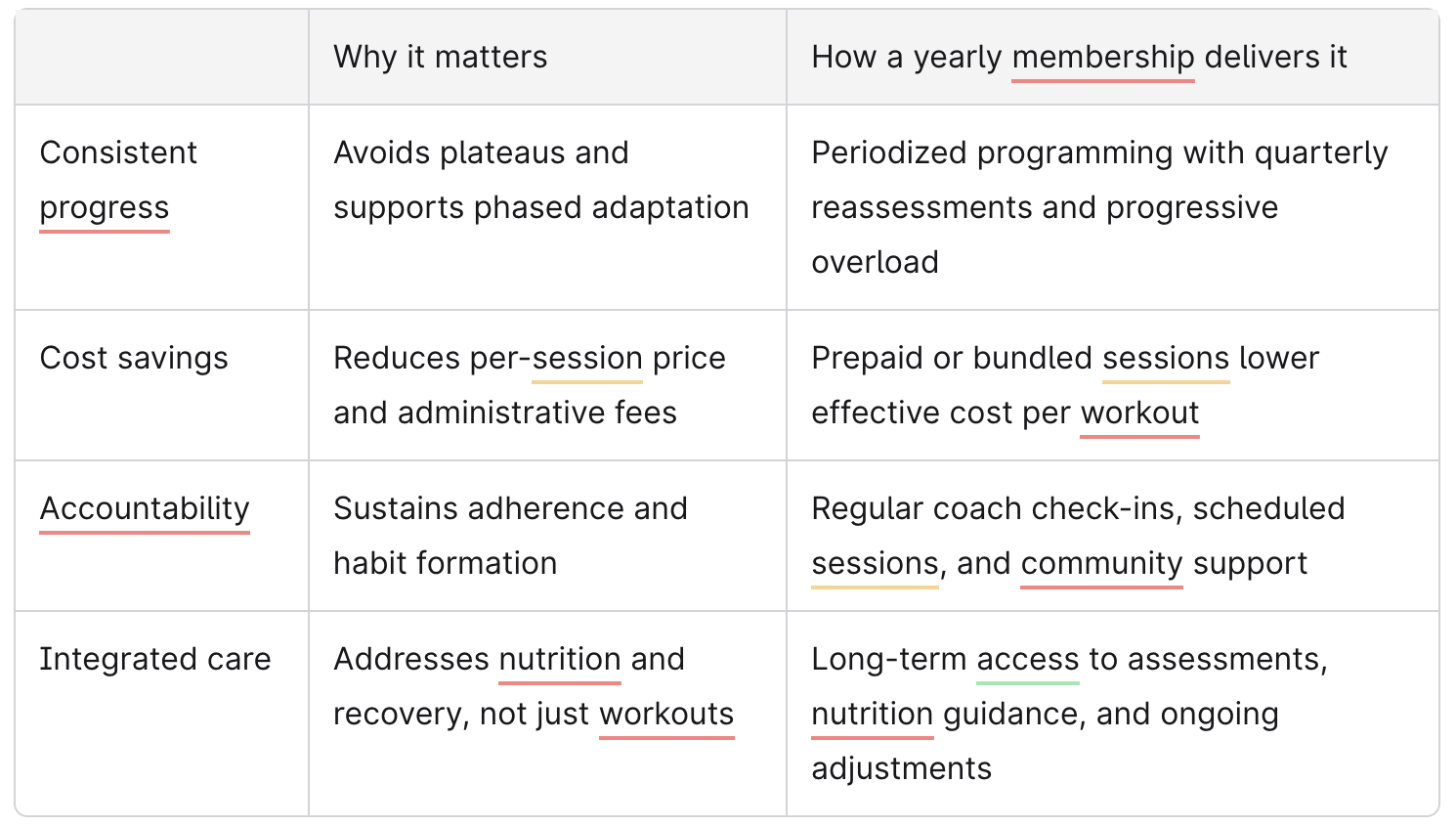
This table maps the structural pieces of a yearly membership to the outcomes you can expect over a full year, including how pre-workout snacks can fuel your workout.
How Does a Yearly Plan Enhance Consistent Progress and Results?
A year-long plan uses a clear progression model: baseline assessment, periodized training blocks, regular metric reviews, and targeted adjustments guided by performance data. The initial assessment identifies movement limitations, strength imbalances, and cardio capacity; from there your trainer builds block phases—foundation, build, peak, and sustain—so adaptations accumulate instead of canceling out. Quarterly reassessments measure strength benchmarks, movement screens, and body-composition or performance markers to validate progress and steer the next block. For example, the first 8–12 weeks often focus on movement quality and foundational strength, the next 12 weeks raise load and intensity, then you move into performance or endurance work—each quarter gives you a milestone to celebrate and recalibrate. That structure removes guesswork and keeps training aligned with long-term goals.
Evidence supports periodized approaches as a superior method for building strength over time.
Benefits of Periodized Resistance Training for Strength Periodization organizes training into sequential phases and cycles to raise the likelihood of reaching specific performance goals while lowering overtraining risk. Meta-analytic evidence suggests periodized resistance programs outperform non-periodized plans for improving maximal strength. Comparison of periodized and non-periodized resistance training on maximal strength: a meta-analysis, TD Williams, 2017
What Cost Savings Can You Expect Compared to Monthly Memberships?
Prepaid yearly plans usually cut your per-session cost by bundling coaching hours and removing month-to-month administrative fees, so the effective rate per session is often lower than paying monthly. For example, a one-on-one program that includes weekly sessions plus quarterly assessments spreads its discount across many workouts and adds value in the form of assessments and nutrition check-ins. Non-monetary savings matter too: fewer billing interruptions, guaranteed scheduling with your coach, and priority rebooking during busy months. Always calculate the true per-session price including assessments and coach touchpoints so you compare real value, not just the sticker price.
With that cost perspective in hand, next we’ll review the typical annual offerings and what to expect inside each format.
Finding the Right Personal Trainer
Choosing the right personal trainer is a passionate step that will change your fitness journey and help you move ahead in life. Certified personal trainers that has the expertise, motivation, and accountability brings so much to your routine, making sure that your customized workout plan is both safe and effective for where you are at in your fitness level. When you are searching for a trainer, you want to look for those reputable certifications like the American Council on Exercise (ACE) or the National Academy of Sports Medicine (NASM), because these shows a strong foundation in exercise science and the care you deserve as a client.
Beyond just certifications, you need to consider a trainer's experience, what they specialize in, and their approach to helping you set goals and understand nutrition that works for your life. The best personal trainers takes time to really understand your health history, what you want to achieve, and how you live your life, then they create a plan that grows as you progress and get stronger. They provide ongoing support that encourages you, track where you are going, and adjust your workouts to keep you challenged and engaged in ways that matter to you. Many gyms and studios, including Fit Results, offers free access to introductory personal training sessions or consultations for new members, giving you a chance to experience their approach and see if they truly care about helping you before you commit to a membership or package.
By partnering with a knowledgeable trainer who understands your needs and what you prefer, you will benefit from expert guidance, structured accountability, and the motivation that you need to achieve real results that last. Whether your focus is weight loss, strength training, or overall wellness for your life, the right personal trainer will help you create a sustainable plan and support you throughout your fitness journey like a true partnership. We set goals and we achieve them together because no one gets left behind when you have the right trainer by your side.
What Affordable Yearly Personal Training Options Does Fit Results Offer in Chicago?
Yearly options usually include one-on-one personal training memberships, semi-private annual programs, and sometimes prepaid unlimited or volume-based year plans for high-frequency users. One-on-one yearly memberships deliver individualized program design, consistent trainer assignment, and frequent progress checks. Semi-private yearly programs lower per-person cost by sharing coaching across small groups while keeping individualized progress markers. Many year-long memberships also bundle movement assessments, nutrition guidance, and scheduled coach check-ins so the training stays holistic and adaptable. Amenities such as locker rooms, showers, and lounge areas, along with high-quality equipment in the studio, enhance the overall training experience by supporting a variety of exercise styles and ensuring comfort during every visit.
Fit Results operates in Chicago with the South Loop. They offer a variety of services including one-on-one personal training, semi-private personal training, and group fitness classes such as TRIPLE 20, GROUNDWORKS, and FIT CAMP. What sets Fit Results apart is their community-focused ‘FitFam’ approach, expert and supportive coaching, and programs designed for all fitness levels—including beginners and those recovering from injuries. They also have a unique ‘Second Chance Program’ that combines personal training with nutrition guidance to help members get back on track. New members can take advantage of complimentary consultations for placement and assessments, and the gym offers flexible pricing with a minimum three-month commitment for new memberships. There’s also an option for an unlimited one-year prepaid membership, which is popular among many members. The gym’s website includes pages for Training, Schedule, About (including Our Mission, Meet the Team, Blog), Personal Training, All Classes. To make things easier for members, they use helpful features like structured data for organization details, services, offers, FAQs, and information about their trainers. Overall, Fit Results provides clear and comprehensive content about their yearly membership options, making it easy for you to understand what’s included and how to get started.
Below are the typical features you can expect in each year-long format and how they support value and affordability.
- One-on-one yearly personal training: Personalized program design, a dedicated coach, baseline and quarterly assessments, and periodic nutrition check-ins.
- Semi-private yearly programs: Small-group sessions with shared coaching, individualized progress checks, and lower per-person pricing while following structured programming.
- Unlimited or prepaid annual access: Prioritizes frequency and flexibility for members who train often or want broad class access under a yearly prepay model.
Many gyms offer discounts for purchasing multiple personal training sessions at once, and some provide introductory packages for new clients that include several sessions at a reduced rate.
These options help you match coaching intensity and cost to your goals; the next sections break down features for one-on-one and semi-private yearly programs. Choosing an annual personal training membership also means you benefit from the convenience of having all services, amenities, and equipment available in one location.
What Are the Features of One-on-One Annual Personal Training?
One-on-one annual training centers on a customized plan built from your baseline assessment, goals (strength, fat loss, rehab, performance), and schedule. Typical inclusions: a comprehensive initial movement and goal assessment, a periodized plan with quarterly milestones, weekly or biweekly scheduled sessions, ongoing performance tracking, and coach-led technique correction each session. Advanced body composition analysis using inbody scans is also available, providing detailed insights into muscle mass, body fat, and hydration levels to help tailor your fitness routine and track progress. Over a year, trainers adjust load, modify exercises around injuries or limitations, and coordinate nutrition guidance or referrals to support recovery. A typical month might include two to three focused sessions, a coach review of metrics, targeted homework or mobility work, and a short nutrition touchpoint—each piece keeps progress consistent and measurable.
Personal training session costs can range from $30 to over $100 per session, depending on the trainer's experience and the gym's pricing structure. Memberships that include personal training often have a monthly fee that can be lower if paid annually.
Building and updating a year-long plan works best when it’s evidence-informed and responsive to each client’s changing needs.
Crafting Evidence-Informed Personalized Training Plans* A training plan translates sport and exercise science into practice. Like medicine, good practice means prescribing exercise based on the best available evidence. Because long-term training mixes many interacting interventions (exercises, nutrition, periodisation), it’s rarely possible to base every decision solely on randomized trials. That’s why we use evidence-informed plans that combine scientific insight with practical coaching adjustments over time. Personalized, evidence-informed training plans and exercise prescriptions for performance, fitness and health, H Wackerhage, 2021*
How Does Semi-Private Yearly Personal Training Provide Value?
Semi-private yearly training lowers individual cost while keeping personalized coaching through small groups—typically 2–6 people per coach—who follow synchronized programming with scaled variations. This model spreads coaching time across members but preserves regular skill checks, progress tracking, and technique corrections. Beyond price, semi-private formats add peer accountability, shared milestones, and social motivation that boost attendance and long-term consistency—key drivers of results. Training with friends in these semi-private settings further enhances motivation and creates a supportive community atmosphere. For budget-conscious members who still want meaningful coaching, semi-private yearly memberships strike a strong balance between affordability and impact. Additionally, loyalty programs can help reduce the cost of personal training for regular clients.
How Does Fit Results Support Your Fitness Journey with Yearly Memberships?
Fit Results structures yearly memberships to combine expert coaching, a supportive community, and practical onboarding so members progress safely and sustainably across a full year. Annual members typically receive a placement consultation or movement assessment to set baselines, regular coach check-ins to review metrics and adjust programming, and access to complementary group classes that reinforce mobility, conditioning, or skill work. In addition, members can track their progress through inbody scans and other advanced body composition analysis tools, with personal trainers providing detailed insights into muscle mass, body fat, and hydration levels. Our FitFam culture adds peer accountability and motivation alongside professional coaching—making a year of training more than just repeated workouts, but a framework for lasting behavior change and measurable improvement.
From the provided SERP Analysis Report: Fit Results operates in Chicago in the South Loop. Services explicitly mentioned: one-on-one personal training, semi-private personal training, group fitness classes (examples named: TRIPLE 20, GROUNDWORKS, FITCAMP). Unique offerings / UVPs listed in the report: community-centric ‘FitFam’ approach, expert/supportive coaching, programs for all levels including beginners and people with injuries, a ‘Second Chance Program’ (paired with personal training and nutrition guidance), complimentary consultations for placement and assessments, flexible pricing, mention of ‘minimum 3 month commitment’ for new memberships, and a referenced ‘unlimited 1 year prepaid membership’ in FAQ context. The site structure includes pages for Training, Schedule, About (Our Mission, Meet the Team, Blog), Personal Training and All Classes pages, and location pages for the South Loop. The report recommends schema markup (Organization, Local Business, Service, Offer, FAQ Page, Person for trainers) and stronger, explicit yearly-membership content.
Below are the core support features to expect across an annual program and how to evaluate them, including guidance from experienced fitness professionals like Marina Centeno.
- Comprehensive onboarding: Initial assessments that inform individualized programming and reduce injury risk.
- Ongoing coach accountability: Scheduled check-ins, trainer adjustments, and clear milestone reviews.
- Community and class access: Group classes and semi-private sessions that supplement one-on-one work and improve results, all supported by high-quality amenities and equipment that enhance the overall workout experience.
Together these features create a scaffold for long-term success; the sections that follow explain coaching touch points and community mechanisms in more detail.

What Personalized Coaching and Goal Tracking Are Included?
Personalized coaching in a yearly plan includes a baseline movement and goals assessment, a written program with periodized blocks, weekly or biweekly sessions, monthly metric reviews, and scheduled reassessments each quarter. Trainers use objective measures—strength tests, movement screens, and conditioning benchmarks—to quantify progress and pivot programming when adaptations stall. In addition, inbody scans are used to provide detailed body composition analysis, allowing members to track muscle mass, body fat, and hydration levels as they work toward their health goals. Members can track their progress through these scans and other metrics provided by personal trainers. Communication often includes in-session notes, brief weekly coach check-ins, and assigned at-home work to reinforce gym time. That consistent, data-informed approach keeps coaching aligned with your evolving needs and creates a clear timeline of improvements across the year.
How Does the FitFam Community Enhance Motivation and Accountability?
Small-group classes, semi-private training, and member events create social accountability that complements coach-led accountability and boosts attendance. Participating in group activities and training with friends can significantly increase motivation and enjoyment, making it easier to stay committed to your annual personal training membership. Regular classmates become training partners who cheer progress, swap tips, and celebrate milestones—turning hard work into something shared and enjoyable. The FitFam community also provides practical benefits: consistent partners for skill practice, informal check-ins outside sessions, and shared knowledge about recovery and nutrition. Those social connections make a year of training feel sustainable and fun, not like a chore.
Where Are Fit Results’ Chicago Locations Offering Yearly Personal Training?
Fit Results serves Chicago with staffed locations designed to meet different neighborhood schedules and needs, so yearly memberships remain convenient across sites. With the convenience of the South Loop —members can access services, equipment, and amenities at any time to fit their busy schedules. There's tailored scheduling windows every hour, coach assignments, and class rosters that reflect local member habits—commuters often prefer early-morning or lunchtime spots, while neighborhood members choose morning, evenings and weekends. Confirm which services (one-on-one, semi-private, group classes) are available at your chosen location so your yearly commitment fits into your routine. A good next step is booking a complimentary consultation or placement assessment to lock in the right program and site for your goals.
Here’s how to weigh each location when choosing a yearly plan.
- South Loop: Ideal for downtown commuters and residents who want early-morning or lunchtime sessions and easy access to structured classes that complement private training. Built for members who value evening schedules, community-focused classes, and the FitFam vibe.
- Take a pick: Compare coach availability, class schedules, and whether semi-private or one-on-one options match your preferences before committing to a yearly plan.
These local details help keep your year-long program convenient and sustainable; next we cover pricing and policy items to confirm.
What Personal Training Services Are Available in South Loop?
South Loop typically offers a mix of one-on-one personal training, semi-private sessions, and group classes that complement individualized coaching. Members benefit from a range of amenities and high-quality equipment, supporting everything from strength training to endurance workouts and ensuring a comfortable, enjoyable gym experience. In practice, you can pair scheduled private sessions with nearby classes focused on conditioning or mobility to round out your program. During a complimentary placement consultation expect a movement screen and goal discussion so we place you in the right training format and class roster. South Loop is a smart pick for members who prioritize weekday access and quick downtown transit—helping make consistent attendance over a year easier.
What Yearly Membership Options Exist?
The welcoming studio environment offers the convenience of local access for members, making it easy to enjoy equipment, amenities, and personal training services close to home. Yearly memberships here emphasize FitFam culture—peer support, community challenges, and varied class formats that keep motivation high. If you prioritize a neighborhood community, evening classes, or programs that support beginners and clients returning from injury, yearly options are a strong fit. A placement consultation helps determine whether to start with one-on-one training or jump into semi-private classes based on local cadence.
What Should You Know About Pricing and Membership Policies for Yearly Plans?
Yearly pricing typically follows three models: prepaid annual plans, installment annual plans, and monthly billing with a minimum commitment. When you purchase a membership, you can save by choosing an annual plan, as prepaid plans usually deliver the biggest per-session savings. Installment plans spread cost across months with modest savings, while minimum-commitment monthly plans balance flexibility with an onboarding time horizon. Monthly plans offer flexibility but come with higher overall costs and may lead to inconsistent progress. Healthcare providers often recommend starting with a month-to-month plan before committing to a full-year membership to ensure compatibility with your trainer. Freeze and cancellation policies vary but commonly include medical freezes, advance notice requirements, and limited refunds for prepaid packages. Be aware of any restrictions and important dates related to membership terms and package expiration. Ask for per-session equivalency calculations so you can compare true value across offers.
To make comparisons easier, use an EAV-style pricing table listing sample one-on-one and semi-private yearly tiers, sessions per week, included services, and approximate cost indicators so you can calculate per-session value and check freeze/cancellation terms for clarity.

This comparison clarifies how session frequency and included services shape price and value—always confirm exact numbers, any minimum commitment clauses, restrictions, and key dates before signing.
How Is Pricing Structured for Yearly Personal Training Memberships?
Pricing usually fits into three buckets: full prepaid annual, monthly installments across the year, and monthly billing with a minimum commitment (commonly three months for onboarding). The main difference between annual and monthly plans is the overall cost—members can save significantly by choosing the prepaid annual option compared to paying month-to-month. Prepaid annual plans maximize savings; installment plans improve cashflow. When comparing offers, convert the package into a per-session cost by dividing total annual cost by expected sessions per year and include the value of assessments, nutrition coaching, or class access to judge true cost-effectiveness. A plan that includes quarterly reassessments and nutrition check-ins can be better value than a cheaper monthly plan that lacks those extras. If unsure, ask for a sample yearly schedule and transparent per-session math.
What Are the Terms for Freezing or Cancelling Yearly Memberships?
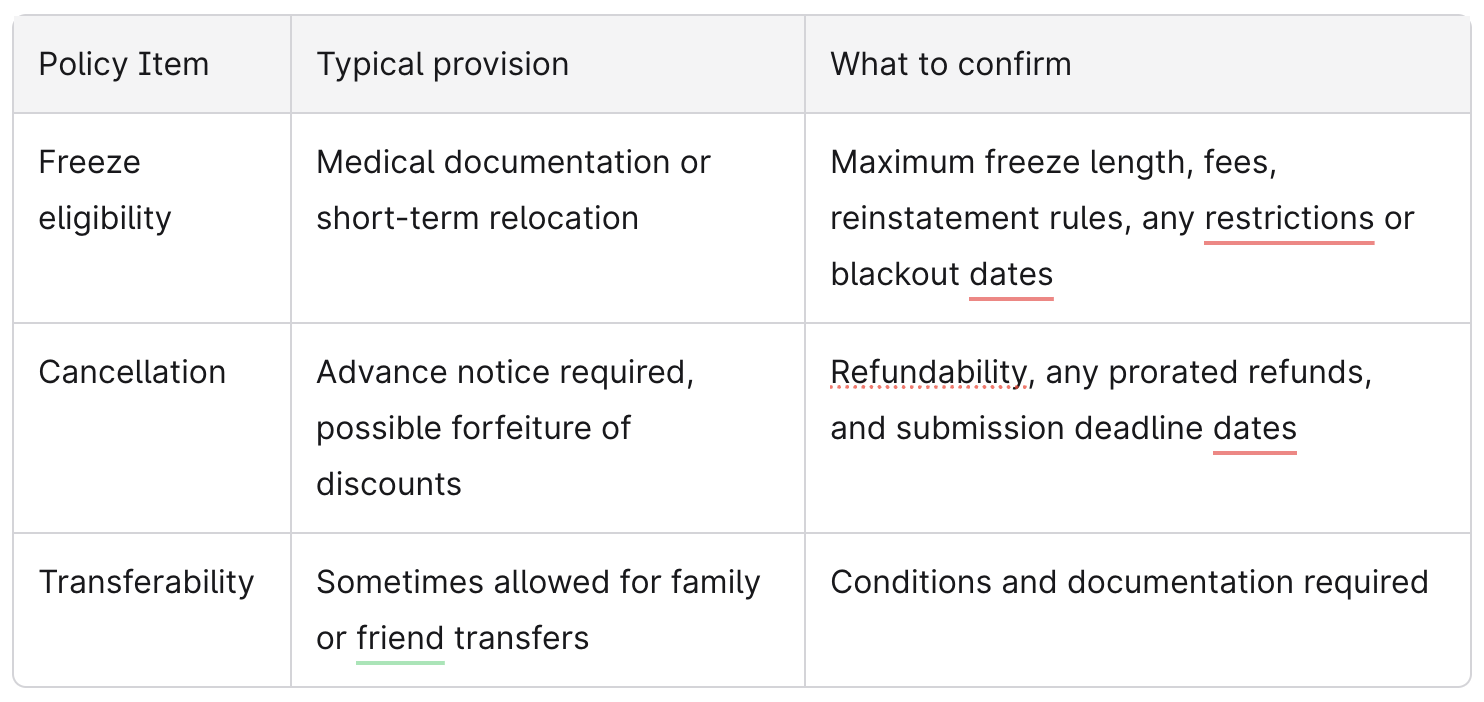
Freeze and cancellation policies often allow medical freezes, require administrative notice windows (e.g., 30 days), and limit refunds for prepaid packages. Many gyms permit temporary freezes for documented medical reasons or relocations, while cancellations may need advance notice and could forfeit prepaid discounts. The referenced “unlimited 1 year prepaid membership” in the FAQ suggests some annual products have unique freeze or transfer terms. Be aware that certain restrictions may apply, such as blackout periods or limits on the number of freezes per membership year, and that key dates—like the deadline to submit a freeze or cancellation request—can affect your eligibility for these options. Always request the written freeze, transfer, and refund policy before you commit so you understand how flexibility is handled during the membership year.
Conditions and documentation required
- Ask for written freeze and cancellation policies before signing so you’re protected from unexpected charges.
- Calculate per-session equivalency including included services to reveal true value.
- Confirm minimum commitment and onboarding expectations so you know what the first months will look like.
Following these steps helps ensure your yearly membership matches both your financial and practical needs as you commit to long-term training.
Frequently Asked Questions
What should I consider when choosing between one-on-one and semi-private training?
Consider your goals, budget, and how you like to train. One-on-one is best when you need individualized programming, rehab support, or focused technique work. Semi-private training is the same but more affordable while still offering individual attention within a small group—and the social support can boost motivation. Training with friends in semi-private settings can make workouts more enjoyable and help you stay accountable. Pick the format that aligns with your objectives and the environment you’ll actually stick with.
How can I track my progress during a yearly personal training membership?
Progress is tracked through baseline and quarterly reassessments plus regular coach feedback. Common measures include strength benchmarks, movement screens, body-composition markers, and conditioning tests. We also use inbody scans and other advanced tools to track progress, providing detailed insights into muscle mass, body fat, and hydration levels throughout the year. Trainers often combine in-session notes with brief weekly check-ins and optional app tracking or a training journal so you see consistent, objective improvement over the year.
Are there any specific requirements for joining a yearly personal training program?
Most programs require an initial assessment and a minimum commitment—often three months—to ensure consistency and progress. You may also complete a health questionnaire and, if needed, obtain medical clearance for certain conditions. Be aware that annual personal training membership packages may have specific expiration dates and restrictions, such as scheduling limitations or requirements for pausing your plan. Check with the provider for exact enrollment criteria, important dates, and any restrictions so there are no surprises at sign-up.
What types of nutrition guidance are included in yearly personal training memberships?
Nutrition support typically starts with an assessment of your habits and goals and continues with practical guidance—meal strategies, habit coaching, and regular check-ins to adjust plans as you progress. Nutrition guidance is tailored to support your individual health goals, whether you’re focused on weight management, boosting energy, or recovering from injury. Trainers provide actionable recommendations and resources; for specialized medical or clinical nutrition needs, they’ll refer you to a registered dietitian.
Can I switch between one-on-one and semi-private training during my membership?
Many facilities allow format changes based on availability and your evolving goals. You might begin with one-on-one sessions for focused work and later switch to semi-private classes for cost efficiency and social motivation. This flexibility adds convenience to your annual personal training membership, letting you easily adapt your training format as your needs change. Always discuss potential pricing or scheduling changes with your trainer or membership manager before switching.
What happens if I need to pause my membership due to unforeseen circumstances?
Most memberships include freeze options for documented medical issues or short relocations. Typically you’ll provide written notice and any required documentation. Restrictions may apply, such as limits on the number of times you can pause your annual personal training membership or the minimum/maximum duration allowed. Be sure to note any key dates, such as deadlines for submitting freeze requests or expiration dates for paused periods. Terms vary, so review the facility’s freeze and cancellation policy before committing to understand how interruptions are handled.
Conclusion
Choosing a yearly personal training membership in Chicago gives you steady progress, better value, and stronger accountability. With a structured plan, expert coaching, and the FitFam community behind you, a year of training becomes a sustainable path to real results. Ready to get started? Explore our annual options and book a complimentary placement consultation to find the plan that fits your goals and schedule.
Affordable Annual Personal Training Membership in Chicago
A yearly personal training membership is a prepaid or contract-based plan where a dedicated coach delivers structured, progressive training and ongoing support across twelve months. Annual personal training memberships offer convenience and flexibility, allowing members to access the gym, amenities, and services at any time to fit their schedule.
Choosing a year-long program spreads costs, lets your trainer build periodized programming, schedules regular reassessments, and supports real behavior change—not just short-term results. The importance of amenities and quality equipment cannot be overstated, as they ensure a comfortable, effective, and enjoyable workout experience for all members.
This guide walks through the practical advantages of committing to an annual personal training membership in Chicago, how yearly plans compare to month-to-month options, the affordable formats we offer (one-on-one and semi-private), and the pricing and policy items to check before you sign. You’ll also find a clear comparison of what year-long programs include, sample timelines for client progress, and next steps for finding a plan that fits your goals and budget in neighborhoods like the South Loop. With an annual membership, you can easily track progress throughout the year and enjoy the opportunity to train with friends in group or semi-private settings. Read on to understand how yearly plans deliver better value and more reliable outcomes over time.
Introduction to Personal Training
Personal training is one of the most effective ways that helps you achieve your fitness goals, whether you're looking for weight loss, building strength, or just wanting to improve your overall health. With guidance from a certified personal trainer, you get access to a customized workout plan that is designed specifically for your needs, your abilities, and where you are in your fitness journey. These programs help you maximize results by focusing on your unique goals and providing expert support every step along the way.
At participating locations throughout Chicago, including Fit Results, local residents can take advantage of personal training services that really work. These programs are not one-size-fits-all; instead, they are built around your lifestyle, your schedule, and what you want to achieve with your health. Whether you're new to exercise or looking to break through a plateau, a certified personal trainer will help you create a plan that fits your life and keeps you motivated on your wellness journey. By investing in personal training, you're not just signing up for workouts—you're committing to a partnership approach that helps you achieve lasting results and a healthier, more active lifestyle.
What Are the Benefits of Choosing a Yearly Personal Training Membership?
A year-long membership gives you consistent, cumulative progress through planned programming, steady accountability, and integrated support for lifestyle changes. The difference between annual and monthly memberships is clear: annual personal training memberships often provide 24/7 access to gyms worldwide, giving you unmatched flexibility and support for your health goals—including cardiovascular fitness, strength, and endurance. When you commit to twelve months, trainers can use periodization and progressive overload and set quarterly reassessments to measure strength, movement quality, and conditioning—an approach that reliably beats short, fragmented training bursts. Annual plans also tend to lower your effective per-session cost through prepaid discounts or bundled packages, and they allow coaches to layer in nutrition guidance, recovery strategies, and habit-based coaching that together improve retention and results. Knowing these benefits helps you decide if a year-long commitment matches your readiness for sustained change and your budget priorities.
Research emphasizes the value of studying exercise behavior over the long term to improve retention and meaningful outcomes in fitness programs.
Understanding Long-Term Exercise Behavior in Fitness Clubs* The transtheoretical model of behavior change (TTM) is commonly applied to study how health behaviors—like regular exercise—change over time. Early research in fitness clubs found low visit frequencies and high dropout rates; this follow-up study examines exercise behavior over 52 weeks and explores how TTM constructs relate to long-term activity patterns. The effects of a self-efficacy intervention on exercise behavior of fitness club members in 52 weeks and long-term relationships of transtheoretical model constructs, 2017*
Annual structure supports common goals in concrete ways:
- Consistent progress: A 12-month plan lets you move through deliberate phases—foundation, strength/hypertrophy, performance, then maintenance—so gains stack over time.
- Lower per-session cost: Prepaid or bundled annual packages reduce administrative overhead and pass savings to members.
- Behavior change: Regular coach contact and scheduled reassessments promote accountability and build lasting habits across the year.
Many personal training clients achieve their fitness goals faster with the guidance and accountability of a trainer. Clients often report feeling more motivated and working harder when they have a personal trainer guiding them, and experience improved mental health and increased self-confidence as a result. Qualified trainers also help create SMART (Specific, Measurable, Attainable, Realistic, Time-sensitive) goals to keep clients on track and ensure steady progress toward their health goals.
Those advantages add up to measurable improvements and justify the upfront commitment. Next, we’ll explain how the programming mechanics actually drive progress across twelve months.
This table maps the structural pieces of a yearly membership to the outcomes you can expect over a full year, including how pre-workout snacks can fuel your workout.
How Does a Yearly Plan Enhance Consistent Progress and Results?
A year-long plan uses a clear progression model: baseline assessment, periodized training blocks, regular metric reviews, and targeted adjustments guided by performance data. The initial assessment identifies movement limitations, strength imbalances, and cardio capacity; from there your trainer builds block phases—foundation, build, peak, and sustain—so adaptations accumulate instead of canceling out. Quarterly reassessments measure strength benchmarks, movement screens, and body-composition or performance markers to validate progress and steer the next block. For example, the first 8–12 weeks often focus on movement quality and foundational strength, the next 12 weeks raise load and intensity, then you move into performance or endurance work—each quarter gives you a milestone to celebrate and recalibrate. That structure removes guesswork and keeps training aligned with long-term goals.
Evidence supports periodized approaches as a superior method for building strength over time.
Benefits of Periodized Resistance Training for Strength Periodization organizes training into sequential phases and cycles to raise the likelihood of reaching specific performance goals while lowering overtraining risk. Meta-analytic evidence suggests periodized resistance programs outperform non-periodized plans for improving maximal strength. Comparison of periodized and non-periodized resistance training on maximal strength: a meta-analysis, TD Williams, 2017
What Cost Savings Can You Expect Compared to Monthly Memberships?
Prepaid yearly plans usually cut your per-session cost by bundling coaching hours and removing month-to-month administrative fees, so the effective rate per session is often lower than paying monthly. For example, a one-on-one program that includes weekly sessions plus quarterly assessments spreads its discount across many workouts and adds value in the form of assessments and nutrition check-ins. Non-monetary savings matter too: fewer billing interruptions, guaranteed scheduling with your coach, and priority rebooking during busy months. Always calculate the true per-session price including assessments and coach touchpoints so you compare real value, not just the sticker price.
With that cost perspective in hand, next we’ll review the typical annual offerings and what to expect inside each format.
Finding the Right Personal Trainer
Choosing the right personal trainer is a passionate step that will change your fitness journey and help you move ahead in life. Certified personal trainers that has the expertise, motivation, and accountability brings so much to your routine, making sure that your customized workout plan is both safe and effective for where you are at in your fitness level. When you are searching for a trainer, you want to look for those reputable certifications like the American Council on Exercise (ACE) or the National Academy of Sports Medicine (NASM), because these shows a strong foundation in exercise science and the care you deserve as a client.
Beyond just certifications, you need to consider a trainer's experience, what they specialize in, and their approach to helping you set goals and understand nutrition that works for your life. The best personal trainers takes time to really understand your health history, what you want to achieve, and how you live your life, then they create a plan that grows as you progress and get stronger. They provide ongoing support that encourages you, track where you are going, and adjust your workouts to keep you challenged and engaged in ways that matter to you. Many gyms and studios, including Fit Results, offers free access to introductory personal training sessions or consultations for new members, giving you a chance to experience their approach and see if they truly care about helping you before you commit to a membership or package.
By partnering with a knowledgeable trainer who understands your needs and what you prefer, you will benefit from expert guidance, structured accountability, and the motivation that you need to achieve real results that last. Whether your focus is weight loss, strength training, or overall wellness for your life, the right personal trainer will help you create a sustainable plan and support you throughout your fitness journey like a true partnership. We set goals and we achieve them together because no one gets left behind when you have the right trainer by your side.
What Affordable Yearly Personal Training Options Does Fit Results Offer in Chicago?
Yearly options usually include one-on-one personal training memberships, semi-private annual programs, and sometimes prepaid unlimited or volume-based year plans for high-frequency users. One-on-one yearly memberships deliver individualized program design, consistent trainer assignment, and frequent progress checks. Semi-private yearly programs lower per-person cost by sharing coaching across small groups while keeping individualized progress markers. Many year-long memberships also bundle movement assessments, nutrition guidance, and scheduled coach check-ins so the training stays holistic and adaptable. Amenities such as locker rooms, showers, and lounge areas, along with high-quality equipment in the studio, enhance the overall training experience by supporting a variety of exercise styles and ensuring comfort during every visit.
Fit Results operates in Chicago with the South Loop. They offer a variety of services including one-on-one personal training, semi-private personal training, and group fitness classes such as TRIPLE 20, GROUNDWORKS, and FIT CAMP. What sets Fit Results apart is their community-focused ‘FitFam’ approach, expert and supportive coaching, and programs designed for all fitness levels—including beginners and those recovering from injuries. They also have a unique ‘Second Chance Program’ that combines personal training with nutrition guidance to help members get back on track. New members can take advantage of complimentary consultations for placement and assessments, and the gym offers flexible pricing with a minimum three-month commitment for new memberships. There’s also an option for an unlimited one-year prepaid membership, which is popular among many members. The gym’s website includes pages for Training, Schedule, About (including Our Mission, Meet the Team, Blog), Personal Training, All Classes. To make things easier for members, they use helpful features like structured data for organization details, services, offers, FAQs, and information about their trainers. Overall, Fit Results provides clear and comprehensive content about their yearly membership options, making it easy for you to understand what’s included and how to get started.
Below are the typical features you can expect in each year-long format and how they support value and affordability.
- One-on-one yearly personal training: Personalized program design, a dedicated coach, baseline and quarterly assessments, and periodic nutrition check-ins.
- Semi-private yearly programs: Small-group sessions with shared coaching, individualized progress checks, and lower per-person pricing while following structured programming.
- Unlimited or prepaid annual access: Prioritizes frequency and flexibility for members who train often or want broad class access under a yearly prepay model.
Many gyms offer discounts for purchasing multiple personal training sessions at once, and some provide introductory packages for new clients that include several sessions at a reduced rate.
These options help you match coaching intensity and cost to your goals; the next sections break down features for one-on-one and semi-private yearly programs. Choosing an annual personal training membership also means you benefit from the convenience of having all services, amenities, and equipment available in one location.
What Are the Features of One-on-One Annual Personal Training?
One-on-one annual training centers on a customized plan built from your baseline assessment, goals (strength, fat loss, rehab, performance), and schedule. Typical inclusions: a comprehensive initial movement and goal assessment, a periodized plan with quarterly milestones, weekly or biweekly scheduled sessions, ongoing performance tracking, and coach-led technique correction each session. Advanced body composition analysis using inbody scans is also available, providing detailed insights into muscle mass, body fat, and hydration levels to help tailor your fitness routine and track progress. Over a year, trainers adjust load, modify exercises around injuries or limitations, and coordinate nutrition guidance or referrals to support recovery. A typical month might include two to three focused sessions, a coach review of metrics, targeted homework or mobility work, and a short nutrition touchpoint—each piece keeps progress consistent and measurable.
Personal training session costs can range from $30 to over $100 per session, depending on the trainer's experience and the gym's pricing structure. Memberships that include personal training often have a monthly fee that can be lower if paid annually.
Building and updating a year-long plan works best when it’s evidence-informed and responsive to each client’s changing needs.
Crafting Evidence-Informed Personalized Training Plans* A training plan translates sport and exercise science into practice. Like medicine, good practice means prescribing exercise based on the best available evidence. Because long-term training mixes many interacting interventions (exercises, nutrition, periodisation), it’s rarely possible to base every decision solely on randomized trials. That’s why we use evidence-informed plans that combine scientific insight with practical coaching adjustments over time. Personalized, evidence-informed training plans and exercise prescriptions for performance, fitness and health, H Wackerhage, 2021*
How Does Semi-Private Yearly Personal Training Provide Value?
Semi-private yearly training lowers individual cost while keeping personalized coaching through small groups—typically 2–6 people per coach—who follow synchronized programming with scaled variations. This model spreads coaching time across members but preserves regular skill checks, progress tracking, and technique corrections. Beyond price, semi-private formats add peer accountability, shared milestones, and social motivation that boost attendance and long-term consistency—key drivers of results. Training with friends in these semi-private settings further enhances motivation and creates a supportive community atmosphere. For budget-conscious members who still want meaningful coaching, semi-private yearly memberships strike a strong balance between affordability and impact. Additionally, loyalty programs can help reduce the cost of personal training for regular clients.
How Does Fit Results Support Your Fitness Journey with Yearly Memberships?
Fit Results structures yearly memberships to combine expert coaching, a supportive community, and practical onboarding so members progress safely and sustainably across a full year. Annual members typically receive a placement consultation or movement assessment to set baselines, regular coach check-ins to review metrics and adjust programming, and access to complementary group classes that reinforce mobility, conditioning, or skill work. In addition, members can track their progress through inbody scans and other advanced body composition analysis tools, with personal trainers providing detailed insights into muscle mass, body fat, and hydration levels. Our FitFam culture adds peer accountability and motivation alongside professional coaching—making a year of training more than just repeated workouts, but a framework for lasting behavior change and measurable improvement.
From the provided SERP Analysis Report: Fit Results operates in Chicago in the South Loop. Services explicitly mentioned: one-on-one personal training, semi-private personal training, group fitness classes (examples named: TRIPLE 20, GROUNDWORKS, FITCAMP). Unique offerings / UVPs listed in the report: community-centric ‘FitFam’ approach, expert/supportive coaching, programs for all levels including beginners and people with injuries, a ‘Second Chance Program’ (paired with personal training and nutrition guidance), complimentary consultations for placement and assessments, flexible pricing, mention of ‘minimum 3 month commitment’ for new memberships, and a referenced ‘unlimited 1 year prepaid membership’ in FAQ context. The site structure includes pages for Training, Schedule, About (Our Mission, Meet the Team, Blog), Personal Training and All Classes pages, and location pages for the South Loop. The report recommends schema markup (Organization, Local Business, Service, Offer, FAQ Page, Person for trainers) and stronger, explicit yearly-membership content.
Below are the core support features to expect across an annual program and how to evaluate them, including guidance from experienced fitness professionals like Marina Centeno.
- Comprehensive onboarding: Initial assessments that inform individualized programming and reduce injury risk.
- Ongoing coach accountability: Scheduled check-ins, trainer adjustments, and clear milestone reviews.
- Community and class access: Group classes and semi-private sessions that supplement one-on-one work and improve results, all supported by high-quality amenities and equipment that enhance the overall workout experience.
Together these features create a scaffold for long-term success; the sections that follow explain coaching touch points and community mechanisms in more detail.
What Personalized Coaching and Goal Tracking Are Included?
Personalized coaching in a yearly plan includes a baseline movement and goals assessment, a written program with periodized blocks, weekly or biweekly sessions, monthly metric reviews, and scheduled reassessments each quarter. Trainers use objective measures—strength tests, movement screens, and conditioning benchmarks—to quantify progress and pivot programming when adaptations stall. In addition, inbody scans are used to provide detailed body composition analysis, allowing members to track muscle mass, body fat, and hydration levels as they work toward their health goals. Members can track their progress through these scans and other metrics provided by personal trainers. Communication often includes in-session notes, brief weekly coach check-ins, and assigned at-home work to reinforce gym time. That consistent, data-informed approach keeps coaching aligned with your evolving needs and creates a clear timeline of improvements across the year.
How Does the FitFam Community Enhance Motivation and Accountability?
Small-group classes, semi-private training, and member events create social accountability that complements coach-led accountability and boosts attendance. Participating in group activities and training with friends can significantly increase motivation and enjoyment, making it easier to stay committed to your annual personal training membership. Regular classmates become training partners who cheer progress, swap tips, and celebrate milestones—turning hard work into something shared and enjoyable. The FitFam community also provides practical benefits: consistent partners for skill practice, informal check-ins outside sessions, and shared knowledge about recovery and nutrition. Those social connections make a year of training feel sustainable and fun, not like a chore.
Where Are Fit Results’ Chicago Locations Offering Yearly Personal Training?
Fit Results serves Chicago with staffed locations designed to meet different neighborhood schedules and needs, so yearly memberships remain convenient across sites. With the convenience of the South Loop —members can access services, equipment, and amenities at any time to fit their busy schedules. There's tailored scheduling windows every hour, coach assignments, and class rosters that reflect local member habits—commuters often prefer early-morning or lunchtime spots, while neighborhood members choose morning, evenings and weekends. Confirm which services (one-on-one, semi-private, group classes) are available at your chosen location so your yearly commitment fits into your routine. A good next step is booking a complimentary consultation or placement assessment to lock in the right program and site for your goals.
Here’s how to weigh each location when choosing a yearly plan.
- South Loop: Ideal for downtown commuters and residents who want early-morning or lunchtime sessions and easy access to structured classes that complement private training. Built for members who value evening schedules, community-focused classes, and the FitFam vibe.
- Take a pick: Compare coach availability, class schedules, and whether semi-private or one-on-one options match your preferences before committing to a yearly plan.
These local details help keep your year-long program convenient and sustainable; next we cover pricing and policy items to confirm.
What Personal Training Services Are Available in South Loop?
South Loop typically offers a mix of one-on-one personal training, semi-private sessions, and group classes that complement individualized coaching. Members benefit from a range of amenities and high-quality equipment, supporting everything from strength training to endurance workouts and ensuring a comfortable, enjoyable gym experience. In practice, you can pair scheduled private sessions with nearby classes focused on conditioning or mobility to round out your program. During a complimentary placement consultation expect a movement screen and goal discussion so we place you in the right training format and class roster. South Loop is a smart pick for members who prioritize weekday access and quick downtown transit—helping make consistent attendance over a year easier.
What Yearly Membership Options Exist?
The welcoming studio environment offers the convenience of local access for members, making it easy to enjoy equipment, amenities, and personal training services close to home. Yearly memberships here emphasize FitFam culture—peer support, community challenges, and varied class formats that keep motivation high. If you prioritize a neighborhood community, evening classes, or programs that support beginners and clients returning from injury, yearly options are a strong fit. A placement consultation helps determine whether to start with one-on-one training or jump into semi-private classes based on local cadence.
What Should You Know About Pricing and Membership Policies for Yearly Plans?
Yearly pricing typically follows three models: prepaid annual plans, installment annual plans, and monthly billing with a minimum commitment. When you purchase a membership, you can save by choosing an annual plan, as prepaid plans usually deliver the biggest per-session savings. Installment plans spread cost across months with modest savings, while minimum-commitment monthly plans balance flexibility with an onboarding time horizon. Monthly plans offer flexibility but come with higher overall costs and may lead to inconsistent progress. Healthcare providers often recommend starting with a month-to-month plan before committing to a full-year membership to ensure compatibility with your trainer. Freeze and cancellation policies vary but commonly include medical freezes, advance notice requirements, and limited refunds for prepaid packages. Be aware of any restrictions and important dates related to membership terms and package expiration. Ask for per-session equivalency calculations so you can compare true value across offers.
To make comparisons easier, use an EAV-style pricing table listing sample one-on-one and semi-private yearly tiers, sessions per week, included services, and approximate cost indicators so you can calculate per-session value and check freeze/cancellation terms for clarity.
This comparison clarifies how session frequency and included services shape price and value—always confirm exact numbers, any minimum commitment clauses, restrictions, and key dates before signing.
How Is Pricing Structured for Yearly Personal Training Memberships?
Pricing usually fits into three buckets: full prepaid annual, monthly installments across the year, and monthly billing with a minimum commitment (commonly three months for onboarding). The main difference between annual and monthly plans is the overall cost—members can save significantly by choosing the prepaid annual option compared to paying month-to-month. Prepaid annual plans maximize savings; installment plans improve cashflow. When comparing offers, convert the package into a per-session cost by dividing total annual cost by expected sessions per year and include the value of assessments, nutrition coaching, or class access to judge true cost-effectiveness. A plan that includes quarterly reassessments and nutrition check-ins can be better value than a cheaper monthly plan that lacks those extras. If unsure, ask for a sample yearly schedule and transparent per-session math.
What Are the Terms for Freezing or Cancelling Yearly Memberships?
Freeze and cancellation policies often allow medical freezes, require administrative notice windows (e.g., 30 days), and limit refunds for prepaid packages. Many gyms permit temporary freezes for documented medical reasons or relocations, while cancellations may need advance notice and could forfeit prepaid discounts. The referenced “unlimited 1 year prepaid membership” in the FAQ suggests some annual products have unique freeze or transfer terms. Be aware that certain restrictions may apply, such as blackout periods or limits on the number of freezes per membership year, and that key dates—like the deadline to submit a freeze or cancellation request—can affect your eligibility for these options. Always request the written freeze, transfer, and refund policy before you commit so you understand how flexibility is handled during the membership year.
Conditions and documentation required
- Ask for written freeze and cancellation policies before signing so you’re protected from unexpected charges.
- Calculate per-session equivalency including included services to reveal true value.
- Confirm minimum commitment and onboarding expectations so you know what the first months will look like.
Following these steps helps ensure your yearly membership matches both your financial and practical needs as you commit to long-term training.
Frequently Asked Questions
What should I consider when choosing between one-on-one and semi-private training?
Consider your goals, budget, and how you like to train. One-on-one is best when you need individualized programming, rehab support, or focused technique work. Semi-private training is the same but more affordable while still offering individual attention within a small group—and the social support can boost motivation. Training with friends in semi-private settings can make workouts more enjoyable and help you stay accountable. Pick the format that aligns with your objectives and the environment you’ll actually stick with.
How can I track my progress during a yearly personal training membership?
Progress is tracked through baseline and quarterly reassessments plus regular coach feedback. Common measures include strength benchmarks, movement screens, body-composition markers, and conditioning tests. We also use inbody scans and other advanced tools to track progress, providing detailed insights into muscle mass, body fat, and hydration levels throughout the year. Trainers often combine in-session notes with brief weekly check-ins and optional app tracking or a training journal so you see consistent, objective improvement over the year.
Are there any specific requirements for joining a yearly personal training program?
Most programs require an initial assessment and a minimum commitment—often three months—to ensure consistency and progress. You may also complete a health questionnaire and, if needed, obtain medical clearance for certain conditions. Be aware that annual personal training membership packages may have specific expiration dates and restrictions, such as scheduling limitations or requirements for pausing your plan. Check with the provider for exact enrollment criteria, important dates, and any restrictions so there are no surprises at sign-up.
What types of nutrition guidance are included in yearly personal training memberships?
Nutrition support typically starts with an assessment of your habits and goals and continues with practical guidance—meal strategies, habit coaching, and regular check-ins to adjust plans as you progress. Nutrition guidance is tailored to support your individual health goals, whether you’re focused on weight management, boosting energy, or recovering from injury. Trainers provide actionable recommendations and resources; for specialized medical or clinical nutrition needs, they’ll refer you to a registered dietitian.
Can I switch between one-on-one and semi-private training during my membership?
Many facilities allow format changes based on availability and your evolving goals. You might begin with one-on-one sessions for focused work and later switch to semi-private classes for cost efficiency and social motivation. This flexibility adds convenience to your annual personal training membership, letting you easily adapt your training format as your needs change. Always discuss potential pricing or scheduling changes with your trainer or membership manager before switching.
What happens if I need to pause my membership due to unforeseen circumstances?
Most memberships include freeze options for documented medical issues or short relocations. Typically you’ll provide written notice and any required documentation. Restrictions may apply, such as limits on the number of times you can pause your annual personal training membership or the minimum/maximum duration allowed. Be sure to note any key dates, such as deadlines for submitting freeze requests or expiration dates for paused periods. Terms vary, so review the facility’s freeze and cancellation policy before committing to understand how interruptions are handled.
Conclusion
Choosing a yearly personal training membership in Chicago gives you steady progress, better value, and stronger accountability. With a structured plan, expert coaching, and the FitFam community behind you, a year of training becomes a sustainable path to real results. Ready to get started? Explore our annual options and book a complimentary placement consultation to find the plan that fits your goals and schedule.
.png)