

Chicago Trainer Pricing — How Fit Results Compares

This page walks you through how Fit Results’ pricing and services stack up against common Chicago personal training options, so you can pick the model that fits your goals and budget. You’ll get the current market price ranges for Chicago trainers, the key factors that change rates, how semi-private and group formats change the per-person math, and how Fit Results packages value-added services. We also highlight signature offerings—like the Second Chance Program and our group classes—explain how trainer credentials affect outcomes, and show an anonymous comparison to typical competitors. By the end you’ll have clear price ranges, per-session calculations, and practical steps to choose a trainer or program that balances cost with what you actually need. For quick scanning, this guide includes simple tables, bullet checklists, and direct evaluation steps.
Introduction to Personal Training
Personal training is one of the most effective way to achieve your fitness goals, whether you’re aiming for weight loss, building muscle, or simply improving your overall health. Working with a certified personal trainer means you get expert guidance and a customized workout plan that is designed specifically for your needs, abilities, and what you want to achieve. Your personal trainer will assess where you’re starting from and create a approach that is tailored just for you, helping you stay motivated and accountable throughout your fitness journey. Understanding your fitness budget helps you choose the right personal training option for your needs and ensures you get the most value from your investment.
Today, personal training is more accessible than it has ever been. With the rise of online personal training, you can connect with many personal trainers no matter where you are located, making it easier to fit training sessions into your schedule. Whether you prefer in-person training at a local gym, private studio, or the convenience of online personal sessions, there’s a solution that will match your lifestyle. Online personal trainers offers the same level of expertise and support as traditional in-person training, often with added flexibility and ongoing communication that helps you succeed. As your fitness goals evolve and change, your trainer will adjust your customized workout plan to ensure steady progress and lasting results that you can be proud of. No matter where you start from, personal training provides a clear, personalized path to success that works for everyone.
What Are the Average Personal Training Costs in Chicago?
Prices for personal training in Chicago depend on the training format, the trainer’s experience, and the studio’s location. As a rule of thumb, one-on-one sessions usually run between $50 and $120 per hour, which reflects differences in overhead and certification. The average personal trainer cost in Chicago typically ranges from $40 to $150 per hour, with personal trainers charging different rates based on experience, certifications, and training format. Understanding a personal trainer's hourly rate is important for budgeting, as personal trainers charge more in major metropolitan areas due to higher costs of living and demand. Personal trainer cost and personal training prices are influenced by factors such as session type, trainer experience, and additional services.
Location also plays a significant role in pricing. Rates are typically higher in upscale downtown neighborhoods such as the Loop or River North due to higher operating costs. Buying packages typically lowers the per-session cost and often bundles in assessments, nutrition check-ins, or program design.
In semi-private and group settings, per-person costs commonly fall in the $25–$50 range, depending on group size and session length. One-on-one sessions are the most expensive training format, while small group sessions can lower the per-person cost to $30–$50. Use these ranges as a baseline when comparing bundles and specialty programs from Fit Results and other local studios.
Within the broader personal training industry, trends such as increased demand for specialized coaching and flexible training formats continue to influence how personal trainers charge and structure their pricing.
Which Factors Influence Chicago Personal Trainer Rates?
Trainer pricing comes from a mix of education, specialization, and operating costs. Higher certifications and specialist credentials—ACE, NASM, corrective exercise, etc.—usually mean higher hourly rates because they translate to safer, smarter programming. Trainers who do rehab work, sports performance, or nutrition counseling often charge more because of the extra assessment and planning time. Studio location matters too: downtown or high-rent neighborhoods push prices up, while neighborhood studios farther from the core tend to be more affordable. Commercial gyms and major gyms often have a higher personal trainer's hourly rate due to greater overhead costs like rent and equipment, while independent studios or personal training businesses may offer more flexible pricing. The personal training business model, as well as broader fitness industry trends and standards, also influence how rates are set. Knowing these drivers helps you compare true value instead of just the sticker price. Measurement of success in personal training is increasingly based on concrete metrics like client retention and body composition changes. Session effectiveness is generally higher with experienced specialists who offer tailored plans, especially for complex goals.
- Primary factors that shape trainer rates in Chicago include: Certifications and specializations that justify higher rates for extra expertise. Studio location and overhead, which raise base hourly costs in pricey areas—especially in a commercial gym or major gym setting. Session length and whether assessments or follow-ups are included, which change per-session value. The personal trainer's hourly rate is also determined by experience, location, and the business model, reflecting both the personal training business and fitness industry market trends.
These elements combine to create different pricing tiers and to help you find the right match for your goals.
How Do Semi-Private and Group Training Affect Pricing?
Semi-private and group training spread a trainer’s time across several people, which reduces the per-person price but changes how much individualized attention you get. For example, a two-person semi-private session priced at $80 total equals $40 per person; a five-person group billed at $150 total equates to $30 per person. Training with a few friends can make personal training more affordable by sharing the cost among the group. Larger groups and fixed session fees drive the per-head math. Trade-offs include less one-on-one form work and customization, balanced by more motivation, peer accountability, and programming suited for varied fitness levels. Many studios offer class packs or monthly memberships that lower the effective per-class cost and reward consistency—useful when weighing budget against depth of service. Additionally, package deals are often available, providing discounted rates for clients who purchase multiple sessions upfront, which encourages long-term commitment and cost savings.
- Typical trade-offs with semi-private or group formats: Lower per-person cost, which makes regular training more affordable. Less individualized coaching time, requiring you to self-manage between touchpoints. Stronger community and accountability, which often boosts consistency.
Those trade-offs explain why semi-private and group options are popular and common in Chicago pricing mixes.
Types of Personal Training in Chicago: Exploring Your Options
Independent Trainers vs. Commercial Gyms: What’s the Difference?
The Gym Route: What to Expect When Training at a Commercial Facility
How Does Fit Results Structure Its Personal Training Pricing?
Fit Results offers pricing across one-on-one training, semi-private sessions, and group classes, all built around bundled value—assessments, nutrition coaching, and accountability. Our personal training services include comprehensive assessments, individualized nutrition coaching, and ongoing accountability to support your progress. We provide complimentary consultations to clarify goals and recommend the best format. During this consultation, we help you maximize your fitness budget by suggesting the most cost-effective training format and package to meet your needs. Below is a straightforward table that summarizes typical Fit Results offerings, the per-session equivalent, and what’s included to make comparisons easier.
Quick summary of Fit Results’ core formats and the typical value each provides.
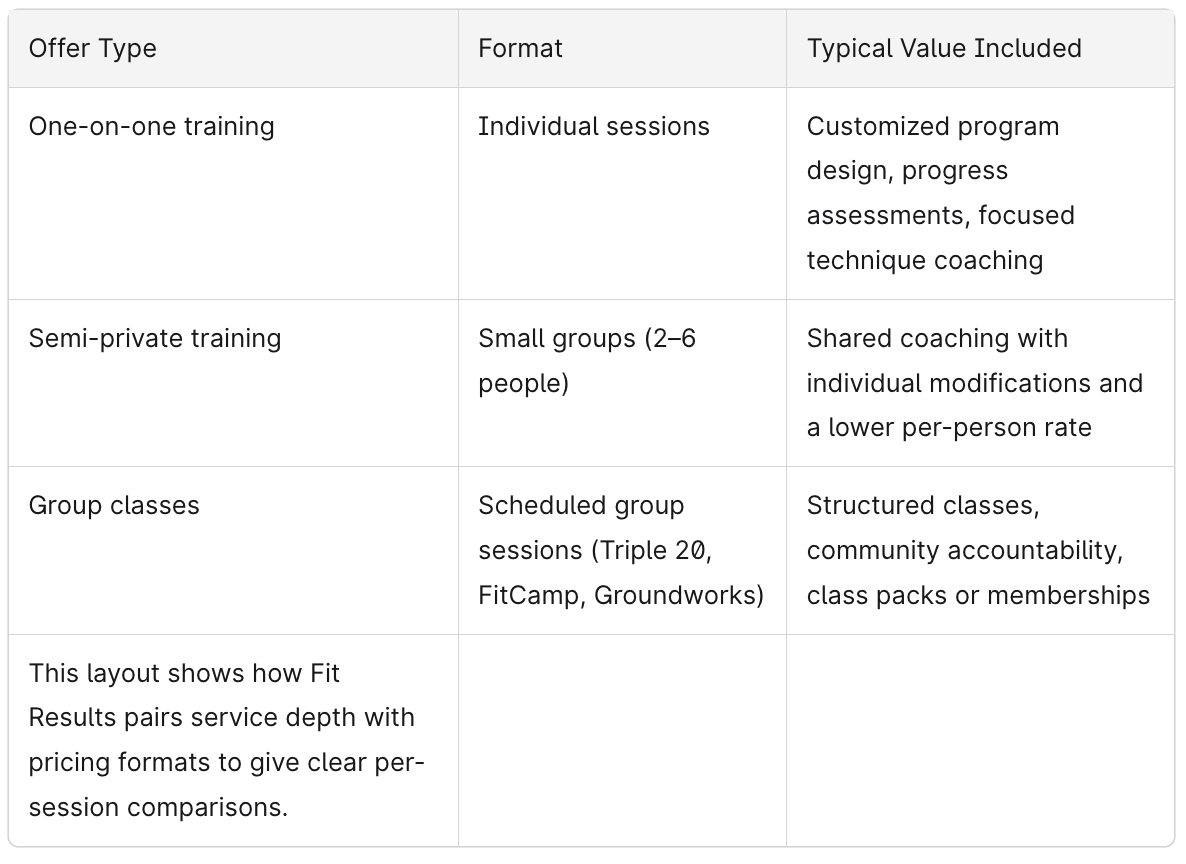
Our fitness programs are designed to be comprehensive and goal-oriented, providing ongoing support and tailored workouts to help you achieve specific health and fitness goals. We combine these formats with program design and nutrition coaching to increase long-term ROI. Packages and memberships commonly include scheduled progress checks and accountability touchpoints so clients keep momentum and avoid wasted sessions. A complimentary consultation helps you see the per-session equivalent and choose the path that fits your budget and desired results.
What Are the Pricing Options for One-on-One and Semi-Private Training?
Fit Results offers flexible pricing: single sessions, multi-session packages, and membership models. Trial sessions are available for clients who want to experience our training approach before committing to a package. Single sessions give scheduling freedom but usually cost more per visit. Some sessions are available in half an hour (30-minute) formats, offering a more affordable and flexible option compared to full-hour sessions. Packages lower the per-session price by committing to a block of time, and trainers often offer discounted rates for clients who purchase sessions in packages, further reducing the per-session cost. Semi-private pricing is calculated by dividing the total session fee among participants, which provides a middle ground between affordability and coaching attention. During a complementary consultation we walk through the per-session math so you can compare our effective hourly rate to independent trainers or big gyms.
These options align with different levels of commitment and scheduling needs while keeping programming quality consistent.
What Value-Added Services Does Fit Results Include?
Fit Results bundles services to speed results and lower long-term cost. Nutrition coaching, nutritional guidance, program design, and injury-modification strategies are often included in higher-tier packages or offered as bundled add-ons—improving adherence and cutting down the number of sessions needed to reach goals. Our Second Chance Program is an outcomes-focused pathway that blends onboarding assessments, progressive fitness training, and accountability for clients who need a reset. Group classes provide community-driven motivation that supports sustained effort. Bundling these services increases lifetime value and sets clearer expectations for each pricing tier.
These bundled elements are the main ways Fit Results shifts price-to-value comparisons versus hourly-only models.
What Unique Services and Programs Does Fit Results Offer Compared to Competitors?
Fit Results builds layered support through outcome-focused programs and group fitness classes—like the Second Chance Program, Triple 20, FitCamp, and Groundworks—rather than selling time by the hour alone. Within the broader personal training industry, Fit Results stands out by focusing on bundled programs and community support, rather than just individual sessions. Each fitness class is structured, scheduled, and socially engaging, providing a cost-effective and motivating alternative to one-on-one coaching. These programs mix progressive training, nutrition guidance, and accountability checkpoints so clients work toward measurable transformations. In addition to personal and semi-private training, Fit Results offers advanced specializations such as functional training, which supports injury recovery, sports performance, and tailored, goal-specific programs. Our group fitness classes are designed to complement individual coaching and encourage consistency through scheduled sessions. Emphasizing program structure, advanced expertise, and community sets Fit Results apart from providers that offer only hourly coaching without bundled follow-up.
How Does Fit Results’ Second Chance Program Support Client Transformation?
The Second Chance Program is for clients who want a clear, accountable path back to consistent training. It starts with a full evaluation to set baselines, then moves into progressive strength and conditioning phases with nutrition adjustments to support fat loss or performance goals. The program is specifically designed to help clients lose weight and build muscle mass through structured phases. Regular check-ins—both individual and group—keep clients on track and let us tweak the plan quickly based on results. That structure raises the chance of lasting change versus ad-hoc training, and it pairs naturally with our group classes to reinforce healthy habits.
- Core components of a transformation program: Initial assessment and goal-setting to create measurable targets. Progressive training phases with personalized exercise modifications. Nutrition coaching plus scheduled accountability check-ins to maintain behavior change.
Together these elements support reliable transformations and can reduce the total sessions needed for durable results.
What Are the Benefits of Fit Results’ Group Fitness Classes?
Our group classes—Triple 20, FitCamp, and Groundworks—offer an affordable, varied, and community-driven way to train. Group fitness classes are especially popular among fitness enthusiasts who are looking for affordable, motivating options to reach their goals. Classes use efficient programming to improve cardio, strength, and movement quality in short, structured sessions. The group setting improves motivation and consistency, which we see lead to better retention than solo routines. Group classes are a lower-cost entry point that many clients combine with occasional one-on-one sessions for technique checks and individualized progress. Fit Results also sometimes collaborates with other personal trainers to offer diverse programming and bring fresh perspectives to our group classes.
- Main benefits of group classes: Lower per-class cost, making regular training easier to maintain. Community-driven motivation that helps you show up consistently. Program variety that complements personalized coaching.
This mix makes group classes a smart choice for people who want value plus social support.
Online Coaching and Support: Expanding Your Training Options
Online coaching and support has really changed the personal training world and made it so much easier for people to get the help they need to stay on track with fitness goals. With online personal training, you can get workout plans that is made just for you, nutrition help, and someone tracking how you're doing—all from your house or when you're traveling somewhere. Online trainers use video calls and computer programs to give you feedback right away, answer any questions you got, and keep you motivated during your workout sessions that you do virtually.
This flexible way of doing things is perfect for anyone that has a busy life, people that likes working out at home, or folks that don't have a gym close by where they live. Many online personal training programs also help create a feeling of community by connecting people with others that has similar fitness goals like them. This supportive place encourages people to be accountable, stay motivated, and feel like they belong somewhere—which is really important factors for having success with fitness. By using technology, online coaching and support has made personal training something more people can get, more affordable, and works better to help more folks achieve what they want and keep healthy habits for a long time.
Injury Recovery and Personal Training: Specialized Support at Fit Results
Injury recovery is a crucial part of the fitness journey, and Fit Results specialized personal training can make all the difference in regaining strength, mobility, and confidence. At Fit Results, our certified personal trainers has 12+ years of experience in supporting clients through injury recovery with personalized workout plans and expert modifications. Fit Results take the time to understand your unique needs, limitations, and goals, designing programs that promote healing while building strength and flexibility. We work together like a partnership because Fit Results does not leave anyone behind because of excuses or setbacks.
Fit Results trainers emphasize proper form and technique to ensure every movement is safe and effective, reducing the risk of further injury. Progressive overload and carefully structured sessions help you rebuild at a sustainable pace that works for your body. In addition to physical training, Fit Results injury recovery programs often include nutrition coaching, stress management, and lifestyle guidance to support holistic healing. Whether you're recovering from a sports injury, surgery, or managing a chronic condition like arthritis or joint issues, Fit Results provides the specialized support you need to return to full health. Fit Results goal is to empower you to overcome setbacks, achieve optimal wellness, and continue progressing toward your fitness goals with confidence. We set goals and we achieve them together as a team.
Who Are the Fit Results Trainers and What Qualifications Do They Hold?
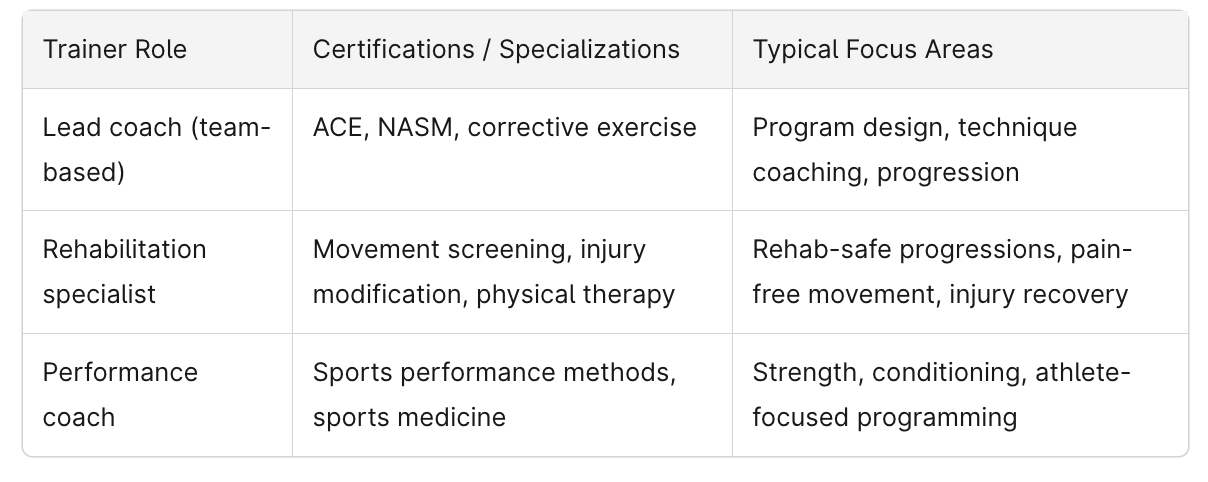
Our trainers come with a range of certifications and specializations that matter for safety and results. Many have advanced education or certifications in sports medicine and physical therapy, which enhances their ability to support injury prevention and recovery. Industry-standard credentials like ACE and NASM signal solid training in program design and progression, and our coaches add expertise in corrective exercise, movement screening, and sports performance. Fit Results trainers often collaborate with other fitness professionals, including physical therapists, to provide comprehensive support for our members. Trainer experience shapes the programs we offer—rehab-focused work, athlete coaching, or weight-loss plans—and determines how much we tailor sessions. The table below summarizes typical trainer roles and focus areas to help you find the right coach.
Why trainer qualifications matter and how to use them when choosing a coach.
What Certifications and Specializations Do Fit Results Trainers Have?
Our coaches typically hold respected industry certifications and extra specializations that allow for safe, effective programs across different goals. An experienced trainer with the right certifications is often considered a good personal trainer, as they provide personalized guidance, motivation, and accountability to help clients achieve their fitness goals. ACE and NASM provide the foundation in exercise science and program design, while specialties—corrective exercise, nutrition coaching, sport-specific training—help trainers tailor plans for injury recovery or performance gains. Those skills lower risk, support steady progress, and let us modify movements for clients with prior injuries. Spotting the right credential mix helps you match with the best trainer for your needs.
These qualifications are the practical basis for safer programming and better long-term adherence.
How Does Trainer Expertise Enhance Client Results and Safety?
Experienced, certified trainers speed progress by designing smart progressions, catching technique problems early, and adding injury-prevention strategies that reduce setbacks. A coach trained in corrective exercise can adapt movements for past injuries so you can train consistently without pain and recover function faster. Good programming balances intensity, volume, and recovery to make gains without raising injury risk. Strength training is a key component of many programs, and finding the right trainer ensures your program matches your goals, preferences, and personality for the best results. When trainers also include nutrition guidance and accountability, clients usually reach goals faster and keep them longer—key when comparing overall value between providers.
That link between expertise and outcomes is central to judging the true value of different training offers.
How Do Fit Results’ Pricing and Services Compare to Other Chicago Personal Trainers?
When comparing Fit Results with other Chicago options, it's important to consider your overall fitness budget to ensure you get the best value for your investment. Personal trainers charge different rates depending on their experience, the format of training (private, semi-private, group), and trends within the personal training industry, which all influence pricing structures across the market. The table below gives representative provider types, typical price ranges, and common services so you can see where Fit Results adds bundled value. We often combine programming, nutrition coaching, and group-community elements that change the effective cost-per-outcome versus hourly-only models. Knowing those trade-offs helps you decide whether a higher upfront hourly rate delivers better long-term ROI through faster, safer progress.
Representative provider types and how they typically price and package services.
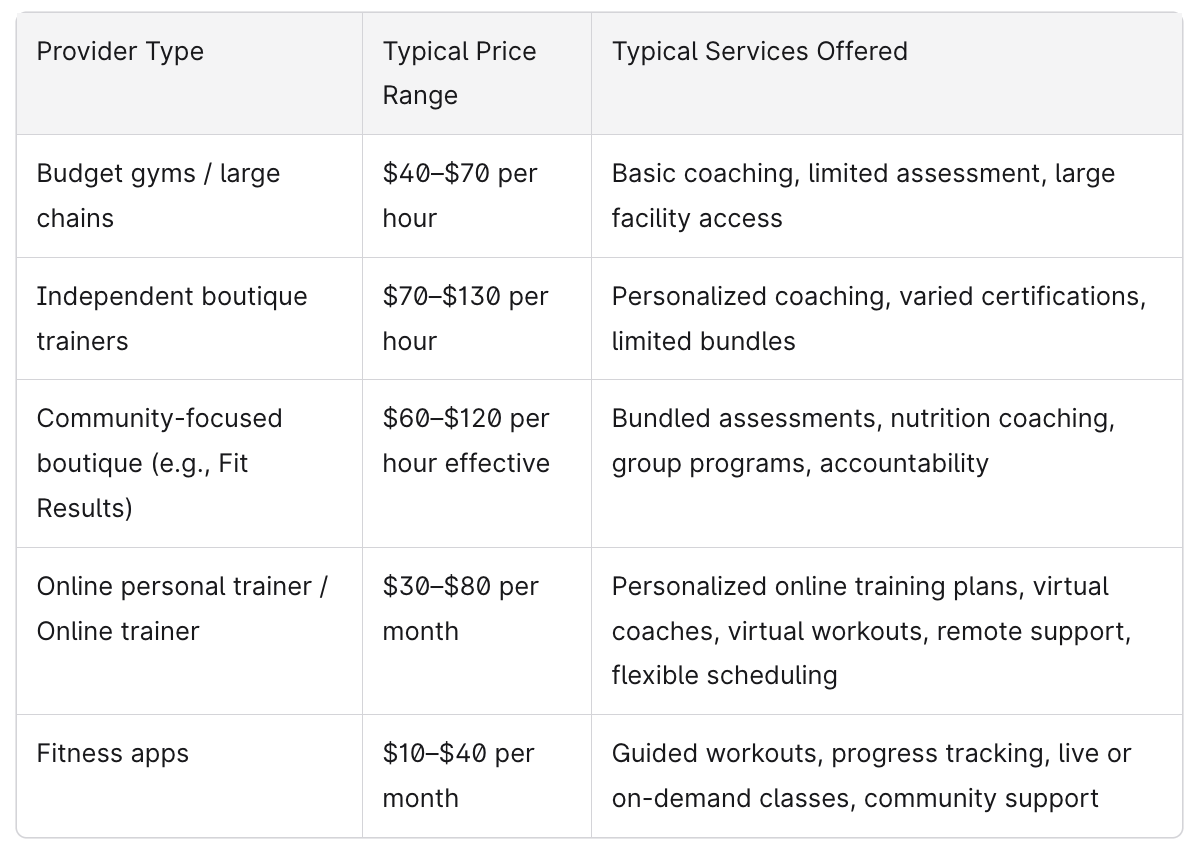
Guided workouts, progress tracking, live or on-demand classes, community support
That comparison shows how bundled services can shift per-session value even when headline rates look similar. Online personal training is generally more affordable than in-person training due to lower overhead costs, and options like online trainers, virtual coaches, and fitness apps provide flexible, accessible, and cost-effective alternatives. When comparing personal training prices, consider whether you prefer an in person trainer or in person coaching at a private gym, or if online training and virtual workouts better fit your needs and budget.
What Are Typical Pricing Ranges Among Chicago Competitors?
Chicago providers generally fall into a few predictable tiers with typical inclusions:
- Budget to mid-range: $40–$70 per hour with fewer bundled services.
- Mid to premium independents: $70–$130 per hour with more personalized attention.
- Semi-private/group per-person rates: $25–$50 depending on class size and frequency.
These ranges show that higher hourly rates can include extras that reduce long-term cost by improving outcomes—so compare per-session math, not just the sticker price.
How Do Service Offerings Differ Between Fit Results and Other Gyms?
Service differences usually come down to bundling, community programming, and rehab support—areas where Fit Results focuses on structured programs and group-driven accountability. Some providers sell hourly time with minimal programming or nutrition support; others include regular assessments and nutrition check-ins in packages. Our approach mixes group classes, personalized coaching options, and targeted programs like the Second Chance Program to balance affordability and program depth. The checklist below helps you spot those differences quickly.
- Feature comparison highlights: Bundled assessments and nutrition coaching, which increase the chance of success. Regular community classes and accountability touchpoints that improve retention. Injury-modification capabilities built into programming for safer progress.
These features show practical effects on outcomes and cost-effectiveness when you evaluate providers.
Why Should You Choose Fit Results Over Other Chicago Personal Trainers?
Fit Results is a strong choice if you want community accountability, structured programs, and bundled services that improve long-term ROI instead of isolated hourly coaching. Our mix of one-on-one, semi-private, and group formats—combined with complimentary consultations—helps you find the right investment for your goals. Local recognition and positive ratings back up our approach, and signature programs give clear pathways for people who need a reset or thrive in a group setting. Below are the core reasons clients choose Fit Results.
- Fit Results differentiators to consider: Structured transformation programs that combine training, nutrition, and accountability. A variety of class formats (Triple 20, FitCamp, Groundworks) that encourage consistency. Complimentary consultations to match goals with the most cost-effective plan.
These points lead into how we build community and the themes that come up in client feedback.
How Does Fit Results Foster Community and Accountability?
We build community through scheduled group classes, shared program milestones, and accountability touch-points in multi-week programs—creating frequent social reinforcement for attendance and effort. Regular classes like Triple 20 and FitCamp provide predictable community touch-points; semi-private formats let small cohorts form stronger bonds. Short nutrition follow-ups and progress reviews keep clients aligned with their goals and allow timely adjustments. That network of touchpoints lowers missed sessions and supports steady progress—an advantage over places without formal community structures.
Those community mechanisms tend to improve adherence and long-term results, which shows up in client feedback.
What Do Client Testimonials Reveal About Fit Results’ Effectiveness?
Clients consistently describe measurable changes, supportive staff, and an inclusive environment focused on sustainable progress over quick fixes. Many point to better consistency thanks to scheduled classes and accountability systems, and several credit structured programs like the Second Chance Program for their success. Good local ratings and public recognition add to the trust factor. Use these testimonial themes alongside price when you decide whether to book a complimentary consultation and start a tailored plan.
Those themes suggest that structured programs and community support often translate into better adherence and real results.
Frequently Asked Questions
What should I consider when choosing a personal trainer in Chicago?
Look at qualifications, experience, and specialization. Certifications like ACE or NASM show a solid foundation in exercise science. Match the trainer’s experience to your goals—weight loss, muscle gain, rehab, or sport performance—and make sure their coaching style feels like a good fit. Also check availability and whether they offer flexible scheduling that works with your life.
Are there any hidden fees associated with personal training packages?
Some packages include extra fees for assessments, nutrition coaching, or specialty classes. Ask during your initial consultation about what’s included and any additional costs. Also confirm cancellation or rescheduling policies and whether a membership fee applies, so there are no surprises.
How can I track my progress with a personal trainer?
Progress tracking usually starts with an initial assessment to set baselines—weight, measurements, strength or endurance tests. Trainers typically run regular progress checks and adjust the program based on results. Many use workout logs or apps to track sessions and nutrition. Frequent check-ins keep motivation up and help you see real improvements.
What is the typical duration of personal training sessions?
Most sessions run 45–60 minutes, though some high-intensity formats are shorter and some sessions include longer warm-ups or cooldowns. Group classes often have set durations too. Discuss your goals and preferences with your trainer to pick the best session length for you.
Can I switch trainers if I'm not satisfied with my current one?
Yes—most studios, including Fit Results, allow trainer changes. Talk to management or your coach about your concerns; they can often recommend a better match. Check the studio’s policy on switching to make the transition smooth.
What should I wear to personal training sessions?
Wear comfortable, breathable clothes that allow full movement—moisture-wicking shirts, shorts, or leggings. Supportive athletic shoes are important for safety. If you’ll train outside, dress in layers to handle changing weather. Prioritize comfort and function.
How often should I train with a personal trainer for optimal results?
Frequency depends on goals, fitness level, and schedule. Many trainers recommend 2–3 sessions per week for steady progress. Some clients benefit from more frequent sessions when starting or targeting specific performance goals. Work with your trainer to build a schedule that balances progress and recovery.
Conclusion
Picking the right personal training option in Chicago makes a big difference in your progress. Understanding pricing structures and what each studio actually includes helps you choose the best fit for your goals and budget. Explore multiple formats and value-added services so you can find the right balance of cost, coaching, and community. When you’re ready, book a complimentary consultation with Fit Results to get a personalized plan and clear next steps.
Chicago Trainer Pricing — How Fit Results Compares

This page walks you through how Fit Results’ pricing and services stack up against common Chicago personal training options, so you can pick the model that fits your goals and budget. You’ll get the current market price ranges for Chicago trainers, the key factors that change rates, how semi-private and group formats change the per-person math, and how Fit Results packages value-added services. We also highlight signature offerings—like the Second Chance Program and our group classes—explain how trainer credentials affect outcomes, and show an anonymous comparison to typical competitors. By the end you’ll have clear price ranges, per-session calculations, and practical steps to choose a trainer or program that balances cost with what you actually need. For quick scanning, this guide includes simple tables, bullet checklists, and direct evaluation steps.
Introduction to Personal Training
Personal training is one of the most effective way to achieve your fitness goals, whether you’re aiming for weight loss, building muscle, or simply improving your overall health. Working with a certified personal trainer means you get expert guidance and a customized workout plan that is designed specifically for your needs, abilities, and what you want to achieve. Your personal trainer will assess where you’re starting from and create a approach that is tailored just for you, helping you stay motivated and accountable throughout your fitness journey. Understanding your fitness budget helps you choose the right personal training option for your needs and ensures you get the most value from your investment.
Today, personal training is more accessible than it has ever been. With the rise of online personal training, you can connect with many personal trainers no matter where you are located, making it easier to fit training sessions into your schedule. Whether you prefer in-person training at a local gym, private studio, or the convenience of online personal sessions, there’s a solution that will match your lifestyle. Online personal trainers offers the same level of expertise and support as traditional in-person training, often with added flexibility and ongoing communication that helps you succeed. As your fitness goals evolve and change, your trainer will adjust your customized workout plan to ensure steady progress and lasting results that you can be proud of. No matter where you start from, personal training provides a clear, personalized path to success that works for everyone.
What Are the Average Personal Training Costs in Chicago?
Prices for personal training in Chicago depend on the training format, the trainer’s experience, and the studio’s location. As a rule of thumb, one-on-one sessions usually run between $50 and $120 per hour, which reflects differences in overhead and certification. The average personal trainer cost in Chicago typically ranges from $40 to $150 per hour, with personal trainers charging different rates based on experience, certifications, and training format. Understanding a personal trainer's hourly rate is important for budgeting, as personal trainers charge more in major metropolitan areas due to higher costs of living and demand. Personal trainer cost and personal training prices are influenced by factors such as session type, trainer experience, and additional services.
Location also plays a significant role in pricing. Rates are typically higher in upscale downtown neighborhoods such as the Loop or River North due to higher operating costs. Buying packages typically lowers the per-session cost and often bundles in assessments, nutrition check-ins, or program design.
In semi-private and group settings, per-person costs commonly fall in the $25–$50 range, depending on group size and session length. One-on-one sessions are the most expensive training format, while small group sessions can lower the per-person cost to $30–$50. Use these ranges as a baseline when comparing bundles and specialty programs from Fit Results and other local studios.
Within the broader personal training industry, trends such as increased demand for specialized coaching and flexible training formats continue to influence how personal trainers charge and structure their pricing.
Which Factors Influence Chicago Personal Trainer Rates?
Trainer pricing comes from a mix of education, specialization, and operating costs. Higher certifications and specialist credentials—ACE, NASM, corrective exercise, etc.—usually mean higher hourly rates because they translate to safer, smarter programming. Trainers who do rehab work, sports performance, or nutrition counseling often charge more because of the extra assessment and planning time. Studio location matters too: downtown or high-rent neighborhoods push prices up, while neighborhood studios farther from the core tend to be more affordable. Commercial gyms and major gyms often have a higher personal trainer's hourly rate due to greater overhead costs like rent and equipment, while independent studios or personal training businesses may offer more flexible pricing. The personal training business model, as well as broader fitness industry trends and standards, also influence how rates are set. Knowing these drivers helps you compare true value instead of just the sticker price. Measurement of success in personal training is increasingly based on concrete metrics like client retention and body composition changes. Session effectiveness is generally higher with experienced specialists who offer tailored plans, especially for complex goals.
- Primary factors that shape trainer rates in Chicago include: Certifications and specializations that justify higher rates for extra expertise. Studio location and overhead, which raise base hourly costs in pricey areas—especially in a commercial gym or major gym setting. Session length and whether assessments or follow-ups are included, which change per-session value. The personal trainer's hourly rate is also determined by experience, location, and the business model, reflecting both the personal training business and fitness industry market trends.
These elements combine to create different pricing tiers and to help you find the right match for your goals.
How Do Semi-Private and Group Training Affect Pricing?
Semi-private and group training spread a trainer’s time across several people, which reduces the per-person price but changes how much individualized attention you get. For example, a two-person semi-private session priced at $80 total equals $40 per person; a five-person group billed at $150 total equates to $30 per person. Training with a few friends can make personal training more affordable by sharing the cost among the group. Larger groups and fixed session fees drive the per-head math. Trade-offs include less one-on-one form work and customization, balanced by more motivation, peer accountability, and programming suited for varied fitness levels. Many studios offer class packs or monthly memberships that lower the effective per-class cost and reward consistency—useful when weighing budget against depth of service. Additionally, package deals are often available, providing discounted rates for clients who purchase multiple sessions upfront, which encourages long-term commitment and cost savings.
- Typical trade-offs with semi-private or group formats: Lower per-person cost, which makes regular training more affordable. Less individualized coaching time, requiring you to self-manage between touchpoints. Stronger community and accountability, which often boosts consistency.
Those trade-offs explain why semi-private and group options are popular and common in Chicago pricing mixes.
Types of Personal Training in Chicago: Exploring Your Options
Independent Trainers vs. Commercial Gyms: What’s the Difference?
The Gym Route: What to Expect When Training at a Commercial Facility
How Does Fit Results Structure Its Personal Training Pricing?
Fit Results offers pricing across one-on-one training, semi-private sessions, and group classes, all built around bundled value—assessments, nutrition coaching, and accountability. Our personal training services include comprehensive assessments, individualized nutrition coaching, and ongoing accountability to support your progress. We provide complimentary consultations to clarify goals and recommend the best format. During this consultation, we help you maximize your fitness budget by suggesting the most cost-effective training format and package to meet your needs. Below is a straightforward table that summarizes typical Fit Results offerings, the per-session equivalent, and what’s included to make comparisons easier.
Quick summary of Fit Results’ core formats and the typical value each provides.

Our fitness programs are designed to be comprehensive and goal-oriented, providing ongoing support and tailored workouts to help you achieve specific health and fitness goals. We combine these formats with program design and nutrition coaching to increase long-term ROI. Packages and memberships commonly include scheduled progress checks and accountability touchpoints so clients keep momentum and avoid wasted sessions. A complimentary consultation helps you see the per-session equivalent and choose the path that fits your budget and desired results.
What Are the Pricing Options for One-on-One and Semi-Private Training?
Fit Results offers flexible pricing: single sessions, multi-session packages, and membership models. Trial sessions are available for clients who want to experience our training approach before committing to a package. Single sessions give scheduling freedom but usually cost more per visit. Some sessions are available in half an hour (30-minute) formats, offering a more affordable and flexible option compared to full-hour sessions. Packages lower the per-session price by committing to a block of time, and trainers often offer discounted rates for clients who purchase sessions in packages, further reducing the per-session cost. Semi-private pricing is calculated by dividing the total session fee among participants, which provides a middle ground between affordability and coaching attention. During a complementary consultation we walk through the per-session math so you can compare our effective hourly rate to independent trainers or big gyms.
These options align with different levels of commitment and scheduling needs while keeping programming quality consistent.
What Value-Added Services Does Fit Results Include?
Fit Results bundles services to speed results and lower long-term cost. Nutrition coaching, nutritional guidance, program design, and injury-modification strategies are often included in higher-tier packages or offered as bundled add-ons—improving adherence and cutting down the number of sessions needed to reach goals. Our Second Chance Program is an outcomes-focused pathway that blends onboarding assessments, progressive fitness training, and accountability for clients who need a reset. Group classes provide community-driven motivation that supports sustained effort. Bundling these services increases lifetime value and sets clearer expectations for each pricing tier.
These bundled elements are the main ways Fit Results shifts price-to-value comparisons versus hourly-only models.
What Unique Services and Programs Does Fit Results Offer Compared to Competitors?
Fit Results builds layered support through outcome-focused programs and group fitness classes—like the Second Chance Program, Triple 20, FitCamp, and Groundworks—rather than selling time by the hour alone. Within the broader personal training industry, Fit Results stands out by focusing on bundled programs and community support, rather than just individual sessions. Each fitness class is structured, scheduled, and socially engaging, providing a cost-effective and motivating alternative to one-on-one coaching. These programs mix progressive training, nutrition guidance, and accountability checkpoints so clients work toward measurable transformations. In addition to personal and semi-private training, Fit Results offers advanced specializations such as functional training, which supports injury recovery, sports performance, and tailored, goal-specific programs. Our group fitness classes are designed to complement individual coaching and encourage consistency through scheduled sessions. Emphasizing program structure, advanced expertise, and community sets Fit Results apart from providers that offer only hourly coaching without bundled follow-up.
How Does Fit Results’ Second Chance Program Support Client Transformation?
The Second Chance Program is for clients who want a clear, accountable path back to consistent training. It starts with a full evaluation to set baselines, then moves into progressive strength and conditioning phases with nutrition adjustments to support fat loss or performance goals. The program is specifically designed to help clients lose weight and build muscle mass through structured phases. Regular check-ins—both individual and group—keep clients on track and let us tweak the plan quickly based on results. That structure raises the chance of lasting change versus ad-hoc training, and it pairs naturally with our group classes to reinforce healthy habits.
- Core components of a transformation program: Initial assessment and goal-setting to create measurable targets. Progressive training phases with personalized exercise modifications. Nutrition coaching plus scheduled accountability check-ins to maintain behavior change.
Together these elements support reliable transformations and can reduce the total sessions needed for durable results.
What Are the Benefits of Fit Results’ Group Fitness Classes?
Our group classes—Triple 20, FitCamp, and Groundworks—offer an affordable, varied, and community-driven way to train. Group fitness classes are especially popular among fitness enthusiasts who are looking for affordable, motivating options to reach their goals. Classes use efficient programming to improve cardio, strength, and movement quality in short, structured sessions. The group setting improves motivation and consistency, which we see lead to better retention than solo routines. Group classes are a lower-cost entry point that many clients combine with occasional one-on-one sessions for technique checks and individualized progress. Fit Results also sometimes collaborates with other personal trainers to offer diverse programming and bring fresh perspectives to our group classes.
- Main benefits of group classes: Lower per-class cost, making regular training easier to maintain. Community-driven motivation that helps you show up consistently. Program variety that complements personalized coaching.
This mix makes group classes a smart choice for people who want value plus social support.
Online Coaching and Support: Expanding Your Training Options
Online coaching and support has really changed the personal training world and made it so much easier for people to get the help they need to stay on track with fitness goals. With online personal training, you can get workout plans that is made just for you, nutrition help, and someone tracking how you're doing—all from your house or when you're traveling somewhere. Online trainers use video calls and computer programs to give you feedback right away, answer any questions you got, and keep you motivated during your workout sessions that you do virtually.
This flexible way of doing things is perfect for anyone that has a busy life, people that likes working out at home, or folks that don't have a gym close by where they live. Many online personal training programs also help create a feeling of community by connecting people with others that has similar fitness goals like them. This supportive place encourages people to be accountable, stay motivated, and feel like they belong somewhere—which is really important factors for having success with fitness. By using technology, online coaching and support has made personal training something more people can get, more affordable, and works better to help more folks achieve what they want and keep healthy habits for a long time.
Injury Recovery and Personal Training: Specialized Support at Fit Results
Injury recovery is a crucial part of the fitness journey, and Fit Results specialized personal training can make all the difference in regaining strength, mobility, and confidence. At Fit Results, our certified personal trainers has 12+ years of experience in supporting clients through injury recovery with personalized workout plans and expert modifications. Fit Results take the time to understand your unique needs, limitations, and goals, designing programs that promote healing while building strength and flexibility. We work together like a partnership because Fit Results does not leave anyone behind because of excuses or setbacks.
Fit Results trainers emphasize proper form and technique to ensure every movement is safe and effective, reducing the risk of further injury. Progressive overload and carefully structured sessions help you rebuild at a sustainable pace that works for your body. In addition to physical training, Fit Results injury recovery programs often include nutrition coaching, stress management, and lifestyle guidance to support holistic healing. Whether you're recovering from a sports injury, surgery, or managing a chronic condition like arthritis or joint issues, Fit Results provides the specialized support you need to return to full health. Fit Results goal is to empower you to overcome setbacks, achieve optimal wellness, and continue progressing toward your fitness goals with confidence. We set goals and we achieve them together as a team.
Who Are the Fit Results Trainers and What Qualifications Do They Hold?
Our trainers come with a range of certifications and specializations that matter for safety and results. Many have advanced education or certifications in sports medicine and physical therapy, which enhances their ability to support injury prevention and recovery. Industry-standard credentials like ACE and NASM signal solid training in program design and progression, and our coaches add expertise in corrective exercise, movement screening, and sports performance. Fit Results trainers often collaborate with other fitness professionals, including physical therapists, to provide comprehensive support for our members. Trainer experience shapes the programs we offer—rehab-focused work, athlete coaching, or weight-loss plans—and determines how much we tailor sessions. The table below summarizes typical trainer roles and focus areas to help you find the right coach.
Why trainer qualifications matter and how to use them when choosing a coach.

What Certifications and Specializations Do Fit Results Trainers Have?
Our coaches typically hold respected industry certifications and extra specializations that allow for safe, effective programs across different goals. An experienced trainer with the right certifications is often considered a good personal trainer, as they provide personalized guidance, motivation, and accountability to help clients achieve their fitness goals. ACE and NASM provide the foundation in exercise science and program design, while specialties—corrective exercise, nutrition coaching, sport-specific training—help trainers tailor plans for injury recovery or performance gains. Those skills lower risk, support steady progress, and let us modify movements for clients with prior injuries. Spotting the right credential mix helps you match with the best trainer for your needs.
These qualifications are the practical basis for safer programming and better long-term adherence.
How Does Trainer Expertise Enhance Client Results and Safety?
Experienced, certified trainers speed progress by designing smart progressions, catching technique problems early, and adding injury-prevention strategies that reduce setbacks. A coach trained in corrective exercise can adapt movements for past injuries so you can train consistently without pain and recover function faster. Good programming balances intensity, volume, and recovery to make gains without raising injury risk. Strength training is a key component of many programs, and finding the right trainer ensures your program matches your goals, preferences, and personality for the best results. When trainers also include nutrition guidance and accountability, clients usually reach goals faster and keep them longer—key when comparing overall value between providers.
That link between expertise and outcomes is central to judging the true value of different training offers.
How Do Fit Results’ Pricing and Services Compare to Other Chicago Personal Trainers?
When comparing Fit Results with other Chicago options, it's important to consider your overall fitness budget to ensure you get the best value for your investment. Personal trainers charge different rates depending on their experience, the format of training (private, semi-private, group), and trends within the personal training industry, which all influence pricing structures across the market. The table below gives representative provider types, typical price ranges, and common services so you can see where Fit Results adds bundled value. We often combine programming, nutrition coaching, and group-community elements that change the effective cost-per-outcome versus hourly-only models. Knowing those trade-offs helps you decide whether a higher upfront hourly rate delivers better long-term ROI through faster, safer progress.
Representative provider types and how they typically price and package services.

Guided workouts, progress tracking, live or on-demand classes, community support
That comparison shows how bundled services can shift per-session value even when headline rates look similar. Online personal training is generally more affordable than in-person training due to lower overhead costs, and options like online trainers, virtual coaches, and fitness apps provide flexible, accessible, and cost-effective alternatives. When comparing personal training prices, consider whether you prefer an in person trainer or in person coaching at a private gym, or if online training and virtual workouts better fit your needs and budget.
What Are Typical Pricing Ranges Among Chicago Competitors?
Chicago providers generally fall into a few predictable tiers with typical inclusions:
- Budget to mid-range: $40–$70 per hour with fewer bundled services.
- Mid to premium independents: $70–$130 per hour with more personalized attention.
- Semi-private/group per-person rates: $25–$50 depending on class size and frequency.
These ranges show that higher hourly rates can include extras that reduce long-term cost by improving outcomes—so compare per-session math, not just the sticker price.
How Do Service Offerings Differ Between Fit Results and Other Gyms?
Service differences usually come down to bundling, community programming, and rehab support—areas where Fit Results focuses on structured programs and group-driven accountability. Some providers sell hourly time with minimal programming or nutrition support; others include regular assessments and nutrition check-ins in packages. Our approach mixes group classes, personalized coaching options, and targeted programs like the Second Chance Program to balance affordability and program depth. The checklist below helps you spot those differences quickly.
- Feature comparison highlights: Bundled assessments and nutrition coaching, which increase the chance of success. Regular community classes and accountability touchpoints that improve retention. Injury-modification capabilities built into programming for safer progress.
These features show practical effects on outcomes and cost-effectiveness when you evaluate providers.
Why Should You Choose Fit Results Over Other Chicago Personal Trainers?
Fit Results is a strong choice if you want community accountability, structured programs, and bundled services that improve long-term ROI instead of isolated hourly coaching. Our mix of one-on-one, semi-private, and group formats—combined with complimentary consultations—helps you find the right investment for your goals. Local recognition and positive ratings back up our approach, and signature programs give clear pathways for people who need a reset or thrive in a group setting. Below are the core reasons clients choose Fit Results.
- Fit Results differentiators to consider: Structured transformation programs that combine training, nutrition, and accountability. A variety of class formats (Triple 20, FitCamp, Groundworks) that encourage consistency. Complimentary consultations to match goals with the most cost-effective plan.
These points lead into how we build community and the themes that come up in client feedback.
How Does Fit Results Foster Community and Accountability?
We build community through scheduled group classes, shared program milestones, and accountability touch-points in multi-week programs—creating frequent social reinforcement for attendance and effort. Regular classes like Triple 20 and FitCamp provide predictable community touch-points; semi-private formats let small cohorts form stronger bonds. Short nutrition follow-ups and progress reviews keep clients aligned with their goals and allow timely adjustments. That network of touchpoints lowers missed sessions and supports steady progress—an advantage over places without formal community structures.
Those community mechanisms tend to improve adherence and long-term results, which shows up in client feedback.
What Do Client Testimonials Reveal About Fit Results’ Effectiveness?
Clients consistently describe measurable changes, supportive staff, and an inclusive environment focused on sustainable progress over quick fixes. Many point to better consistency thanks to scheduled classes and accountability systems, and several credit structured programs like the Second Chance Program for their success. Good local ratings and public recognition add to the trust factor. Use these testimonial themes alongside price when you decide whether to book a complimentary consultation and start a tailored plan.
Those themes suggest that structured programs and community support often translate into better adherence and real results.
Frequently Asked Questions
What should I consider when choosing a personal trainer in Chicago?
Look at qualifications, experience, and specialization. Certifications like ACE or NASM show a solid foundation in exercise science. Match the trainer’s experience to your goals—weight loss, muscle gain, rehab, or sport performance—and make sure their coaching style feels like a good fit. Also check availability and whether they offer flexible scheduling that works with your life.
Are there any hidden fees associated with personal training packages?
Some packages include extra fees for assessments, nutrition coaching, or specialty classes. Ask during your initial consultation about what’s included and any additional costs. Also confirm cancellation or rescheduling policies and whether a membership fee applies, so there are no surprises.
How can I track my progress with a personal trainer?
Progress tracking usually starts with an initial assessment to set baselines—weight, measurements, strength or endurance tests. Trainers typically run regular progress checks and adjust the program based on results. Many use workout logs or apps to track sessions and nutrition. Frequent check-ins keep motivation up and help you see real improvements.
What is the typical duration of personal training sessions?
Most sessions run 45–60 minutes, though some high-intensity formats are shorter and some sessions include longer warm-ups or cooldowns. Group classes often have set durations too. Discuss your goals and preferences with your trainer to pick the best session length for you.
Can I switch trainers if I'm not satisfied with my current one?
Yes—most studios, including Fit Results, allow trainer changes. Talk to management or your coach about your concerns; they can often recommend a better match. Check the studio’s policy on switching to make the transition smooth.
What should I wear to personal training sessions?
Wear comfortable, breathable clothes that allow full movement—moisture-wicking shirts, shorts, or leggings. Supportive athletic shoes are important for safety. If you’ll train outside, dress in layers to handle changing weather. Prioritize comfort and function.
How often should I train with a personal trainer for optimal results?
Frequency depends on goals, fitness level, and schedule. Many trainers recommend 2–3 sessions per week for steady progress. Some clients benefit from more frequent sessions when starting or targeting specific performance goals. Work with your trainer to build a schedule that balances progress and recovery.
Conclusion
Picking the right personal training option in Chicago makes a big difference in your progress. Understanding pricing structures and what each studio actually includes helps you choose the best fit for your goals and budget. Explore multiple formats and value-added services so you can find the right balance of cost, coaching, and community. When you’re ready, book a complimentary consultation with Fit Results to get a personalized plan and clear next steps.


.png)
