Elevate Your Fitness in Chicago

What Are the Benefits of Yearly Personal Trainer Memberships in Chicago?
A yearly personal trainer membership in Chicago provides consistent coaching, periodized programming, and scheduled assessments over 12 months. Many gyms use a comprehensive approach combining strength, conditioning, and mobility. Trainers offer expert guidance and access to specialized equipment for optimal results. Annual plans allow progress tracking at 3-, 6-, and 12-month milestones, improving adherence and building lasting habits. They often reduce cost-per-session and include extras like nutrition check-ins and group-class access. The longer timeline supports safer progression for injury recovery and allows recovery-aware adjustments not possible with pay-as-you-go training. These strengths make yearly plans a smart choice for anyone serious about long-term weight loss, strength development, or rehab outcomes in the Chicago market.
This list highlights the core advantages you should expect from an annual plan:
- Consistent progression: Periodized programs and planned reassessments keep progress measurable and targeted.
- Better value per session: Bundled or prepaid models typically lower the average cost and add useful services.
- Safer, personalized pacing: A year-long plan allows rehab-aware progression and reduces injury risk.
Next, we’ll look at the mechanisms—both physiological and behavioral—behind why long-term programming produces lasting results.
How Do Long-Term Memberships Enhance Fitness Results?
Long-term memberships improve results by enabling progressive overload, scheduled recovery, and habit changes over time. Chicago trainers base programs on exercise science for safe, effective progress. Over 12 months, trainers cycle strength phases, hypertrophy blocks, and deload weeks to avoid plateaus and overuse. Building strength and a solid foundation supports health and empowerment. Regular coaching creates routine and accountability, turning effort into consistent practice. Functional training and endurance are key, as seen in Chicago Strength In Motion’s functional resistance training and Chicago Fitness Plus’s focus on endurance, strength, balance, and flexibility for seniors. Clinical reassessments at 3 and 6 months fine-tune programs and reduce setbacks. This approach explains why annual plans yield larger, sustainable improvements than short-term packages.
Why Choose Personalized Training for Weight Loss and Injury Rehabilitation?
Personalized training speeds weight loss and rehab progress by customizing exercise selection, intensity, and progression to your body, limitations, and goals. Trainers provide tailored care and ongoing adjustments to support your wellness journey. For weight loss, they combine resistance work, metabolic conditioning, and nutrition checkpoints to preserve lean mass and cut fat, adjusting calories and workload based on reassessments.For rehabilitation, trainers use corrective strategies, range-of-motion progressions, and careful load management, working with healthcare providers when needed to keep you safe. Pain management is a key component of rehabilitation, with some centers like Galter Life Center providing massage therapy and clinical approaches to pain relief and injury rehabilitation. Initial movement screens, pain mapping, and clear goal-setting create a baseline for a tailored 12-month plan, and ongoing tweaks keep the plan responsive as you improve. Personalized coaching reduces risk and shortens the path to measurable outcomes by addressing movement compensations that generic programs miss.
Which Yearly Personal Trainer Packages Offer the Best Value in Chicago?
To evaluate yearly personal trainer packages in Chicago, compare duration, session frequency, included services, and effective cost-per-session. High-value packages include progress assessments, group-class access, nutrition check-ins, and flexible rescheduling. Many offer small group sessions for a more personalized and supportive experience than traditional classes.Comprehensive services may be available, such as low back therapy (as provided by Discover Strength) and body composition testing, to address a wide range of fitness needs. Amenities like towel service are sometimes included in higher-tier packages for added convenience. When comparing options, calculate the amortized session cost (total fee divided by expected sessions) and consider inclusions like small-group training and reassessments that boost effectiveness. Check trial policies and freeze or cancellation terms to ensure commitments remain flexible. Use these factors to choose the package that best supports steady strength gains, weight loss, or rehab progress with a personalized approach.
This table compares three common yearly package structures—Weekly Coaching, Standard Annual, and Hybrid Annual—across duration, session frequency, core inclusions, and pricing notes so you can identify which model fits your goals and schedule.
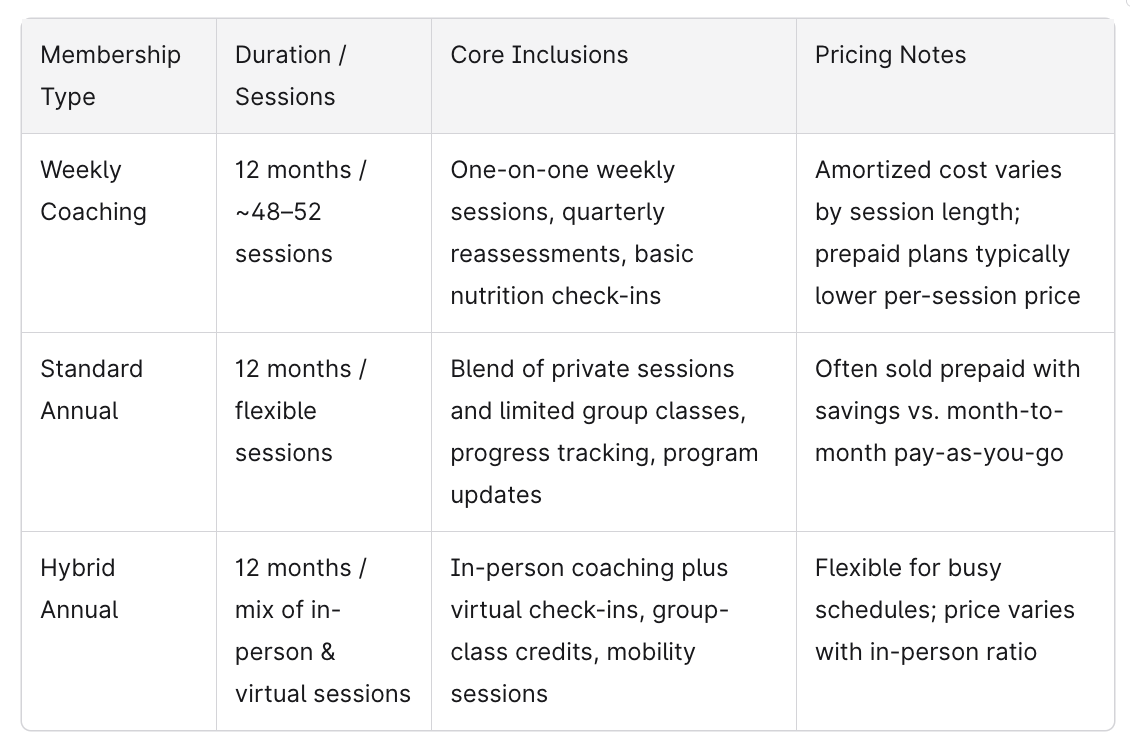
Ultimately, the best value depends on how many one-on-one sessions you need, whether group classes or small group sessions provide meaningful support, and if virtual touchpoints are enough for your progress. For exact package details and current availability, check providers’ membership pages or contact their teams for a consultation.
What Are the Pricing Options and Membership Durations Available?
Common pricing structures include prepaid annual plans, monthly autopay tied to a 12-month commitment, and session-pack amortization that spreads a set number of sessions across the year. Prepaid annual plans usually give the lowest cost-per-session, while monthly autopay smooths cash flow. Session packs offer flexibility but can cost more per session if not part of a long-term agreement. To judge value, estimate your expected attendance, factor in add-ons like nutrition coaching and group classes, and ask how reassessments are scheduled. Small group sessions can offer a more personalized approach than traditional group classes, providing tailored workouts and a supportive environment, often at a lower cost per session. If you’re budget-conscious, prioritize packages that include periodic progress reviews and small-group options to supplement one-on-one coaching without doubling costs.
Are There Discounts or Flexible Terms for Long-Term Memberships?
Discounts and flexible terms are often negotiable and can include early-signup incentives, referral credits, or bundled family/corporate rates that lower your effective cost. Many providers offer hardship policies such as temporary freezes or prorated transfers for life interruptions, and some let you switch program tiers mid-term. When evaluating offers, request written details on freeze windows, cancellation policies, and whether unused sessions roll over or expire. Ask about trial sessions or short introductory periods before you commit to a full year—transparent providers will explain options clearly so you can decide with confidence. Clear contract terms protect your investment and preserve the long-term coach–client relationship that drives results.
Who Are the Expert Personal Trainers Behind Chicago’s Top Yearly Memberships?
Top yearly personal trainer memberships in Chicago are staffed by a team of certified trainers who provide expert guidance grounded in exercise science. These professionals combine relevant specializations, recognized certifications, and a client-centered coaching style to support goals like weight loss, strength, and injury rehab. Don’t rely on job titles alone—evaluate trainers by their certifications, the modalities they use, and how they structure long-term progression and recovery. Many quality programs publish trainer bios so you can review experience and coaching philosophy before booking. For detailed profiles and to match specializations to your goals, visit the provider’s trainers page.
A personalized approach and a supportive community—such as the one fostered by TRAIN Moment, where clients and coaches encourage each other without judgment—are key elements of successful long-term memberships.
The table below summarizes common trainer types you’ll find in Chicago gyms and what each typically offers in specialization, certifications to look for, and best client matches.
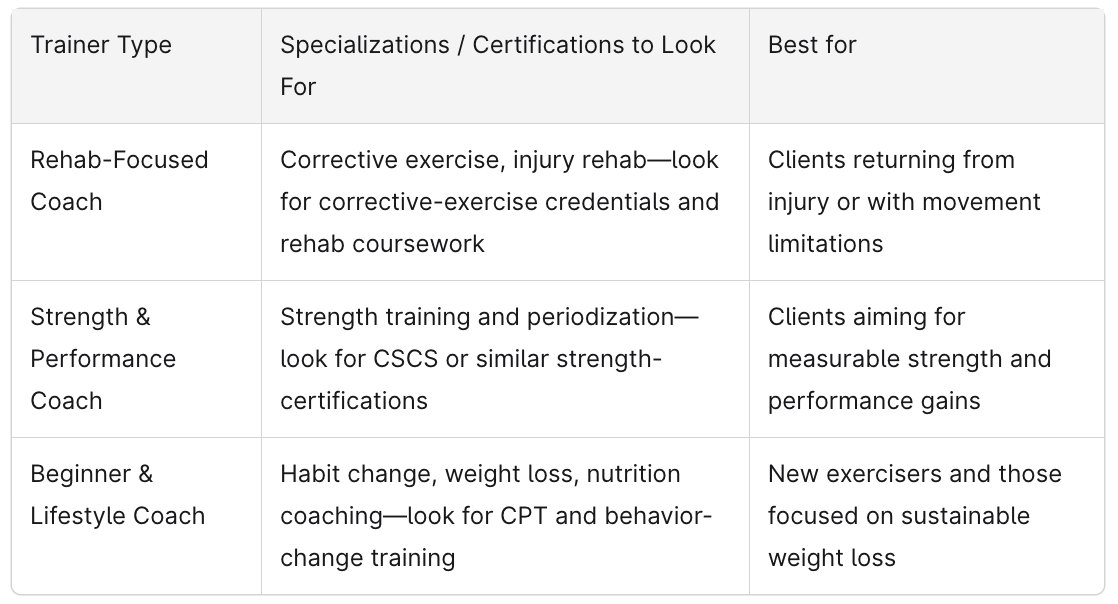
Use these categories to match coach strengths to your needs. For full bios and to confirm qualifications, review the trainers page and schedule a consultation to meet coaches in person.
What Specializations and Certifications Do Chicago Trainers Hold?
Chicago trainers typically hold a mix of certifications that signal competency—standard CPT credentials for foundational coaching, strength and conditioning certifications for advanced programming, and corrective/rehab credentials for clients with movement limits. Certifications like CSCS, corrective-exercise credentials, and continuing education in rehab or nutrition show that a trainer invests in relevant skills for year-long programming. Expert guidance grounded in exercise science is essential for safe and effective long-term progress, ensuring that training programs are based on proven principles of human movement and physiology. Beyond certificates, ask trainers about their periodization approach, assessment protocols, and how they coordinate with medical professionals when needed. Those answers reveal whether a trainer has the technical and practical methods to support sustained improvement.
How Do Trainers Support Beginners and Clients with Injuries?
Trainers onboard beginners and injured clients with an initial consultation, movement screening, goal-setting, and a tailored early phase focused on technique and safe progression. They provide personalized attention and pain management to support each client's wellness journey. For injured clients, trainers emphasize corrective work, incremental loading, and coordinate with medical providers. Beginners receive habit-based coaching with small goals and gradual intensity increases to build confidence. A motivating environment supports clients throughout their program. Clear onboarding and adaptable programming reduce risk and set realistic milestones, key to sticking with a 12-month plan..
How Do Group Fitness Classes Complement Yearly Personal Trainer Memberships in Chicago?
Group fitness classes add variety, extra conditioning, and community support to a yearly personal training plan without the same cost as private sessions. Small group sessions provide a more personalized experience, often utilizing specialized equipment for targeted exercises, and foster a motivating environment where members support each other. Classes serve as targeted options—HIIT for metabolic conditioning, progressive strength classes for hypertrophy, and mobility or recovery sessions for tissue health. Participating in activities like dance or aerial fitness can make workouts more enjoyable and varied. Including group classes expands your training variety, raises weekly activity, and provides social accountability that boosts adherence. When you add classes, coordinate them with your one-on-one plan so class intensity complements rather than competes with scheduled strength or recovery days.
Outdoor fitness courses in Chicago, such as Lincoln Park Fitness Course and Burnham Fitness Course, provide equipment for exercising outdoors. Additionally, many parks—including Millennium Park—offer free fitness classes like yoga, Pilates, and boot camps during the summer, contributing to a motivating environment and supportive community.
Use this table to see which class types best supplement an annual plan and how to balance weekly training and recovery.
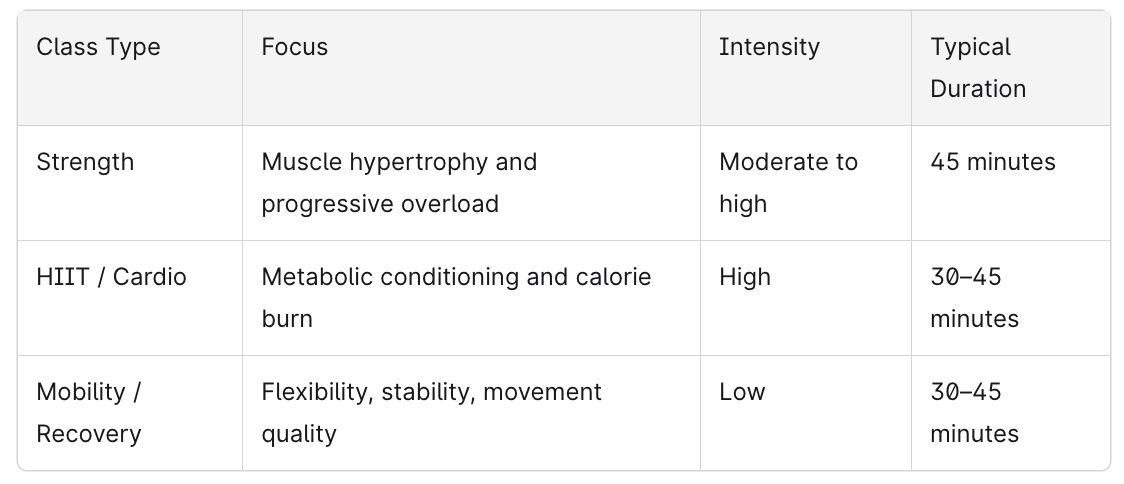
This matrix shows how different class formats fill training gaps—strength classes for overload, HIIT for conditioning, and mobility for longevity. Pair classes with one-on-one sessions to build balanced weekly cycles.
What Types of Group Classes Are Included or Available?
Common group offerings that complement yearly training include structured strength sessions, interval conditioning classes, mobility and corrective movement sessions, and low-intensity recovery formats. These classes use specialized equipment and exercises tailored to all fitness levels for effective progression. Strength classes focus on progressive loading and technique to build strength; HIIT classes target calorie burn and endurance, as emphasized in programs like Chicago Fitness Plus for seniors. Mobility classes improve joint range and support lifting. For example, Galter Life Center offers over 100 weekly group fitness classes, and SALT Fitness provides energizing strength-focused classes. A typical week might include two strength sessions (one private, one group), one HIIT or conditioning class, and one mobility session, balancing personalized coaching with group energy and affordability.
How Do Group Classes Enhance Community and Motivation?
Group classes build social routines—regular meeting times, shared goals, and friendly competition—that increase accountability and make training more consistent over a year. Small group sessions contribute to a motivating environment by offering tailored workouts and fostering a supportive community where members connect and encourage each other. Community features like paired drills, challenges, and milestone recognition provide external motivation when individual drive dips. The SALT community, for example, is filled with strong, vibrant individuals who share inspiring stories and support each other in their fitness journeys. Research shows social belonging and scheduled group interactions improve long-term exercise adherence compared to isolated workouts. Providers with inclusive, supportive class cultures see better member retention and satisfaction, enhancing the value of yearly personal trainer memberships.
What Success Stories and Testimonials Highlight the Value of Yearly Memberships?
Social proof for yearly memberships highlights measurable improvements—weight loss, strength gains, better mobility, and successful injury recovery—documented over 12 months. Case examples show baseline, approach, and outcomes. Optimal results come from expert guidance and a personalized approach, ensuring members get the support they need throughout their fitness journey.
Testimonials highlighting coaching support, community, and accountability set clear expectations for long-term success. TRAIN Moment offers full-body training in 4-week blocks for progress tracking, while Discover Strength provides efficient 30-minute strength sessions twice weekly. These programs demonstrate how expert guidance and tailored plans support every stage of your fitness journey. These approaches highlight how expert guidance and tailored programs support clients at every stage of their fitness and wellness journey. Multimedia elements like short progress videos or benchmark charts add credibility when available.
Which Client Experiences Showcase Measurable Fitness Improvements?
Short case studies that list baseline metrics, the trainer’s approach, and specific 12-month outcomes—like steady strength increases, improved function, or sustainable fat loss—show the value of annual commitments. Building strength and endurance are key outcomes of a comprehensive approach to fitness, ensuring clients achieve balanced, long-term results. Typical stories describe an initial assessment, an individualized program that balances progressive overload with nutrition check-ins, and measurable gains at 3-, 6-, and 12-month reassessments. Metrics-based storytelling helps set realistic fitness goals for new members. When you evaluate providers, look for quantifiable outcomes and evidence that progress is tracked and communicated routinely.
SALT Fitness, for example, focuses on core techniques and exercises that help participants feel stronger and more energized, supporting their fitness goals through a comprehensive approach.
How Do Community Testimonials Reflect Supportive Training Environments?
Community testimonials often highlight encouragement, accountability, and inclusion—showing how a supportive culture keeps members engaged over a year or more. Many clients specifically mention that small group sessions help create a motivating environment and a strong sense of community, making it easier to stay committed and connected. Testimonials that mention group challenges, peer support, and coach responsiveness point to a program that prioritizes retention and long-term success. Those cultural cues—motivation, belonging, and practical support during setbacks—can be as important as technical certifications when choosing a program. Look for recurring themes in testimonials that match what you value.
What Are the Common Questions About Booking and Using Yearly Personal Trainer Memberships?
Common practical questions cover how to book consultations, what to expect at the first session, scheduling norms, medical eligibility, and contract details like cancellations and freezes. Clear answers help interested people move from browsing to action: know the booking steps, required intake information, assessment priorities, and scheduling rules that affect attendance. Providers who publish transparent booking flows and policy summaries make joining a year-long plan easier and more predictable.
If you’re ready to elevate your fitness in Chicago, join and experience the benefits of a personalized approach and expert guidance from certified trainers who tailor your program to your needs. For example, TRAIN Moment offers a 2 Week Unlimited Trial for new clients to try their fitness classes and see what works best for them.
Below are the typical steps and policy points to check before you commit.
How Can I Book a Consultation and Start My Membership?
Booking a consultation and starting a yearly membership usually follows a simple process: pick a package type, request an initial consultation, complete a pre-consult intake form, and schedule your first assessment and training session. Expect the consultation to cover goals, a movement screen or brief fitness test, and a proposed plan with session frequency and reassessment timing. The initial consultation is designed to provide a personalized approach and expert guidance tailored to each client's needs. Ask about trial sessions, freeze and reschedule policies, and whether virtual check-ins are included. Review staff bios and program details first to match specializations to your needs, then request a consultation to confirm fit.
Here’s a quick booking checklist you can follow:
- Choose the membership architecture that suits your goals (weekly coaching, standard annual, hybrid).
- Review trainer profiles to identify coaches with relevant specializations.
- Request a consultation and complete any pre-visit intake questionnaire.
- Schedule your initial assessment and plan the first month of sessions.
Following these steps reduces onboarding friction and ensures the first training phase is tailored to your baseline and objectives.
What Should I Know About Scheduling and Membership Eligibility?
Scheduling rules include rescheduling windows, no-show policies, and membership freeze options that vary by provider. Eligibility often requires medical clearance for injuries or chronic conditions. Personalized programs accommodate different fitness levels and needs for safe participation. Review policies on freezes, cancellations, make-up sessions, and session rollovers before signing to protect your investment and ensure flexibility.
When comparing providers, clear policy language and simple booking procedures are strong signs of a client-centered program that supports year-long adherence.
Frequently Asked Questions
What should I consider when choosing a personal trainer in Chicago?
Look at qualifications, experience, and specialization. Seek trainers with recognized certifications (CPT, CSCS, or corrective-exercise credentials) and coaching styles that match your goals—weight loss, strength, or rehab. A personalized approach and expert guidance from a dedicated team are key factors to consider, ensuring your fitness plan is tailored to your needs and supported by knowledgeable professionals. Read client testimonials and trainer bios to get a sense of fit and real-world results.
How often should I expect to meet with my personal trainer?
Frequency depends on your fitness goals and package. Many clients train once a week; others do two to three weekly workout sessions. The frequency and structure of these workout sessions, along with the selection of exercises, are tailored by our trainers to help you reach your specific fitness goals efficiently. Packages often add group classes or virtual check-ins for extra support. Discuss your schedule and goals with a trainer to set a sustainable meeting cadence.
Can I switch trainers if I feel I need a different approach?
Yes—most facilities allow trainer changes. Talk with management or your coach about your concerns so they can help facilitate a smooth transition. Switching trainers can provide a fresh personalized approach, allowing you to benefit from the expertise of a diverse team of certified professionals. A new perspective can reignite progress; just share your goals and past programming with the new trainer to keep momentum.
What types of assessments can I expect during my training?
Expect baseline assessments like movement screens, body-composition checks, strength tests, and flexibility evaluations, which may utilize specialized equipment for more accurate results. These assessments are part of our comprehensive approach to tracking progress, ensuring that your program integrates strength, conditioning, and mobility for balanced, sustainable results. Reassessments usually happen every three to six months to track progress and adjust the program as needed.
Are there any specific health requirements to start a personal training program?
Most people can begin training, but those with pre-existing conditions or injuries may need medical clearance. Trainers perform initial screens to identify limitations and tailor programs using a personalized approach, ensuring individualized attention for each client. For clients with injuries or chronic conditions, trainers incorporate pain management strategies and modify exercises to support recovery and comfort. If you have concerns, consult your healthcare provider and inform your trainer so your plan is safe and effective.
How do I maintain motivation throughout my yearly membership?
Keep motivation by setting clear, achievable goals and tracking progress regularly. A motivating environment and supportive community, like the one at Fit Results, can help you stay committed. Participating in small group sessions and group classes adds accountability and social support. Work with your trainer to change programming as you improve, and celebrate milestones to sustain momentum.
What happens if I need to pause my membership due to unforeseen circumstances?
Many facilities offer flexible freeze policies that let you suspend membership for a set period without losing progress. Review the specific freeze and cancellation terms before signing and talk to your trainer or management to arrange a smooth pause and return.
Conclusion
A yearly personal trainer membership in Chicago delivers structured progression, consistent accountability, and stronger value through bundled services. This long-term approach supports sustainable fitness improvements and builds a supportive community that helps you stay on track. Choose the package that aligns with your goals and budget, and take the first step toward lasting results by exploring membership options today.
Elevate Your Fitness in Chicago
What Are the Benefits of Yearly Personal Trainer Memberships in Chicago?
A yearly personal trainer membership in Chicago provides consistent coaching, periodized programming, and scheduled assessments over 12 months. Many gyms use a comprehensive approach combining strength, conditioning, and mobility. Trainers offer expert guidance and access to specialized equipment for optimal results. Annual plans allow progress tracking at 3-, 6-, and 12-month milestones, improving adherence and building lasting habits. They often reduce cost-per-session and include extras like nutrition check-ins and group-class access. The longer timeline supports safer progression for injury recovery and allows recovery-aware adjustments not possible with pay-as-you-go training. These strengths make yearly plans a smart choice for anyone serious about long-term weight loss, strength development, or rehab outcomes in the Chicago market.
This list highlights the core advantages you should expect from an annual plan:
- Consistent progression: Periodized programs and planned reassessments keep progress measurable and targeted.
- Better value per session: Bundled or prepaid models typically lower the average cost and add useful services.
- Safer, personalized pacing: A year-long plan allows rehab-aware progression and reduces injury risk.
Next, we’ll look at the mechanisms—both physiological and behavioral—behind why long-term programming produces lasting results.
How Do Long-Term Memberships Enhance Fitness Results?
Long-term memberships improve results by enabling progressive overload, scheduled recovery, and habit changes over time. Chicago trainers base programs on exercise science for safe, effective progress. Over 12 months, trainers cycle strength phases, hypertrophy blocks, and deload weeks to avoid plateaus and overuse. Building strength and a solid foundation supports health and empowerment. Regular coaching creates routine and accountability, turning effort into consistent practice. Functional training and endurance are key, as seen in Chicago Strength In Motion’s functional resistance training and Chicago Fitness Plus’s focus on endurance, strength, balance, and flexibility for seniors. Clinical reassessments at 3 and 6 months fine-tune programs and reduce setbacks. This approach explains why annual plans yield larger, sustainable improvements than short-term packages.
Why Choose Personalized Training for Weight Loss and Injury Rehabilitation?
Personalized training speeds weight loss and rehab progress by customizing exercise selection, intensity, and progression to your body, limitations, and goals. Trainers provide tailored care and ongoing adjustments to support your wellness journey. For weight loss, they combine resistance work, metabolic conditioning, and nutrition checkpoints to preserve lean mass and cut fat, adjusting calories and workload based on reassessments.For rehabilitation, trainers use corrective strategies, range-of-motion progressions, and careful load management, working with healthcare providers when needed to keep you safe. Pain management is a key component of rehabilitation, with some centers like Galter Life Center providing massage therapy and clinical approaches to pain relief and injury rehabilitation. Initial movement screens, pain mapping, and clear goal-setting create a baseline for a tailored 12-month plan, and ongoing tweaks keep the plan responsive as you improve. Personalized coaching reduces risk and shortens the path to measurable outcomes by addressing movement compensations that generic programs miss.
Which Yearly Personal Trainer Packages Offer the Best Value in Chicago?
To evaluate yearly personal trainer packages in Chicago, compare duration, session frequency, included services, and effective cost-per-session. High-value packages include progress assessments, group-class access, nutrition check-ins, and flexible rescheduling. Many offer small group sessions for a more personalized and supportive experience than traditional classes.Comprehensive services may be available, such as low back therapy (as provided by Discover Strength) and body composition testing, to address a wide range of fitness needs. Amenities like towel service are sometimes included in higher-tier packages for added convenience. When comparing options, calculate the amortized session cost (total fee divided by expected sessions) and consider inclusions like small-group training and reassessments that boost effectiveness. Check trial policies and freeze or cancellation terms to ensure commitments remain flexible. Use these factors to choose the package that best supports steady strength gains, weight loss, or rehab progress with a personalized approach.
This table compares three common yearly package structures—Weekly Coaching, Standard Annual, and Hybrid Annual—across duration, session frequency, core inclusions, and pricing notes so you can identify which model fits your goals and schedule.
Ultimately, the best value depends on how many one-on-one sessions you need, whether group classes or small group sessions provide meaningful support, and if virtual touchpoints are enough for your progress. For exact package details and current availability, check providers’ membership pages or contact their teams for a consultation.
What Are the Pricing Options and Membership Durations Available?
Common pricing structures include prepaid annual plans, monthly autopay tied to a 12-month commitment, and session-pack amortization that spreads a set number of sessions across the year. Prepaid annual plans usually give the lowest cost-per-session, while monthly autopay smooths cash flow. Session packs offer flexibility but can cost more per session if not part of a long-term agreement. To judge value, estimate your expected attendance, factor in add-ons like nutrition coaching and group classes, and ask how reassessments are scheduled. Small group sessions can offer a more personalized approach than traditional group classes, providing tailored workouts and a supportive environment, often at a lower cost per session. If you’re budget-conscious, prioritize packages that include periodic progress reviews and small-group options to supplement one-on-one coaching without doubling costs.
Are There Discounts or Flexible Terms for Long-Term Memberships?
Discounts and flexible terms are often negotiable and can include early-signup incentives, referral credits, or bundled family/corporate rates that lower your effective cost. Many providers offer hardship policies such as temporary freezes or prorated transfers for life interruptions, and some let you switch program tiers mid-term. When evaluating offers, request written details on freeze windows, cancellation policies, and whether unused sessions roll over or expire. Ask about trial sessions or short introductory periods before you commit to a full year—transparent providers will explain options clearly so you can decide with confidence. Clear contract terms protect your investment and preserve the long-term coach–client relationship that drives results.
Who Are the Expert Personal Trainers Behind Chicago’s Top Yearly Memberships?
Top yearly personal trainer memberships in Chicago are staffed by a team of certified trainers who provide expert guidance grounded in exercise science. These professionals combine relevant specializations, recognized certifications, and a client-centered coaching style to support goals like weight loss, strength, and injury rehab. Don’t rely on job titles alone—evaluate trainers by their certifications, the modalities they use, and how they structure long-term progression and recovery. Many quality programs publish trainer bios so you can review experience and coaching philosophy before booking. For detailed profiles and to match specializations to your goals, visit the provider’s trainers page.
A personalized approach and a supportive community—such as the one fostered by TRAIN Moment, where clients and coaches encourage each other without judgment—are key elements of successful long-term memberships.
The table below summarizes common trainer types you’ll find in Chicago gyms and what each typically offers in specialization, certifications to look for, and best client matches.
Use these categories to match coach strengths to your needs. For full bios and to confirm qualifications, review the trainers page and schedule a consultation to meet coaches in person.
What Specializations and Certifications Do Chicago Trainers Hold?
Chicago trainers typically hold a mix of certifications that signal competency—standard CPT credentials for foundational coaching, strength and conditioning certifications for advanced programming, and corrective/rehab credentials for clients with movement limits. Certifications like CSCS, corrective-exercise credentials, and continuing education in rehab or nutrition show that a trainer invests in relevant skills for year-long programming. Expert guidance grounded in exercise science is essential for safe and effective long-term progress, ensuring that training programs are based on proven principles of human movement and physiology. Beyond certificates, ask trainers about their periodization approach, assessment protocols, and how they coordinate with medical professionals when needed. Those answers reveal whether a trainer has the technical and practical methods to support sustained improvement.
How Do Trainers Support Beginners and Clients with Injuries?
Trainers onboard beginners and injured clients with an initial consultation, movement screening, goal-setting, and a tailored early phase focused on technique and safe progression. They provide personalized attention and pain management to support each client's wellness journey. For injured clients, trainers emphasize corrective work, incremental loading, and coordinate with medical providers. Beginners receive habit-based coaching with small goals and gradual intensity increases to build confidence. A motivating environment supports clients throughout their program. Clear onboarding and adaptable programming reduce risk and set realistic milestones, key to sticking with a 12-month plan..
How Do Group Fitness Classes Complement Yearly Personal Trainer Memberships in Chicago?
Group fitness classes add variety, extra conditioning, and community support to a yearly personal training plan without the same cost as private sessions. Small group sessions provide a more personalized experience, often utilizing specialized equipment for targeted exercises, and foster a motivating environment where members support each other. Classes serve as targeted options—HIIT for metabolic conditioning, progressive strength classes for hypertrophy, and mobility or recovery sessions for tissue health. Participating in activities like dance or aerial fitness can make workouts more enjoyable and varied. Including group classes expands your training variety, raises weekly activity, and provides social accountability that boosts adherence. When you add classes, coordinate them with your one-on-one plan so class intensity complements rather than competes with scheduled strength or recovery days.
Outdoor fitness courses in Chicago, such as Lincoln Park Fitness Course and Burnham Fitness Course, provide equipment for exercising outdoors. Additionally, many parks—including Millennium Park—offer free fitness classes like yoga, Pilates, and boot camps during the summer, contributing to a motivating environment and supportive community.
Use this table to see which class types best supplement an annual plan and how to balance weekly training and recovery.
This matrix shows how different class formats fill training gaps—strength classes for overload, HIIT for conditioning, and mobility for longevity. Pair classes with one-on-one sessions to build balanced weekly cycles.
What Types of Group Classes Are Included or Available?
Common group offerings that complement yearly training include structured strength sessions, interval conditioning classes, mobility and corrective movement sessions, and low-intensity recovery formats. These classes use specialized equipment and exercises tailored to all fitness levels for effective progression. Strength classes focus on progressive loading and technique to build strength; HIIT classes target calorie burn and endurance, as emphasized in programs like Chicago Fitness Plus for seniors. Mobility classes improve joint range and support lifting. For example, Galter Life Center offers over 100 weekly group fitness classes, and SALT Fitness provides energizing strength-focused classes. A typical week might include two strength sessions (one private, one group), one HIIT or conditioning class, and one mobility session, balancing personalized coaching with group energy and affordability.
How Do Group Classes Enhance Community and Motivation?
Group classes build social routines—regular meeting times, shared goals, and friendly competition—that increase accountability and make training more consistent over a year. Small group sessions contribute to a motivating environment by offering tailored workouts and fostering a supportive community where members connect and encourage each other. Community features like paired drills, challenges, and milestone recognition provide external motivation when individual drive dips. The SALT community, for example, is filled with strong, vibrant individuals who share inspiring stories and support each other in their fitness journeys. Research shows social belonging and scheduled group interactions improve long-term exercise adherence compared to isolated workouts. Providers with inclusive, supportive class cultures see better member retention and satisfaction, enhancing the value of yearly personal trainer memberships.
What Success Stories and Testimonials Highlight the Value of Yearly Memberships?
Social proof for yearly memberships highlights measurable improvements—weight loss, strength gains, better mobility, and successful injury recovery—documented over 12 months. Case examples show baseline, approach, and outcomes. Optimal results come from expert guidance and a personalized approach, ensuring members get the support they need throughout their fitness journey.
Testimonials highlighting coaching support, community, and accountability set clear expectations for long-term success. TRAIN Moment offers full-body training in 4-week blocks for progress tracking, while Discover Strength provides efficient 30-minute strength sessions twice weekly. These programs demonstrate how expert guidance and tailored plans support every stage of your fitness journey. These approaches highlight how expert guidance and tailored programs support clients at every stage of their fitness and wellness journey. Multimedia elements like short progress videos or benchmark charts add credibility when available.
Which Client Experiences Showcase Measurable Fitness Improvements?
Short case studies that list baseline metrics, the trainer’s approach, and specific 12-month outcomes—like steady strength increases, improved function, or sustainable fat loss—show the value of annual commitments. Building strength and endurance are key outcomes of a comprehensive approach to fitness, ensuring clients achieve balanced, long-term results. Typical stories describe an initial assessment, an individualized program that balances progressive overload with nutrition check-ins, and measurable gains at 3-, 6-, and 12-month reassessments. Metrics-based storytelling helps set realistic fitness goals for new members. When you evaluate providers, look for quantifiable outcomes and evidence that progress is tracked and communicated routinely.
SALT Fitness, for example, focuses on core techniques and exercises that help participants feel stronger and more energized, supporting their fitness goals through a comprehensive approach.
How Do Community Testimonials Reflect Supportive Training Environments?
Community testimonials often highlight encouragement, accountability, and inclusion—showing how a supportive culture keeps members engaged over a year or more. Many clients specifically mention that small group sessions help create a motivating environment and a strong sense of community, making it easier to stay committed and connected. Testimonials that mention group challenges, peer support, and coach responsiveness point to a program that prioritizes retention and long-term success. Those cultural cues—motivation, belonging, and practical support during setbacks—can be as important as technical certifications when choosing a program. Look for recurring themes in testimonials that match what you value.
What Are the Common Questions About Booking and Using Yearly Personal Trainer Memberships?
Common practical questions cover how to book consultations, what to expect at the first session, scheduling norms, medical eligibility, and contract details like cancellations and freezes. Clear answers help interested people move from browsing to action: know the booking steps, required intake information, assessment priorities, and scheduling rules that affect attendance. Providers who publish transparent booking flows and policy summaries make joining a year-long plan easier and more predictable.
If you’re ready to elevate your fitness in Chicago, join and experience the benefits of a personalized approach and expert guidance from certified trainers who tailor your program to your needs. For example, TRAIN Moment offers a 2 Week Unlimited Trial for new clients to try their fitness classes and see what works best for them.
Below are the typical steps and policy points to check before you commit.
How Can I Book a Consultation and Start My Membership?
Booking a consultation and starting a yearly membership usually follows a simple process: pick a package type, request an initial consultation, complete a pre-consult intake form, and schedule your first assessment and training session. Expect the consultation to cover goals, a movement screen or brief fitness test, and a proposed plan with session frequency and reassessment timing. The initial consultation is designed to provide a personalized approach and expert guidance tailored to each client's needs. Ask about trial sessions, freeze and reschedule policies, and whether virtual check-ins are included. Review staff bios and program details first to match specializations to your needs, then request a consultation to confirm fit.
Here’s a quick booking checklist you can follow:
- Choose the membership architecture that suits your goals (weekly coaching, standard annual, hybrid).
- Review trainer profiles to identify coaches with relevant specializations.
- Request a consultation and complete any pre-visit intake questionnaire.
- Schedule your initial assessment and plan the first month of sessions.
Following these steps reduces onboarding friction and ensures the first training phase is tailored to your baseline and objectives.
What Should I Know About Scheduling and Membership Eligibility?
Scheduling rules include rescheduling windows, no-show policies, and membership freeze options that vary by provider. Eligibility often requires medical clearance for injuries or chronic conditions. Personalized programs accommodate different fitness levels and needs for safe participation. Review policies on freezes, cancellations, make-up sessions, and session rollovers before signing to protect your investment and ensure flexibility.
When comparing providers, clear policy language and simple booking procedures are strong signs of a client-centered program that supports year-long adherence.
Frequently Asked Questions
What should I consider when choosing a personal trainer in Chicago?
Look at qualifications, experience, and specialization. Seek trainers with recognized certifications (CPT, CSCS, or corrective-exercise credentials) and coaching styles that match your goals—weight loss, strength, or rehab. A personalized approach and expert guidance from a dedicated team are key factors to consider, ensuring your fitness plan is tailored to your needs and supported by knowledgeable professionals. Read client testimonials and trainer bios to get a sense of fit and real-world results.
How often should I expect to meet with my personal trainer?
Frequency depends on your fitness goals and package. Many clients train once a week; others do two to three weekly workout sessions. The frequency and structure of these workout sessions, along with the selection of exercises, are tailored by our trainers to help you reach your specific fitness goals efficiently. Packages often add group classes or virtual check-ins for extra support. Discuss your schedule and goals with a trainer to set a sustainable meeting cadence.
Can I switch trainers if I feel I need a different approach?
Yes—most facilities allow trainer changes. Talk with management or your coach about your concerns so they can help facilitate a smooth transition. Switching trainers can provide a fresh personalized approach, allowing you to benefit from the expertise of a diverse team of certified professionals. A new perspective can reignite progress; just share your goals and past programming with the new trainer to keep momentum.
What types of assessments can I expect during my training?
Expect baseline assessments like movement screens, body-composition checks, strength tests, and flexibility evaluations, which may utilize specialized equipment for more accurate results. These assessments are part of our comprehensive approach to tracking progress, ensuring that your program integrates strength, conditioning, and mobility for balanced, sustainable results. Reassessments usually happen every three to six months to track progress and adjust the program as needed.
Are there any specific health requirements to start a personal training program?
Most people can begin training, but those with pre-existing conditions or injuries may need medical clearance. Trainers perform initial screens to identify limitations and tailor programs using a personalized approach, ensuring individualized attention for each client. For clients with injuries or chronic conditions, trainers incorporate pain management strategies and modify exercises to support recovery and comfort. If you have concerns, consult your healthcare provider and inform your trainer so your plan is safe and effective.
How do I maintain motivation throughout my yearly membership?
Keep motivation by setting clear, achievable goals and tracking progress regularly. A motivating environment and supportive community, like the one at Fit Results, can help you stay committed. Participating in small group sessions and group classes adds accountability and social support. Work with your trainer to change programming as you improve, and celebrate milestones to sustain momentum.
What happens if I need to pause my membership due to unforeseen circumstances?
Many facilities offer flexible freeze policies that let you suspend membership for a set period without losing progress. Review the specific freeze and cancellation terms before signing and talk to your trainer or management to arrange a smooth pause and return.
Conclusion
A yearly personal trainer membership in Chicago delivers structured progression, consistent accountability, and stronger value through bundled services. This long-term approach supports sustainable fitness improvements and builds a supportive community that helps you stay on track. Choose the package that aligns with your goals and budget, and take the first step toward lasting results by exploring membership options today.
.png)