Fit Results vs Competitors: Chicago Personal Training Value Guide

In a city fueled by competitive energy, competition can be a powerful motivator in fitness, pushing individuals to achieve more than they thought possible. This competitive drive is deeply rooted in the same spirit found in sports, where both competition and community are fostered. In fitness, competition can unlock something deep within us, motivating us to push beyond our limits, but it’s important to balance this drive to avoid negative consequences. Individuals are often motivated to push themselves further when surrounded by a supportive community. Community-driven fitness efforts not only help individuals but also contribute to the collective well-being of society, promoting healthier, more connected neighborhoods. Cooperative tasks in fitness apps can also reduce users' fears of embarrassment and promote higher self-esteem.
A hands-on look at what your fitness budget actually buys in Chicago—comparing Fit Results’ services, pricing transparency, and real-world value against typical local options. This guide breaks down the main cost drivers in the Chicago market, outlines usual price bands for one-on-one, semi-private, and group formats, and points out the services that boost long-term return (think nutrition support and accountability). You’ll see how Fit Results runs one-on-one and semi-private training, what the Second Chance Program brings to results, and how classes like Triple 20, Groundworks, and FitCamp give efficient, measurable improvements. We’ll also include a practical checklist for choosing a trainer or studio, a side-by-side comparison of Fit Results versus common competitors, and where to find clear pricing and client success stories. Throughout, we’ll call out what matters most for South Loop and clients while keeping the focus on cost versus value.
What Influences Personal Training Costs in Chicago?
Several predictable factors drive personal training prices in Chicago, each affecting the value you get. Location and rent influence base rates: downtown and high-demand areas have higher overhead and session prices. Trainer experience and certifications impact cost; more experienced coaches charge more but offer safer, tailored programming. Training format matters: one-on-one, semi-private, and group sessions differ in per-person cost due to trainer time division. Session length, frequency, and bundled services like nutrition coaching and accountability check-ins add value and usually come in packages. Understanding these factors helps you compare true value and decide which trade-offs—cost, convenience, or attention—matter most.
How do location and training style affect pricing?
Location affects baseline pricing because studios in higher-rent areas have higher overhead, increasing hourly rates. Neighborhood gyms typically charge less but offer fewer amenities. Facility quality—equipment, locker rooms, specialized spaces—also impacts price and experience. Training style influences per-person cost: one-on-one offers full personalization and injury modifications, costing more; semi-private lowers cost while maintaining some personalization; group classes are cheapest but less tailored.Picking between a convenient nearby spot and a higher-priced boutique depends on your priorities—intensity of coaching, schedule flexibility, and access to extra services. Those trade-offs lead into the typical Chicago price ranges and what you should expect at each service tier.
What are typical price ranges for personal training in Chicago?
Chicago rates range from budget-friendly to premium boutique, with tier differences mainly in included services rather than time. Entry-level trainers and group formats offer the lowest per-person cost due to scalability. Mid-range studios provide experienced coaches with package discounts and some nutrition or accountability support. Premium boutiques and highly credentialed trainers include detailed programming, progress tracking, and flexible scheduling. Understanding these ranges helps evaluate whether higher rates deliver valuable extras like nutrition planning and follow-up systems that improve results over time.
- Common cost drivers include location, trainer experience, format, session length, and bundled services.
- Per-person cost generally falls from one-on-one to semi-private to group formats.
- Package pricing and memberships typically reduce the effective per-session price and encourage consistency.
How Does Fit Results Personal Training Pricing Compare?
To evaluate Fit Results, look at what each offering includes and compare that to Chicago norms for value. Fit Results offers one-on-one and semi-private personal training focused on personalized programming, injury-aware modifications, flexible scheduling, and progress tracking—features that reduce risk and improve adherence versus generic sessions. We start with a complimentary consultation to place you properly and avoid ineffective starts. Fit Results also pairs training with the Second Chance Program, which layers structured accountability and nutrition guidance to boost outcomes and return on investment. The training software we use can be merged with other third party apps. For example: Fitbit prioritizes affordability, simplicity, and superior battery life, making it ideal for casual users interested in daily wellness and sleep tracking. Samsung Galaxy Watch delivers a competitive blend of smartwatch capabilities, fitness tracking, and a vibrant display for Android users. Fitbit devices are primarily user-friendly fitness trackers with excellent battery life and in-depth sleep analysis. Apple Watch excels in smart features, third-party apps, and advanced medical-grade health monitoring, though it requires daily charging. Fit Results does offer a fullbody Inbody Scan in-house. Other tests like, FIT is highly specific for human blood, meaning it is not affected by diet or medication, unlike gFOBT. Those are tests Fit Results does not offer.
The table below highlights what’s often included at other studios and what Fit Results builds into its packages.
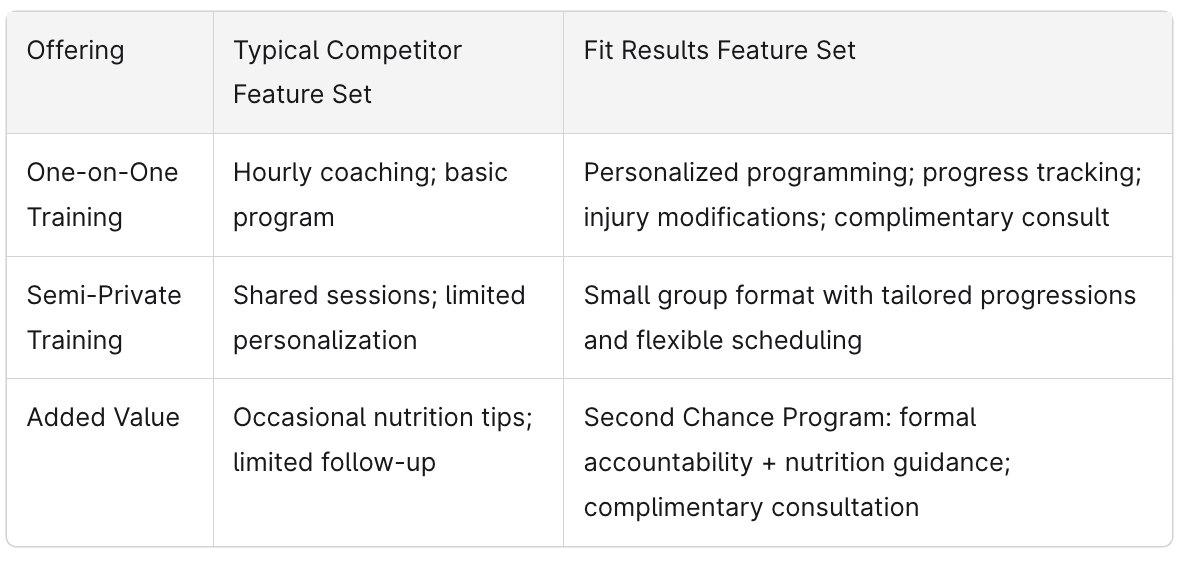
This comparison shows Fit Results prioritizes routine inclusion of nutrition and accountability more often than many competitors. Combining focused personal training with the Second Chance Program reduces wasted sessions and speeds measurable progress—so a simple hourly price comparison can miss the bigger picture of total value. The point is to focus on self-improvement and measurable progress, not just price, which is key to long-term success. The truth is that real value in fitness services comes from transparency, alignment with client needs, and a commitment to supporting each member’s unique journey.
Fit Results’ approach aligns with proven business models in the fitness industry, where building a strong community and validated demand leads to higher stable path for scaling client goals. A product with a clearer competitive edge and a strong value proposition, allowing for efficient resource use and validated demand. By structuring its offerings around member engagement and results, Fit Results supports both client success and long-term community feel.
What is included in Fit Results one-on-one and semi-private training?
Both formats at Fit Results center on individual progress while staying flexible and safe for a wide range of clients. One-on-one training delivers tailored programming, regular progress checks, movement adjustments for common injuries, and scheduling that fits busy Chicago lives. Participants benefit from personalized approaches that ensure fair competition and progress measurement by focusing on individual goals, especially in structured fitness competitions or collaborative activities. Personalized fitness competitions can be structured to ensure fairness for all participants by focusing on individual goals rather than a one-size-fits-all approach. Clients are not just competing against others, but also competing against their own previous results, which motivates continual improvement. Semi-private sessions keep the programming intent but spread trainer attention across a small cohort—lowering per-person cost while preserving technique coaching and progression oversight. In both formats, certified trainers offer accountability and clear next steps so you move faster toward your goals. Comparing packages this way helps you weigh total value rather than just hourly cost.
How does the Second Chance Program add value to personal training?
The Second Chance Program complements personal training with structured accountability and nutrition guidance—the difference between sporadic effort and consistent progress. By formalizing check-ins, habit targets, and nutrition coaching, the program helps clients stay consistent between sessions and break through plateaus. That consistency drives measurable gains in strength and body composition, increasing the return on each training dollar. For many clients, Second Chance means faster results and fewer wasted sessions compared with providers who offer only informal follow-up.
What Are the Benefits of Fit Results Group Fitness Classes?
Fit Results group classes deliver efficient training, steady coaching, and built-in accountability that supports results. Progress is achieved bit by bit, with each session building on small, consistent improvements that add up over time. Classes like Triple 20, Groundworks, and FitCamp are tailored to different goals—some targeting metabolic conditioning, others strength and movement fundamentals—and all feature coach-led instruction and small class sizes to keep quality high. Our coaches acknowledge participants' efforts and achievements, fostering motivation and a positive environment. The social environment encourages attendance and accountability; that peer momentum often helps people stick with a plan longer by putting the focus on personal progress rather than comparison with others. Group classes are a smart choice if you want predictable schedules, varied programming, and a lower per-session cost without sacrificing expert coaching.
How do Triple 20, Groundworks, and FitCamp classes differ?
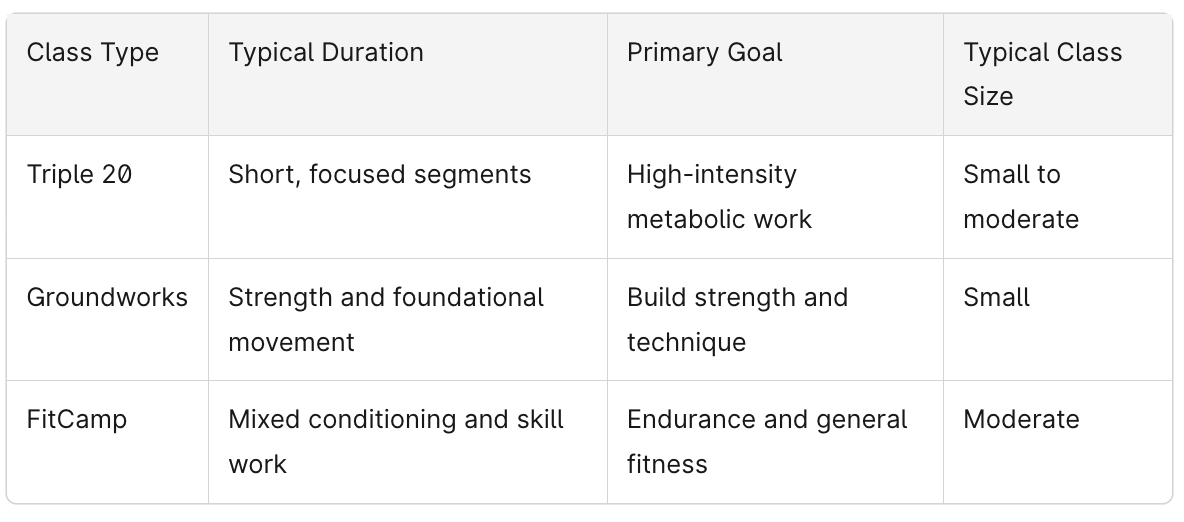
Triple 20 splits sessions into three focused 20-minute blocks that mix intensity and variety for efficient calorie burn and metabolic stimulus. Groundworks focuses on strength fundamentals and controlled technique, with an emphasis on tracking reps to measure progress and develop proper form, helping beginners and those rehabbing movement patterns build sustainable progress with lower injury risk. FitCamp blends conditioning, intervals, and cardio as a key component, along with skill work to boost cardiovascular fitness and muscular endurance. Each class serves different goals and fitness levels, so you can mix them across a week for balanced progress. Pick classes based on your priority—fat loss, strength, or endurance—to get the best value.
How does Fit Results foster community in group fitness?
We build community through small class sizes, active coach interaction, onboarding that puts members in the right classes, and periodic challenges that create cohort-based accountability. Coaches encourage peer support and track progress in visible ways so wins are celebrated and motivation stays high. Feedback from both coaches and peers plays a crucial role in supporting progress, enhancing motivation, and fostering a sense of belonging. Talking about progress and results within the community—whether in classes, during check-ins, or through informal conversations—can further boost motivation and help members stay engaged with their fitness journey. Member check-ins and goal-setting turn occasional attendance into routine participation. Research has shown that social support significantly improves exercise adherence and outcomes. That social structure lowers dropout rates and improves long-term results—meaning group-class members often get more value per dollar than they would from solo, unstructured workouts.
- Key community features at Fit Results include onboarding, small class sizes, coach-led progress checks, cohort challenges, and regular feedback.
- Community elements boost accountability, which typically improves attendance and outcomes.
- Members who engage socially with classes frequently see faster adherence and better long-term results.
How Does Fit Results Stand Out Among Chicago Competitors?
Fit Results stands apart by combining structured programs, a community focus, and support services that add measurable value beyond a single training hour. Two clear differentiators are the Second Chance Program—which bundles accountability and nutrition guidance—and the complimentary consultation that helps place clients in the right program from day one. Our trainers are certified and skilled in safe progressions and injury-aware modifications, which creates a safer, more effective environment for beginners and clients returning from setbacks. Fit Results is actively creating a supportive gym culture that prioritizes individual health goals over competitive pressures, ensuring every member feels valued and empowered. Here, winning is defined by personal progress and self-improvement, not just by outperforming others. In personalized fitness competitions, the parameters for winning can be defined by individual progress rather than absolute performance metrics, promoting a healthier and more inclusive competitive environment. These features align with best practices for lasting results and are worth comparing to cheaper, purely price-driven options when judging total value.
What unique services and support does Fit Results offer?
Fit Results includes services that many competitors leave as add-ons: a formal Second Chance Program for accountability and nutrition, a complimentary consultation to confirm program fit, and flexible scheduling across two Chicago locations in South Loop and Logan Square. These elements remove common friction—uncertain program fit, missing nutrition support, and scheduling conflicts—that often cause people to quit. By focusing on the user experience and achieving strong product-market fit, Fit Results delivers higher customer satisfaction, which promotes greater retention and advocacy. Compared with studios that sell hourly sessions without structured follow-up, Fit Results integrates coaching and support to improve outcomes and lower long-term cost by boosting adherence and accelerating progress.
How do Fit Results trainers’ expertise and certifications compare?
Fit Results presents trainers as expert and certified professionals who adapt programming for beginners and clients with injuries, which influences safety and effectiveness directly. Trainers at Fit Results also help clients maintain control during workouts, ensuring proper form, discipline, and self-regulation for better results and reduced risk of injury. Certified trainers who can assess movement and apply progressive programming reduce injury risk and deliver more efficient, targeted sessions that lead to measurable gains. That means fewer stalled workouts and clearer progress—an important cost saver over months. In today's fitness industry, current market leaders are leveraging AI-driven personalization to improve user retention by 50% over static programs, highlighting the value of tailored approaches. We recommend verifying credentials during the complimentary consultation to confirm trainer fit and program appropriateness before purchasing packages.
What Should You Look for When Choosing a Chicago Personal Trainer?
Choosing a trainer or studio in Chicago comes down to balancing certifications, personalization, trial options, transparent pricing, and community fit. Certifications and relevant experience show a trainer can create safe, effective programs for your specific goals or injury history. Personalized programming and integrated nutrition/accountability systems produce better outcomes than one-size-fits-all approaches. Transparent pricing and a complimentary consultation reduce uncertainty so you can compare real value rather than headline rates. And community and schedule fit determine whether you’ll stay consistent—consistency is the biggest predictor of results. For new members, onboarding should include guidance on focusing on self-comparison and personal progress, as this is more beneficial than comparing oneself to others in a fitness environment.
- Certifications and experience: Confirm trainers hold relevant credentials and practical experience for your goals.
- Personalized programs: Choose trainers who write individualized plans and reassess progress regularly. For instance, ask to see a sample week of programming or request an example of how the trainer would modify a workout for someone returning from injury.
- Transparent pricing and trials: Favor studios that clearly list inclusions and offer a consultation or trial to test fit.
Why are certifications and personalized plans important?
Certifications show a trainer has met industry standards for programming, movement assessment, and client safety—reducing injury risk and improving effectiveness. Personalized plans make sure sessions target your limitations, schedule, and goals rather than a generic template that can stall progress. It’s important that these plans make sense for your individual goals and circumstances, ensuring every exercise or challenge has a clear purpose for your health and fitness journey. For people with prior injuries or beginners, tailored regressions and progressions are essential for safe improvement. Instead of comparing your progress to others, focus on self-comparison as a healthier way to track your own growth and achievements. Ask for credential verification and a sample plan during a consultation to ensure the trainer’s approach aligns with your needs.
How does Fit Results address beginners and injury recovery?
Fit Results supports beginners and those recovering from injuries with careful onboarding: a complimentary consultation, movement assessment, and customized programming with built-in modifications. Fit Results helps clients begin their fitness journey by setting personalized goals tailored to their unique needs and starting points. Trainers emphasize technique, measured progression, and clear milestones to rebuild capacity while avoiding setbacks. In personalized fitness competitions, participants can set their own goals—such as aiming to lose weight or body fat, increase the amount they can lift as a measure of strength improvement, or achieve endurance targets—to accommodate individual circumstances. Progress is tracked using percentage changes, such as the percentage of weight lost or percentage increase in one-rep max strength, to clearly measure improvements. This structured approach builds confidence and steady gains. Clients are placed into one-on-one, semi-private, or appropriate group classes so early sessions match ability and goals.
Where Can You Find Transparent Pricing and Client Success Stories?
Clear pricing and accessible success stories make comparing training options in Chicago much easier. Transparent pricing spells out what’s included—session length, number of sessions per package, and whether nutrition or accountability is part of the offer—so you can compare apples to apples. Fit Results publishes details on offerings and emphasizes a complimentary consultation to set expectations before clients buy packages. Client stories typically highlight improved consistency, measurable strength or body-composition changes, and supportive coaches—proof points that back up the value claim. Clients are also encouraged to post updates, photos, or progress in group settings, such as online communities or social media, as part of tracking their journey. Tracking progress in personalized fitness competitions can involve taking before and after pictures, using fitness trackers, or posting updates in a group.
How does Fit Results’ pricing transparency benefit clients?
Clear pricing helps clients compare packages on a like-for-like basis by showing what’s included—training minutes, program updates, nutrition guidance, and whether the Second Chance Program is bundled. Knowing the inclusions reduces buyer friction and helps you budget realistically, avoiding the hidden costs that erode trust at many boutiques. With explicit pricing you can estimate effective per-session cost and choose the model (one-on-one, semi-private, group) that matches your budget and goals. Using a fitness app can also help you track your progress and better understand the value you’re getting for your investment. For example, Fitbit prioritizes affordability, simplicity, and superior battery life for casual users focused on daily wellness, while Garmin offers highly accurate GPS, physical buttons, and long battery life for serious athletes and outdoor enthusiasts. A short consultation further confirms fit before you commit.
What do client testimonials reveal about Fit Results’ value?
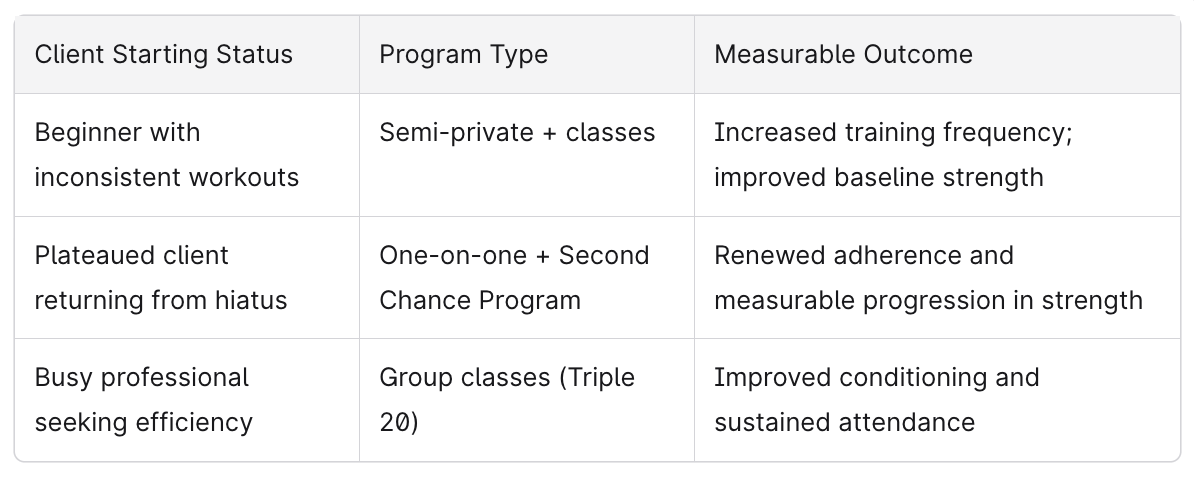
Client stories emphasize consistent coaching, community support, and measurable progress—three pillars that line up with Fit Results’ services. Interesting testimonials often highlight the benefits of cooperative approaches, where community-building and human connection make the fitness experience more compelling than traditional equipment-focused workouts. Research also shows that cooperative fitness apps are better for continuously engaging users and increasing life satisfaction. Testimonials often mention improved adherence, better movement quality, and meaningful results achieved through combined training and accountability, supporting the idea that structured follow-up and nutrition guidance boost ROI. Those themes show why hourly rates alone don’t tell the full story; the systems and supports around training drive real progress.
- Transparent pricing and documented client outcomes make it easier to forecast value.
- Look for testimonials that reference adherence, coach support, and measurable progress.
- Use a complimentary consultation to confirm program fit before committing financially.
Frequently Asked Questions
What should I consider when choosing a personal trainer in Chicago?
Look at certifications, relevant experience, and specialization. Consider all aspects of trainer selection, such as their experience, specific areas of expertise, and how well they fit within the gym's community culture. Choose trainers who have a track record helping clients with similar goals. Evaluate their approach to individualized programming—tailored plans dramatically improve outcomes. Also favor transparent pricing and availability of trial sessions or consultations so you can test the fit before making a financial commitment.
How can I maximize the value of my personal training sessions?
Make consistency and clear communication your priorities. Set realistic, measurable goals and review progress regularly. Add services like nutrition guidance or accountability check-ins when possible, and consider semi-private or group options for cost-effective coaching. Be proactive about challenges so your trainer can adjust your plan for steady progress.
What are the benefits of group fitness classes compared to personal training?
Group classes are lower cost per session and offer community-driven motivation. Unlike the more solitary experience of working out alone in a traditional gym, group classes at Fit Results foster a sense of belonging and social engagement, making fitness more enjoyable and motivating. They deliver structured workouts led by experienced coaches, which helps with accountability and regular attendance. Classes often focus on specific goals—strength, conditioning, or endurance—so you can pick sessions that match your objectives. The social element makes it easier to build a habit and stick with a routine long-term.
How does Fit Results ensure safety during training sessions?
Safety starts with certified trainers who perform movement assessments and design programs that respect injuries and limitations. Mastering the basics of movement and technique is essential for safety during training, as it helps prevent injuries and builds a strong foundation for progress. Initial consultations evaluate fitness level and any existing issues so trainers can create appropriate, progressive plans. Regular technique cues and progress checks keep sessions safe and effective, which is important for beginners and people returning from injury.
What role does nutrition play in personal training success?
Nutrition strongly affects energy, recovery, and results. Eating habits and nutrition choices play a crucial role in training success, as understanding what and how you eat directly impacts your progress. A sensible approach to food supports muscle growth, fat loss, and improved performance—making your training time more effective. Fit Results integrates nutrition guidance within programming to help clients make sustainable choices that align with their goals, which increases the overall return on training investment.
How can I track my progress effectively during personal training?
Set specific, measurable goals and record progress regularly. Use apps, training logs, or progress photos to track strength, endurance, and body-composition changes. Tracking progress through methods like pre- and post-testing, such as one-rep max increases or step counts, is essential to stay motivated and on track. Share updates with your trainer and request periodic assessments so your plan evolves with your results. Regular check-ins keep you motivated and ensure you’re on track to meet your objectives.
Conclusion
Spending on personal training in Chicago can deliver strong returns when you focus on tailored programming, accountability, and community support. Services like the Second Chance Program and clear pricing make it easier to get consistent results and real value. Ready to see which option fits you? Schedule a complimentary consultation with Fit Results and let our trainers show you a practical path to maximize your investment and reach your goals.
Fit Results vs Competitors: Chicago Personal Training Value Guide
In a city fueled by competitive energy, competition can be a powerful motivator in fitness, pushing individuals to achieve more than they thought possible. This competitive drive is deeply rooted in the same spirit found in sports, where both competition and community are fostered. In fitness, competition can unlock something deep within us, motivating us to push beyond our limits, but it’s important to balance this drive to avoid negative consequences. Individuals are often motivated to push themselves further when surrounded by a supportive community. Community-driven fitness efforts not only help individuals but also contribute to the collective well-being of society, promoting healthier, more connected neighborhoods. Cooperative tasks in fitness apps can also reduce users' fears of embarrassment and promote higher self-esteem.
A hands-on look at what your fitness budget actually buys in Chicago—comparing Fit Results’ services, pricing transparency, and real-world value against typical local options. This guide breaks down the main cost drivers in the Chicago market, outlines usual price bands for one-on-one, semi-private, and group formats, and points out the services that boost long-term return (think nutrition support and accountability). You’ll see how Fit Results runs one-on-one and semi-private training, what the Second Chance Program brings to results, and how classes like Triple 20, Groundworks, and FitCamp give efficient, measurable improvements. We’ll also include a practical checklist for choosing a trainer or studio, a side-by-side comparison of Fit Results versus common competitors, and where to find clear pricing and client success stories. Throughout, we’ll call out what matters most for South Loop and clients while keeping the focus on cost versus value.
What Influences Personal Training Costs in Chicago?
Several predictable factors drive personal training prices in Chicago, each affecting the value you get. Location and rent influence base rates: downtown and high-demand areas have higher overhead and session prices. Trainer experience and certifications impact cost; more experienced coaches charge more but offer safer, tailored programming. Training format matters: one-on-one, semi-private, and group sessions differ in per-person cost due to trainer time division. Session length, frequency, and bundled services like nutrition coaching and accountability check-ins add value and usually come in packages. Understanding these factors helps you compare true value and decide which trade-offs—cost, convenience, or attention—matter most.
How do location and training style affect pricing?
Location affects baseline pricing because studios in higher-rent areas have higher overhead, increasing hourly rates. Neighborhood gyms typically charge less but offer fewer amenities. Facility quality—equipment, locker rooms, specialized spaces—also impacts price and experience. Training style influences per-person cost: one-on-one offers full personalization and injury modifications, costing more; semi-private lowers cost while maintaining some personalization; group classes are cheapest but less tailored.Picking between a convenient nearby spot and a higher-priced boutique depends on your priorities—intensity of coaching, schedule flexibility, and access to extra services. Those trade-offs lead into the typical Chicago price ranges and what you should expect at each service tier.
What are typical price ranges for personal training in Chicago?
Chicago rates range from budget-friendly to premium boutique, with tier differences mainly in included services rather than time. Entry-level trainers and group formats offer the lowest per-person cost due to scalability. Mid-range studios provide experienced coaches with package discounts and some nutrition or accountability support. Premium boutiques and highly credentialed trainers include detailed programming, progress tracking, and flexible scheduling. Understanding these ranges helps evaluate whether higher rates deliver valuable extras like nutrition planning and follow-up systems that improve results over time.
- Common cost drivers include location, trainer experience, format, session length, and bundled services.
- Per-person cost generally falls from one-on-one to semi-private to group formats.
- Package pricing and memberships typically reduce the effective per-session price and encourage consistency.
How Does Fit Results Personal Training Pricing Compare?
To evaluate Fit Results, look at what each offering includes and compare that to Chicago norms for value. Fit Results offers one-on-one and semi-private personal training focused on personalized programming, injury-aware modifications, flexible scheduling, and progress tracking—features that reduce risk and improve adherence versus generic sessions. We start with a complimentary consultation to place you properly and avoid ineffective starts. Fit Results also pairs training with the Second Chance Program, which layers structured accountability and nutrition guidance to boost outcomes and return on investment. The training software we use can be merged with other third party apps. For example: Fitbit prioritizes affordability, simplicity, and superior battery life, making it ideal for casual users interested in daily wellness and sleep tracking. Samsung Galaxy Watch delivers a competitive blend of smartwatch capabilities, fitness tracking, and a vibrant display for Android users. Fitbit devices are primarily user-friendly fitness trackers with excellent battery life and in-depth sleep analysis. Apple Watch excels in smart features, third-party apps, and advanced medical-grade health monitoring, though it requires daily charging. Fit Results does offer a fullbody Inbody Scan in-house. Other tests like, FIT is highly specific for human blood, meaning it is not affected by diet or medication, unlike gFOBT. Those are tests Fit Results does not offer.
The table below highlights what’s often included at other studios and what Fit Results builds into its packages.
This comparison shows Fit Results prioritizes routine inclusion of nutrition and accountability more often than many competitors. Combining focused personal training with the Second Chance Program reduces wasted sessions and speeds measurable progress—so a simple hourly price comparison can miss the bigger picture of total value. The point is to focus on self-improvement and measurable progress, not just price, which is key to long-term success. The truth is that real value in fitness services comes from transparency, alignment with client needs, and a commitment to supporting each member’s unique journey.
Fit Results’ approach aligns with proven business models in the fitness industry, where building a strong community and validated demand leads to higher stable path for scaling client goals. A product with a clearer competitive edge and a strong value proposition, allowing for efficient resource use and validated demand. By structuring its offerings around member engagement and results, Fit Results supports both client success and long-term community feel.
What is included in Fit Results one-on-one and semi-private training?
Both formats at Fit Results center on individual progress while staying flexible and safe for a wide range of clients. One-on-one training delivers tailored programming, regular progress checks, movement adjustments for common injuries, and scheduling that fits busy Chicago lives. Participants benefit from personalized approaches that ensure fair competition and progress measurement by focusing on individual goals, especially in structured fitness competitions or collaborative activities. Personalized fitness competitions can be structured to ensure fairness for all participants by focusing on individual goals rather than a one-size-fits-all approach. Clients are not just competing against others, but also competing against their own previous results, which motivates continual improvement. Semi-private sessions keep the programming intent but spread trainer attention across a small cohort—lowering per-person cost while preserving technique coaching and progression oversight. In both formats, certified trainers offer accountability and clear next steps so you move faster toward your goals. Comparing packages this way helps you weigh total value rather than just hourly cost.
How does the Second Chance Program add value to personal training?
The Second Chance Program complements personal training with structured accountability and nutrition guidance—the difference between sporadic effort and consistent progress. By formalizing check-ins, habit targets, and nutrition coaching, the program helps clients stay consistent between sessions and break through plateaus. That consistency drives measurable gains in strength and body composition, increasing the return on each training dollar. For many clients, Second Chance means faster results and fewer wasted sessions compared with providers who offer only informal follow-up.
What Are the Benefits of Fit Results Group Fitness Classes?
Fit Results group classes deliver efficient training, steady coaching, and built-in accountability that supports results. Progress is achieved bit by bit, with each session building on small, consistent improvements that add up over time. Classes like Triple 20, Groundworks, and FitCamp are tailored to different goals—some targeting metabolic conditioning, others strength and movement fundamentals—and all feature coach-led instruction and small class sizes to keep quality high. Our coaches acknowledge participants' efforts and achievements, fostering motivation and a positive environment. The social environment encourages attendance and accountability; that peer momentum often helps people stick with a plan longer by putting the focus on personal progress rather than comparison with others. Group classes are a smart choice if you want predictable schedules, varied programming, and a lower per-session cost without sacrificing expert coaching.
How do Triple 20, Groundworks, and FitCamp classes differ?
Triple 20 splits sessions into three focused 20-minute blocks that mix intensity and variety for efficient calorie burn and metabolic stimulus. Groundworks focuses on strength fundamentals and controlled technique, with an emphasis on tracking reps to measure progress and develop proper form, helping beginners and those rehabbing movement patterns build sustainable progress with lower injury risk. FitCamp blends conditioning, intervals, and cardio as a key component, along with skill work to boost cardiovascular fitness and muscular endurance. Each class serves different goals and fitness levels, so you can mix them across a week for balanced progress. Pick classes based on your priority—fat loss, strength, or endurance—to get the best value.
How does Fit Results foster community in group fitness?
We build community through small class sizes, active coach interaction, onboarding that puts members in the right classes, and periodic challenges that create cohort-based accountability. Coaches encourage peer support and track progress in visible ways so wins are celebrated and motivation stays high. Feedback from both coaches and peers plays a crucial role in supporting progress, enhancing motivation, and fostering a sense of belonging. Talking about progress and results within the community—whether in classes, during check-ins, or through informal conversations—can further boost motivation and help members stay engaged with their fitness journey. Member check-ins and goal-setting turn occasional attendance into routine participation. Research has shown that social support significantly improves exercise adherence and outcomes. That social structure lowers dropout rates and improves long-term results—meaning group-class members often get more value per dollar than they would from solo, unstructured workouts.
- Key community features at Fit Results include onboarding, small class sizes, coach-led progress checks, cohort challenges, and regular feedback.
- Community elements boost accountability, which typically improves attendance and outcomes.
- Members who engage socially with classes frequently see faster adherence and better long-term results.
How Does Fit Results Stand Out Among Chicago Competitors?
Fit Results stands apart by combining structured programs, a community focus, and support services that add measurable value beyond a single training hour. Two clear differentiators are the Second Chance Program—which bundles accountability and nutrition guidance—and the complimentary consultation that helps place clients in the right program from day one. Our trainers are certified and skilled in safe progressions and injury-aware modifications, which creates a safer, more effective environment for beginners and clients returning from setbacks. Fit Results is actively creating a supportive gym culture that prioritizes individual health goals over competitive pressures, ensuring every member feels valued and empowered. Here, winning is defined by personal progress and self-improvement, not just by outperforming others. In personalized fitness competitions, the parameters for winning can be defined by individual progress rather than absolute performance metrics, promoting a healthier and more inclusive competitive environment. These features align with best practices for lasting results and are worth comparing to cheaper, purely price-driven options when judging total value.
What unique services and support does Fit Results offer?
Fit Results includes services that many competitors leave as add-ons: a formal Second Chance Program for accountability and nutrition, a complimentary consultation to confirm program fit, and flexible scheduling across two Chicago locations in South Loop and Logan Square. These elements remove common friction—uncertain program fit, missing nutrition support, and scheduling conflicts—that often cause people to quit. By focusing on the user experience and achieving strong product-market fit, Fit Results delivers higher customer satisfaction, which promotes greater retention and advocacy. Compared with studios that sell hourly sessions without structured follow-up, Fit Results integrates coaching and support to improve outcomes and lower long-term cost by boosting adherence and accelerating progress.
How do Fit Results trainers’ expertise and certifications compare?
Fit Results presents trainers as expert and certified professionals who adapt programming for beginners and clients with injuries, which influences safety and effectiveness directly. Trainers at Fit Results also help clients maintain control during workouts, ensuring proper form, discipline, and self-regulation for better results and reduced risk of injury. Certified trainers who can assess movement and apply progressive programming reduce injury risk and deliver more efficient, targeted sessions that lead to measurable gains. That means fewer stalled workouts and clearer progress—an important cost saver over months. In today's fitness industry, current market leaders are leveraging AI-driven personalization to improve user retention by 50% over static programs, highlighting the value of tailored approaches. We recommend verifying credentials during the complimentary consultation to confirm trainer fit and program appropriateness before purchasing packages.
What Should You Look for When Choosing a Chicago Personal Trainer?
Choosing a trainer or studio in Chicago comes down to balancing certifications, personalization, trial options, transparent pricing, and community fit. Certifications and relevant experience show a trainer can create safe, effective programs for your specific goals or injury history. Personalized programming and integrated nutrition/accountability systems produce better outcomes than one-size-fits-all approaches. Transparent pricing and a complimentary consultation reduce uncertainty so you can compare real value rather than headline rates. And community and schedule fit determine whether you’ll stay consistent—consistency is the biggest predictor of results. For new members, onboarding should include guidance on focusing on self-comparison and personal progress, as this is more beneficial than comparing oneself to others in a fitness environment.
- Certifications and experience: Confirm trainers hold relevant credentials and practical experience for your goals.
- Personalized programs: Choose trainers who write individualized plans and reassess progress regularly. For instance, ask to see a sample week of programming or request an example of how the trainer would modify a workout for someone returning from injury.
- Transparent pricing and trials: Favor studios that clearly list inclusions and offer a consultation or trial to test fit.
Why are certifications and personalized plans important?
Certifications show a trainer has met industry standards for programming, movement assessment, and client safety—reducing injury risk and improving effectiveness. Personalized plans make sure sessions target your limitations, schedule, and goals rather than a generic template that can stall progress. It’s important that these plans make sense for your individual goals and circumstances, ensuring every exercise or challenge has a clear purpose for your health and fitness journey. For people with prior injuries or beginners, tailored regressions and progressions are essential for safe improvement. Instead of comparing your progress to others, focus on self-comparison as a healthier way to track your own growth and achievements. Ask for credential verification and a sample plan during a consultation to ensure the trainer’s approach aligns with your needs.
How does Fit Results address beginners and injury recovery?
Fit Results supports beginners and those recovering from injuries with careful onboarding: a complimentary consultation, movement assessment, and customized programming with built-in modifications. Fit Results helps clients begin their fitness journey by setting personalized goals tailored to their unique needs and starting points. Trainers emphasize technique, measured progression, and clear milestones to rebuild capacity while avoiding setbacks. In personalized fitness competitions, participants can set their own goals—such as aiming to lose weight or body fat, increase the amount they can lift as a measure of strength improvement, or achieve endurance targets—to accommodate individual circumstances. Progress is tracked using percentage changes, such as the percentage of weight lost or percentage increase in one-rep max strength, to clearly measure improvements. This structured approach builds confidence and steady gains. Clients are placed into one-on-one, semi-private, or appropriate group classes so early sessions match ability and goals.
Where Can You Find Transparent Pricing and Client Success Stories?
Clear pricing and accessible success stories make comparing training options in Chicago much easier. Transparent pricing spells out what’s included—session length, number of sessions per package, and whether nutrition or accountability is part of the offer—so you can compare apples to apples. Fit Results publishes details on offerings and emphasizes a complimentary consultation to set expectations before clients buy packages. Client stories typically highlight improved consistency, measurable strength or body-composition changes, and supportive coaches—proof points that back up the value claim. Clients are also encouraged to post updates, photos, or progress in group settings, such as online communities or social media, as part of tracking their journey. Tracking progress in personalized fitness competitions can involve taking before and after pictures, using fitness trackers, or posting updates in a group.
How does Fit Results’ pricing transparency benefit clients?
Clear pricing helps clients compare packages on a like-for-like basis by showing what’s included—training minutes, program updates, nutrition guidance, and whether the Second Chance Program is bundled. Knowing the inclusions reduces buyer friction and helps you budget realistically, avoiding the hidden costs that erode trust at many boutiques. With explicit pricing you can estimate effective per-session cost and choose the model (one-on-one, semi-private, group) that matches your budget and goals. Using a fitness app can also help you track your progress and better understand the value you’re getting for your investment. For example, Fitbit prioritizes affordability, simplicity, and superior battery life for casual users focused on daily wellness, while Garmin offers highly accurate GPS, physical buttons, and long battery life for serious athletes and outdoor enthusiasts. A short consultation further confirms fit before you commit.
What do client testimonials reveal about Fit Results’ value?
Client stories emphasize consistent coaching, community support, and measurable progress—three pillars that line up with Fit Results’ services. Interesting testimonials often highlight the benefits of cooperative approaches, where community-building and human connection make the fitness experience more compelling than traditional equipment-focused workouts. Research also shows that cooperative fitness apps are better for continuously engaging users and increasing life satisfaction. Testimonials often mention improved adherence, better movement quality, and meaningful results achieved through combined training and accountability, supporting the idea that structured follow-up and nutrition guidance boost ROI. Those themes show why hourly rates alone don’t tell the full story; the systems and supports around training drive real progress.
- Transparent pricing and documented client outcomes make it easier to forecast value.
- Look for testimonials that reference adherence, coach support, and measurable progress.
- Use a complimentary consultation to confirm program fit before committing financially.
Frequently Asked Questions
What should I consider when choosing a personal trainer in Chicago?
Look at certifications, relevant experience, and specialization. Consider all aspects of trainer selection, such as their experience, specific areas of expertise, and how well they fit within the gym's community culture. Choose trainers who have a track record helping clients with similar goals. Evaluate their approach to individualized programming—tailored plans dramatically improve outcomes. Also favor transparent pricing and availability of trial sessions or consultations so you can test the fit before making a financial commitment.
How can I maximize the value of my personal training sessions?
Make consistency and clear communication your priorities. Set realistic, measurable goals and review progress regularly. Add services like nutrition guidance or accountability check-ins when possible, and consider semi-private or group options for cost-effective coaching. Be proactive about challenges so your trainer can adjust your plan for steady progress.
What are the benefits of group fitness classes compared to personal training?
Group classes are lower cost per session and offer community-driven motivation. Unlike the more solitary experience of working out alone in a traditional gym, group classes at Fit Results foster a sense of belonging and social engagement, making fitness more enjoyable and motivating. They deliver structured workouts led by experienced coaches, which helps with accountability and regular attendance. Classes often focus on specific goals—strength, conditioning, or endurance—so you can pick sessions that match your objectives. The social element makes it easier to build a habit and stick with a routine long-term.
How does Fit Results ensure safety during training sessions?
Safety starts with certified trainers who perform movement assessments and design programs that respect injuries and limitations. Mastering the basics of movement and technique is essential for safety during training, as it helps prevent injuries and builds a strong foundation for progress. Initial consultations evaluate fitness level and any existing issues so trainers can create appropriate, progressive plans. Regular technique cues and progress checks keep sessions safe and effective, which is important for beginners and people returning from injury.
What role does nutrition play in personal training success?
Nutrition strongly affects energy, recovery, and results. Eating habits and nutrition choices play a crucial role in training success, as understanding what and how you eat directly impacts your progress. A sensible approach to food supports muscle growth, fat loss, and improved performance—making your training time more effective. Fit Results integrates nutrition guidance within programming to help clients make sustainable choices that align with their goals, which increases the overall return on training investment.
How can I track my progress effectively during personal training?
Set specific, measurable goals and record progress regularly. Use apps, training logs, or progress photos to track strength, endurance, and body-composition changes. Tracking progress through methods like pre- and post-testing, such as one-rep max increases or step counts, is essential to stay motivated and on track. Share updates with your trainer and request periodic assessments so your plan evolves with your results. Regular check-ins keep you motivated and ensure you’re on track to meet your objectives.
Conclusion
Spending on personal training in Chicago can deliver strong returns when you focus on tailored programming, accountability, and community support. Services like the Second Chance Program and clear pricing make it easier to get consistent results and real value. Ready to see which option fits you? Schedule a complimentary consultation with Fit Results and let our trainers show you a practical path to maximize your investment and reach your goals.
.png)