Is a Yearly Personal Trainer Membership Worth It?

Committing to a yearly personal trainer membership is more than buying sessions — it’s signing up for a plan, steady coaching, and a system that keeps you on track for long-term results instead of quick fixes. This guide walks through what an annual membership usually includes, why steady coaching changes performance and habits over months, and how to judge if it’s worth the investment for goals from fat loss to rehab. You’ll get clear benefits, how memberships run here in Chicago, typical package structures, common client outcomes, what to ask about trainer credentials, and answers to frequent questions. Whether you’re deciding between month-to-month sessions or a year-long commitment, or choosing one-on-one, semi-private options, or group sessions for a more social or affordable approach in neighborhoods like South Loop or Logan Square, this article will help you choose confidently.
What Are the Key Benefits of a Yearly Personal Training Membership?
A year-long training plan gives sustained structure: progressive programming, built-in accountability, and habit-building that deliver measurable fitness changes. Periodized plans and regular check-ins let trainers increase load safely while correcting technique and ensuring good form, which speeds progress and lowers injury risk compared with hit-or-miss training. Personal trainers help clients learn proper form and technique, which is crucial for safe exercise. Beyond strength and cardio gains, the big win is lifestyle change—habits that stick past the first few months. Here are the main benefits members report after committing to a year of coaching.
- Accountability and consistency: scheduled sessions and trainer check-ins cut down missed workouts and make training routine.
- Faster, safer progress: individualized periodization and technique coaching help you get results while protecting you from setbacks by teaching and reinforcing good form.
- Lasting habits and lifestyle change: regular coaching helps you build daily movement and nutrition habits that actually last.
- Better value per session: annual packages usually lower the effective cost per session compared with pay-as-you-go.
- Holistic support: ongoing tracking plus optional nutrition guidance keeps progress moving through plateaus.
These advantages compound over time—small monthly gains add up once routine and habits are in place. That’s why consistency matters for long-term fitness.
How Does Consistent Personal Training Improve Long-Term Fitness Results?
Regular personal training combines progressive overload, tailored periodization, and frequent reassessment to move you from where you are today to a higher performance level. Trainers organize training into cycles—micro, meso, and macro—that gradually raise load, volume, or intensity and include planned recovery to protect progress. Routine baseline tests and incremental goals give objective markers so the program stays aligned with outcomes like strength, body composition, or mobility. Trainers also use progress metrics—specialized tools and software that track your progress—to monitor and adjust training programs for optimal results. Unlike random workouts, this structured approach targets both physiology and behavior so gains compound over a 6–12 month window.
What Role Does Accountability and Motivation Play in Annual Training?
Accountability and motivation are the practical engines of a yearly plan. Scheduled appointments, coach feedback, and progress check-ins reduce the friction that usually stops people from training. Trainers push effort and form in the moment, increasing workout quality; progress tracking and milestone reviews keep motivation steady. Group formats add peer support, while digital reminders reduce no-shows. Most gyms offer group sessions and accountability structures to help members stay consistent. Together, these layers raise adherence and make a year-long commitment far more likely to deliver lasting results than patchy training.
Research supports the idea that human support and clear accountability boost adherence to fitness programs.
Supportive Accountability and Exercise Adherence* This research proposes a “Supportive Accountability” model: human support improves adherence when coaches are seen as trustworthy, competent, and caring. Accountability works best when expectations are clear and clients help set the process. In short, coach-led support raises commitment by combining expertise with a respectful, collaborative relationship. Supportive accountability: a model for providing human support to enhance adherence to eHealth interventions, D Mohr, 2011*
How Does Fit Results Personal Training Membership Work in Chicago?
A Fit Results membership packages combine regular coaching sessions, customized programming, and optional nutrition support into a clear onboarding-to-progress process focused on measurable results. Most memberships start with a consultation and assessment to place you in the right format—one-on-one, semi-private, or group sessions—and then move into tailored plans, regular reviews, and community classes for added support. Locally, we serve the South Loop, surrounding neighborhoods. We use placement and schedule matches to fit your needs or any injury considerations.
Below is a quick map of program components so you can see what a membership includes and why each piece matters.
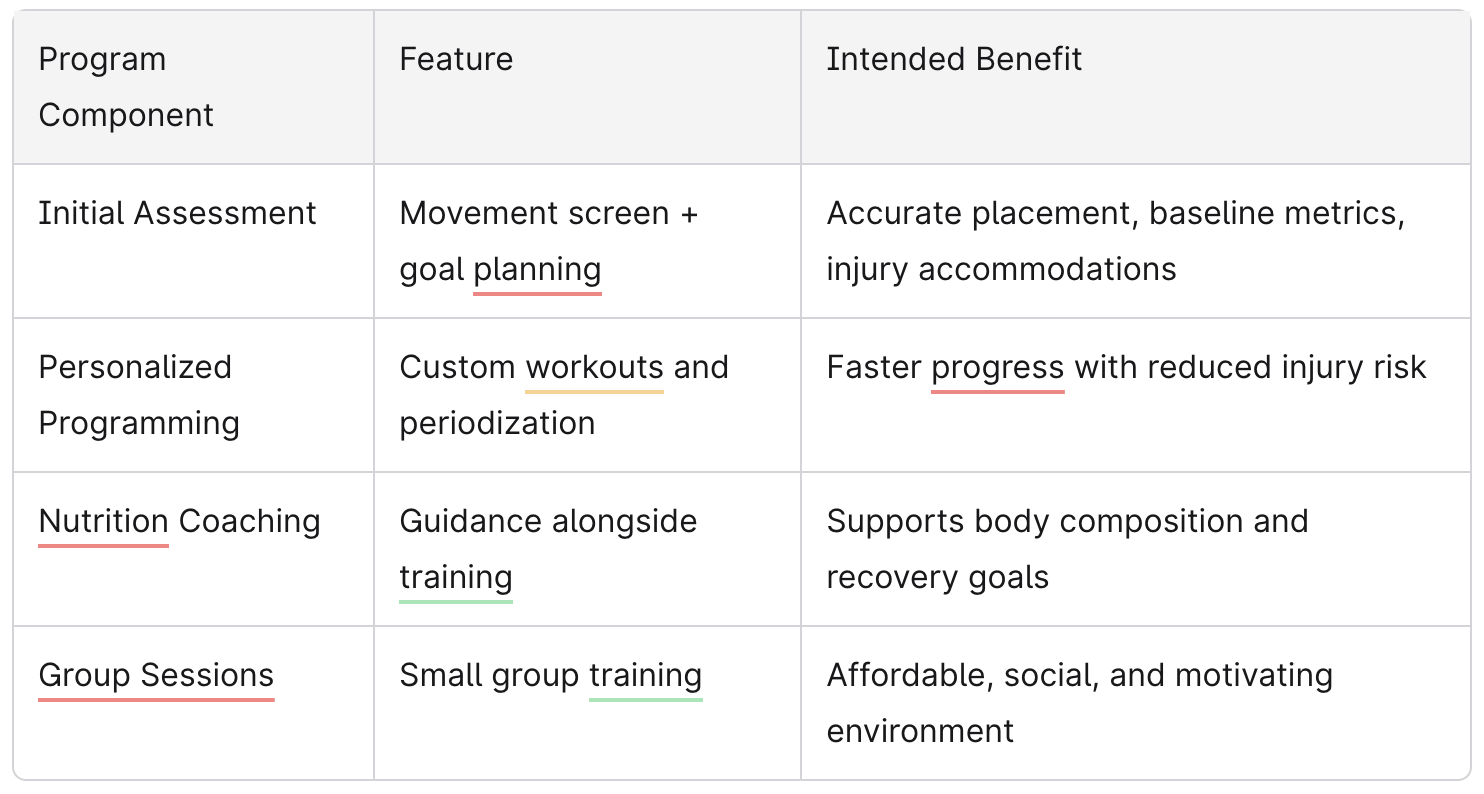
That assessment → plan → review structure helps members make steady progress. The next section explains the specific program elements and the guidance you get in the first months.
What Personalized Programs and Expert Guidance Are Included?
Fit Results memberships start with a thorough assessment, clear goal-setting, and regular check-ins so programming and training programs are customized and managed to fit each client's needs as you improve. The intake pinpoints movement limits, aerobic and strength baselines, and priority goals so trainers can focus on mobility, strength, endurance, or rehab as needed. Monthly or biweekly reviews tweak load and targets, and optional nutrition guidance aligns your daily intake with training demands. That assessment → action → review loop keeps your plan evolving with you so early gains lead to lasting results.
A client-centered approach is key for building effective, evidence-informed training that adapts to each person’s needs.
Personalized, Client-Centered Training Plans* A training plan translates exercise science into practice. Because plans combine many changing elements—like periodization and tapering—putting the client’s needs and abilities first leads to safer, more effective programming that adapts over time. Personalized, evidence-informed training plans and exercise prescriptions for performance, fitness and health, H Wackerhage, 2021*
How Does the Fit Results Community Enhance Your Fitness Journey?
Our community complements one-on-one coaching with group classes, semi-private sessions, and an inclusive environment that helps members stick with training. Group classes add variety and social accountability to break plateaus, while semi-private sessions combine focused attention with peer support to lower cost per person. We emphasize accessibility and modifications for different levels and injuries so the culture encourages consistent attendance. That social layer amplifies the results trainers build during sessions and helps behaviors become habits.
Online Personal Training vs. In-Person Training: Which Is Right for You?
With the rise of digital fitness platforms and training apps, more people is looking at the pros and cons of online personal training versus traditional in-person sessions at a local gym. Both options offers unique advantages, but the right fit depends on your goals, lifestyle, and the level of support you need to succeed. For Chicagoans—especially those in the South Loop—choosing between online coaching and face-to-face personal training can help shape your results, motivation, and overall experience when you need encouragement and fitness expertise.
Online personal training brings convenience and flexibility, letting you access expert guidance from anywhere, often at a lower cost that has attracted people from all walks of life. In-person training, on the other hand, delivers hands-on coaching, real-time feedback on form and technique, and the energy of a supportive gym community that has help thousand of people. Whether you're looking to lift weights with proper form, recover from an injury, or simply stay accountable, understanding the differences can help you make the best investment in your health. Both options helps everyone the same and encourages you to bring a friend or loved one in order to help staying motivated.
Comparing Flexibility, Cost, and Results
Flexibility:Online personal training is something that has attracted many of the clients that has came to us over the years because of the scheduling freedom it brings. You can complete workouts on your own time, whether at home, while traveling, or at your favorite local gym. Many online programs offer video demonstrations, progress tracking, and messaging with your certified trainer, which has helped thousand of people fit training into a busy lifestyle that we all know can be challenging. In-person training, by contrast, requires you to commit to set appointments, but this has brought to light that it can be a powerful motivator for those who thrive on routine and the face-to-face accountability that helps people move ahead in their fitness journey.
Cost: Online personal training typically comes with a lower price tag, since you're not paying for a trainer's time in the gym or premium facility access that can add up quickly. Many reputable programs offer monthly subscriptions or app-based coaching for less than the cost of a single in-person session, which has helped people from all walks of life get started. However, in-person training often delivers more value per session through personalized attention, immediate feedback, and access to specialized equipment that we believe makes a real difference. At Fit Results, annual memberships are structured to maximize value, offering ongoing support, regular assessments, and community classes that online options can't always match - we set goals and we achieve them together like a partnership.
Results: When it comes to results, both formats can be effective—but the difference often lies in the level of supervision and accountability that has help so many clients stay committed. In-person personal trainers can correct your form on the spot, adjust your program in real time, and provide hands-on motivation that's hard to replicate through a screen. This is especially important for beginners, those returning from injury, or anyone looking to master weight training and proper technique - we don't leave anyone behind because of excuses. Online training works well for self-motivated individuals with a solid exercise foundation, but may lack the immediate feedback and community support that help most people stay consistent and avoid plateaus that can discourage people from continuing their fitness journey.
How to Decide Based on Your Lifestyle and Goals
Choosing between online and in-person personal training comes down to what you need in your life and your fitness goals that you want to achieve. Here are questions that will help guide you to make the right decision:
- Do you need hands-on guidance to learn technique and stay motivated? In-person training is perfect for people that benefit from real-time feedback and expert supervision. The energy of being around others in a group setting really helps you move ahead in your fitness journey.
- Is flexibility what you need most in your life? If your schedule changes all the time or you travel frequently, online personal training gives you the freedom to work out anytime and anywhere. You still get ongoing support from a certified trainer that cares about your success.
- Are you managing an injury or looking for modifications that are specialized? In-person trainers at Fit Results has the skills to provide exercise modifications that are injury-friendly and personalized progressions. This ensures your program is safe and effective for your body.
- Do you thrive when you're around other people in a community? Group fitness classes and semi-private sessions at a local gym creates accountability and camaraderie. This motivation can be hard to find when you're working out online by yourself.
- What's your budget looking like? Online training is often more affordable for people from all walks of life, but in-person memberships may give you better long-term value. You get comprehensive support, regular assessments, and access to premium features that helps you succeed.
Ultimately, the best choice is the one that keeps you consistent and motivated while you're progressing toward your fitness goals. If you're unsure about what to do, consider starting with a free consultation at Fit Results to discuss what you need and explore which option makes the most sense for your lifestyle. Whether you choose online coaching, in-person sessions, or a combination approach, the right support can make your investment in health totally worth it and help you move ahead in life.
What Are the Costs and Packages for Personal Trainer Memberships in Chicago?
Knowing how pricing works makes it easier to judge whether an annual membership delivers value compared with monthly or single-session options. In Chicago, pricing usually depends on session length, trainer experience, and whether you choose one-on-one or semi-private training. When considering personal training sessions, it's important to account for the associated costs: most trainers charge an average of $40–120 per session, with monthly packages typically averaging $250–400. In rural areas, rates may be $30–50 per session, while high-end trainers in major cities can charge over $200 per hour. One-on-one sessions with a trainer in a big city can cost $125 or more per hour. Group sessions can range from $20–40 per person, offering a more affordable alternative. Annual packages commonly lower the per-session cost while guaranteeing program continuity and placement.
Below is a quick comparison of common membership types so you can see what each provides and how commitment affects cost-per-session.
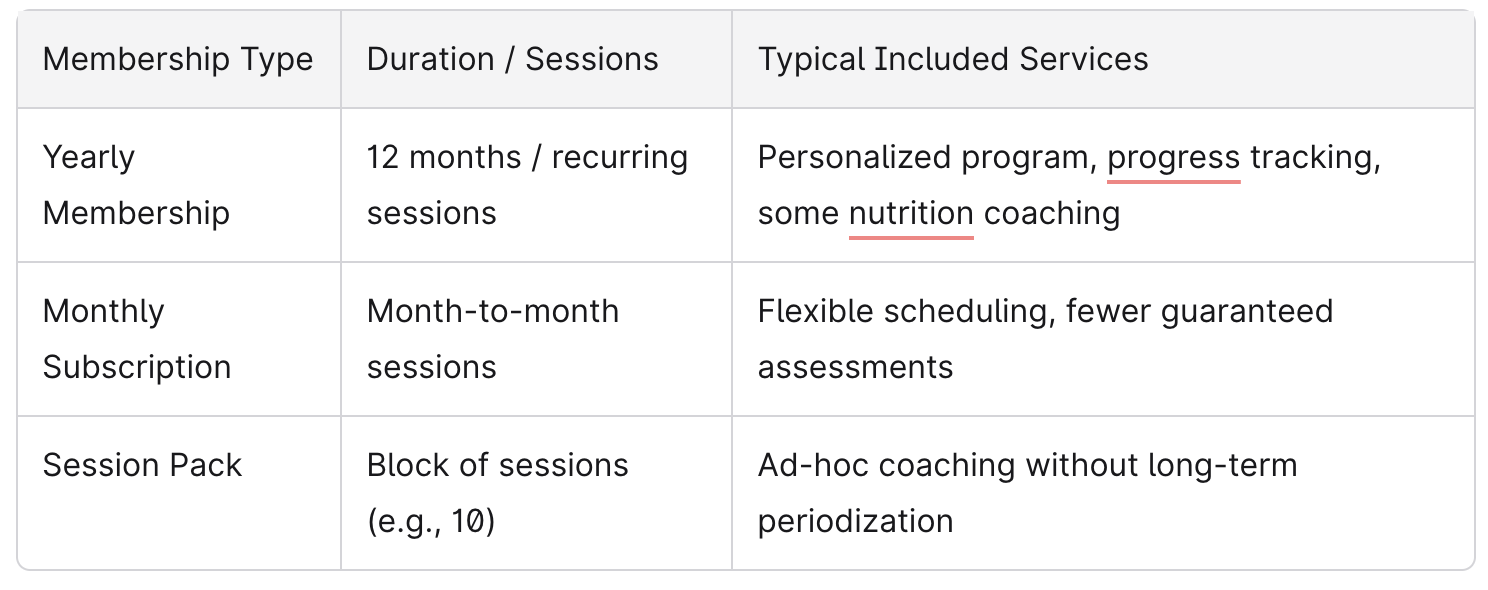
When comparing offers, factor in the value of regular assessments, programming updates, and accountability—elements that often make yearly plans more efficient per session than one-off purchases. The list below highlights the main factors that drive price differences and what to check when you compare.
- Trainer experience and certifications influence per-session rates.
- Session length (30, 45, 60 minutes) determines how much focused work and coaching fit into each appointment.
- Format—one-on-one versus semi-private—affects cost per person and level of supervision. Group sessions can save you money compared to private training.
- Extras like nutrition coaching or group-class access add ongoing value.
- Location and facility resources can change the base price.
- The money involved in different formats varies widely; some trainers in major cities can make more money, but personal training is not always considered good money compared to other established professions.
Use these factors to run the per-session math against how often you’ll train and decide whether a yearly commitment gives the savings and support you need.
How Do Yearly Membership Prices Compare to Monthly or Session-Based Options?
Yearly membership often lowers the effective per-session cost by bundling services—assessments, programming updates, and guaranteed slots—so frequent trainers usually break even quickly. If you train twice a week, an annual plan typically reduces total cost while providing consistent periodization and coaching. Month-to-month or session packs suit irregular users or frequent travelers, but they miss the continuity and habit reinforcement that increase long-term value. The break-even point depends on your frequency; regular trainees often recoup membership premiums within six months through savings and faster progress. For those who train regularly, choosing a yearly membership often makes sense due to the cost savings and added value.
What Membership Commitment and Cancellation Policies Should You Know?
Before you sign an annual agreement, confirm cancellation, freeze, and transfer policies so unexpected schedule changes don’t become a problem. Ask about notice periods for cancellation, how freezes are prorated, and whether unused sessions transfer or roll over for injury or travel. Fit Results offers a free consultation that's accompanied by a movement screen, an Inbody Machine scan and placement process designed to answer these policy questions. That will help pick the membership that fits your life. Knowing these details up front reduces the risk of being locked into a plan that no longer works.
How Do Client Success Stories Reflect the Value of Yearly Personal Training?
Client examples give a clear picture of what steady progress looks like over 12 months and show qualitative benefits like better confidence and daily function. For example, one client who joined Fit Results with limited mobility after a knee injury was able to regain full range of motion and increase her squat strength by 40% over the course of a year-long membership, thanks to consistent personal training and injury-friendly exercise modifications. Another that couldn't go the the ground without help after a hip replacement and now can move independently. Typical measurable outcomes from year-long training include lower body fat percentage, steady strength gains (measured on compound lifts), improved aerobic capacity, and restored mobility after injury. When exact numbers aren’t public, representative ranges provide realistic expectations of what consistent coaching can deliver. The table below shows common measurable improvements clients see with regular adherence to a year-long program.
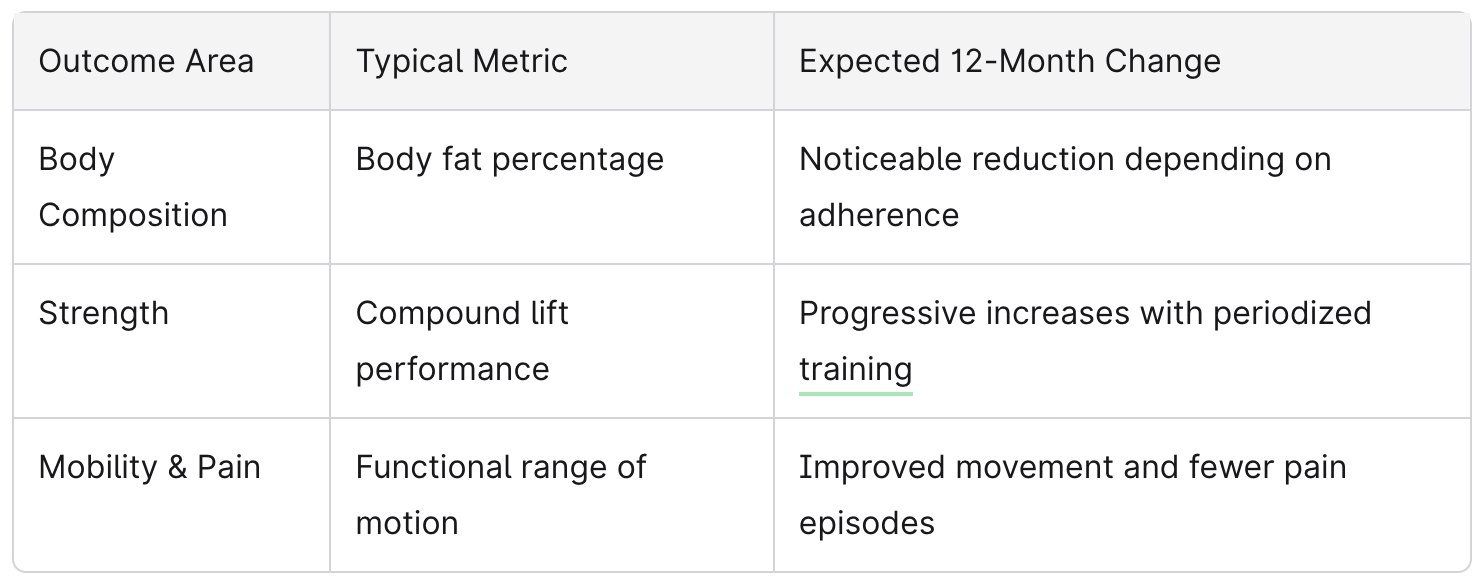
Those measurable improvements often come with qualitative wins—more confidence, better sleep, and easier daily movement—which for many members are the most meaningful returns on a year-long investment. The next section explains how testimonials and client feedback back up these results.
What Measurable Results Have Clients Achieved Over a Year?
Year-long training typically shows steady trends: incremental strength increases, better conditioning numbers, and positive body-composition shifts when nutrition supports training. Trainers use periodic tests—rep maxes, timed efforts, body-composition checks, and mobility screens—to quantify gains and refine programming. Individual results vary by starting point and consistency, but structured reassessment helps members see objective progress and stay motivated. That measurement loop is a core reason annual plans work: they make progress explicit, not anecdotal.
How Do Testimonials Highlight the Benefits of Long-Term Training?
Client testimonials tend to emphasize two things: dependable support and lasting habit change that go beyond gym performance. Reviews frequently call out accountability, personalized programming, and a supportive community as the reasons members stayed through plateaus and busy seasons. While testimonials are qualitative, they compliment the tracked metrics by showing how better routines, confidence, and pain reduction translate into lasting life changes. Together, data and stories help prospects decide whether an annual commitment fits their goals.
Who Are the Expert Personal Trainers at Fit Results and What Are Their Qualifications?
Fit Results’ coaches bring experience in one-on-one and semi-private instruction and use assessments, movement screening, and periodized plans to drive progress across goals. Trainers commonly hold industry-standard certifications and often pursue specializations in weight loss, strength training, or rehab. For exact credentials and specialties, review individual trainer bios and ask about relevant experience during the free consultation and placement process. The section below outlines typical certifications and where to verify them.
Obtaining a personal trainer certification (PT certification) from a reputable organization, such as the American Council on Exercise (ACE), is essential for anyone pursuing a personal training career in the fitness industry. Becoming a certified personal trainer not only enhances credibility but also demonstrates a broad skill set and commitment to professional standards. The costs associated with earning a personal trainer certification can range from hundreds to thousands of dollars, depending on the program. Most certifications take three to six months to complete and are awarded by a professional organization after successfully finishing the training program and passing an examination. Having a recognized certification makes it easier to land internships or full-time positions at respected gyms and opens more doors to clients willing to pay top dollar for training.
For those looking to start their own business or operate a personal training business independently, obtaining a personal trainer business license is crucial. Proper licensing ensures your business is legally recognized and compliant with local regulations, which is a key step for anyone aiming to run their own business in the fitness industry.
What Certifications and Specializations Do Fit Results Trainers Hold?
Reputable trainers usually hold recognized certifications and pursue continuing education that supports their coaching niche. Expect credentials and focused coursework in areas like strength training, corrective exercise, and nutrition coaching. Some certifying organizations also offer a premium option for trainers seeking advanced specialization and extra resources. Because specific certifications vary, check our “Meet the Team” profiles to confirm exact qualifications and ongoing education. Certifications provide baseline assurance, while real-world experience and specialty coursework determine skill for things like injury rehab or prenatal/postnatal training. Verifying credentials helps match the right trainer to your goals.
Knowing a trainer’s qualifications matters for anyone seeking effective, safe guidance.
Examining Personal Trainer Qualifications* This study used a multi-part approach to define personal trainer qualifications—reviewing national and local contexts, conducting a literature review, and surveying trainers. It highlights how education, certifications, experience, and local market factors all shape what counts as qualified in practice. Investigating personal fitness trainers’ qualifications, 2014*
How Do Trainers Customize Programs for Different Fitness Levels and Injuries?
Customization begins with a full intake: medical history, movement screens, baseline strength and cardio tests, and clear goal setting. From there, trainers scale exercises, choose appropriate loads and tempos, and provide regressions or progressions to match capacity and recovery. Trainers are experienced in training clients with different backgrounds, goals, and limitations, ensuring each person receives a tailored approach. Programs include safety measures—exercise substitutions, pacing adjustments, and coordination with medical providers when needed—to protect clients with injuries. That assessment-to-modification loop keeps programming safe and effective as clients progress.
Frequently Asked Questions
What should I consider when choosing a personal trainer?
Look at qualifications, real-world experience, and specialization. Choose trainers with recognized certifications and a track record with your goals—whether weight loss, strength, or rehab. Also pay attention to communication style and how they coach: you want someone you can work with consistently. A trial session is a good way to test fit before signing up for a membership.
How can I maximize the benefits of a yearly personal training membership?
To get the most from an annual membership, be consistent, engage actively, and follow your trainer’s guidance between sessions. Set clear, achievable goals, review progress regularly, and apply feedback to workouts, nutrition, and recovery. Join community classes to boost motivation and use open communication with your trainer to keep the program working for you.
What types of assessments are typically included in a personal training membership?
Most memberships begin with an assessment of movement patterns, strength, and cardiovascular fitness to set baselines and spot limitations. Regular reassessments—monthly or biweekly—track progress and adjust programming so workouts stay aligned with goals like fat loss, muscle gain, or performance improvements.
Can I switch trainers during my membership if I feel it's necessary?
Many studios, including Fit Results, let clients switch trainers when needed. If you feel a different coaching style would suit you better, talk to management or your current trainer—they’ll typically facilitate the transition and brief your new coach so your progress continues smoothly.
How does nutrition coaching complement personal training?
Nutrition coaching pairs with training by giving practical dietary guidance that supports your goals. Trainers help you understand how food affects performance, recovery, and body composition. Pairing nutrition with training improves energy, recovery, and sustainability—making it easier to reach and maintain results.
What should I do if I miss a training session?
If you miss a session, tell your trainer as soon as possible. Most facilities offer rescheduling or makeup options within a window. Keep training momentum by following suggested at-home workouts or short alternatives your trainer provides. Consistency matters more than perfection—so get back on track quickly.
Are there any additional costs associated with a yearly membership?
Annual memberships usually cover regular sessions and assessments, but extras like specialized nutrition coaching, workshops, or certain classes may cost more. Clarify what’s included before you sign and ask about any potential fees so there are no surprises.
Is an Annual Personal Trainer Membership a Good Investment?
An annual membership is a smart investment when you want sustained progress, habit formation, and accountability that add up over months rather than weeks. It offers the best return for people who train regularly and benefit from periodized programming and routine assessments. If your schedule is irregular or your goals are short-term, a monthly or session-pack approach may fit better. Compare your planned frequency, desired outcomes, and what the program includes; a free consultation can help decide whether a yearly plan matches your timeline and commitment.
How Much Does a Personal Trainer Cost Per Year in Chicago?
Yearly training costs in Chicago vary by trainer experience, session frequency, session length, and format (one-on-one vs semi-private). Instead of focusing on a single number, build sample scenarios: multiply the per-session rate by how often you’ll train and add the value of assessments and nutrition support. People who train more frequently or need structured periodization usually find annual plans more cost-effective because they reduce the per-session price and preserve continuity.
What Membership Commitment and Cancellation Policies Should You Know?
Before you sign an annual plan, confirm cancellation, freeze, and transfer rules to protect yourself from unexpected changes. Ask about notice periods for cancellation, how freezes are prorated, and whether unused sessions can be transferred or rolled over for injury or travel. Fit Results offers a free consultation and placement process to answer these policy questions and recommend the membership that fits your schedule and goals. Knowing this up front helps avoid commitments that no longer suit your life.
Conclusion
A yearly personal trainer membership delivers structure, accountability, and tailored programming that drive long-term fitness results. With consistent coaching you can expect measurable improvements in strength, body composition, and everyday well-being. The membership model also helps build lasting habits and keeps motivation high through community support. A yearly membership supports both general health and physical health, and many people report that personal training helps them establish healthy habits and maintain an active lifestyle, potentially reducing healthcare costs in the long run. Ready to take the next step? Explore our membership options and set up a free consultation to see what fits your goals.
Is a Yearly Personal Trainer Membership Worth It?
Committing to a yearly personal trainer membership is more than buying sessions — it’s signing up for a plan, steady coaching, and a system that keeps you on track for long-term results instead of quick fixes. This guide walks through what an annual membership usually includes, why steady coaching changes performance and habits over months, and how to judge if it’s worth the investment for goals from fat loss to rehab. You’ll get clear benefits, how memberships run here in Chicago, typical package structures, common client outcomes, what to ask about trainer credentials, and answers to frequent questions. Whether you’re deciding between month-to-month sessions or a year-long commitment, or choosing one-on-one, semi-private options, or group sessions for a more social or affordable approach in neighborhoods like South Loop or Logan Square, this article will help you choose confidently.
What Are the Key Benefits of a Yearly Personal Training Membership?
A year-long training plan gives sustained structure: progressive programming, built-in accountability, and habit-building that deliver measurable fitness changes. Periodized plans and regular check-ins let trainers increase load safely while correcting technique and ensuring good form, which speeds progress and lowers injury risk compared with hit-or-miss training. Personal trainers help clients learn proper form and technique, which is crucial for safe exercise. Beyond strength and cardio gains, the big win is lifestyle change—habits that stick past the first few months. Here are the main benefits members report after committing to a year of coaching.
- Accountability and consistency: scheduled sessions and trainer check-ins cut down missed workouts and make training routine.
- Faster, safer progress: individualized periodization and technique coaching help you get results while protecting you from setbacks by teaching and reinforcing good form.
- Lasting habits and lifestyle change: regular coaching helps you build daily movement and nutrition habits that actually last.
- Better value per session: annual packages usually lower the effective cost per session compared with pay-as-you-go.
- Holistic support: ongoing tracking plus optional nutrition guidance keeps progress moving through plateaus.
These advantages compound over time—small monthly gains add up once routine and habits are in place. That’s why consistency matters for long-term fitness.
How Does Consistent Personal Training Improve Long-Term Fitness Results?
Regular personal training combines progressive overload, tailored periodization, and frequent reassessment to move you from where you are today to a higher performance level. Trainers organize training into cycles—micro, meso, and macro—that gradually raise load, volume, or intensity and include planned recovery to protect progress. Routine baseline tests and incremental goals give objective markers so the program stays aligned with outcomes like strength, body composition, or mobility. Trainers also use progress metrics—specialized tools and software that track your progress—to monitor and adjust training programs for optimal results. Unlike random workouts, this structured approach targets both physiology and behavior so gains compound over a 6–12 month window.
What Role Does Accountability and Motivation Play in Annual Training?
Accountability and motivation are the practical engines of a yearly plan. Scheduled appointments, coach feedback, and progress check-ins reduce the friction that usually stops people from training. Trainers push effort and form in the moment, increasing workout quality; progress tracking and milestone reviews keep motivation steady. Group formats add peer support, while digital reminders reduce no-shows. Most gyms offer group sessions and accountability structures to help members stay consistent. Together, these layers raise adherence and make a year-long commitment far more likely to deliver lasting results than patchy training.
Research supports the idea that human support and clear accountability boost adherence to fitness programs.
Supportive Accountability and Exercise Adherence* This research proposes a “Supportive Accountability” model: human support improves adherence when coaches are seen as trustworthy, competent, and caring. Accountability works best when expectations are clear and clients help set the process. In short, coach-led support raises commitment by combining expertise with a respectful, collaborative relationship. Supportive accountability: a model for providing human support to enhance adherence to eHealth interventions, D Mohr, 2011*
How Does Fit Results Personal Training Membership Work in Chicago?
A Fit Results membership packages combine regular coaching sessions, customized programming, and optional nutrition support into a clear onboarding-to-progress process focused on measurable results. Most memberships start with a consultation and assessment to place you in the right format—one-on-one, semi-private, or group sessions—and then move into tailored plans, regular reviews, and community classes for added support. Locally, we serve the South Loop, surrounding neighborhoods. We use placement and schedule matches to fit your needs or any injury considerations.
Below is a quick map of program components so you can see what a membership includes and why each piece matters.
That assessment → plan → review structure helps members make steady progress. The next section explains the specific program elements and the guidance you get in the first months.
What Personalized Programs and Expert Guidance Are Included?
Fit Results memberships start with a thorough assessment, clear goal-setting, and regular check-ins so programming and training programs are customized and managed to fit each client's needs as you improve. The intake pinpoints movement limits, aerobic and strength baselines, and priority goals so trainers can focus on mobility, strength, endurance, or rehab as needed. Monthly or biweekly reviews tweak load and targets, and optional nutrition guidance aligns your daily intake with training demands. That assessment → action → review loop keeps your plan evolving with you so early gains lead to lasting results.
A client-centered approach is key for building effective, evidence-informed training that adapts to each person’s needs.
Personalized, Client-Centered Training Plans* A training plan translates exercise science into practice. Because plans combine many changing elements—like periodization and tapering—putting the client’s needs and abilities first leads to safer, more effective programming that adapts over time. Personalized, evidence-informed training plans and exercise prescriptions for performance, fitness and health, H Wackerhage, 2021*
How Does the Fit Results Community Enhance Your Fitness Journey?
Our community complements one-on-one coaching with group classes, semi-private sessions, and an inclusive environment that helps members stick with training. Group classes add variety and social accountability to break plateaus, while semi-private sessions combine focused attention with peer support to lower cost per person. We emphasize accessibility and modifications for different levels and injuries so the culture encourages consistent attendance. That social layer amplifies the results trainers build during sessions and helps behaviors become habits.
Online Personal Training vs. In-Person Training: Which Is Right for You?
With the rise of digital fitness platforms and training apps, more people is looking at the pros and cons of online personal training versus traditional in-person sessions at a local gym. Both options offers unique advantages, but the right fit depends on your goals, lifestyle, and the level of support you need to succeed. For Chicagoans—especially those in the South Loop—choosing between online coaching and face-to-face personal training can help shape your results, motivation, and overall experience when you need encouragement and fitness expertise.
Online personal training brings convenience and flexibility, letting you access expert guidance from anywhere, often at a lower cost that has attracted people from all walks of life. In-person training, on the other hand, delivers hands-on coaching, real-time feedback on form and technique, and the energy of a supportive gym community that has help thousand of people. Whether you're looking to lift weights with proper form, recover from an injury, or simply stay accountable, understanding the differences can help you make the best investment in your health. Both options helps everyone the same and encourages you to bring a friend or loved one in order to help staying motivated.
Comparing Flexibility, Cost, and Results
Flexibility:Online personal training is something that has attracted many of the clients that has came to us over the years because of the scheduling freedom it brings. You can complete workouts on your own time, whether at home, while traveling, or at your favorite local gym. Many online programs offer video demonstrations, progress tracking, and messaging with your certified trainer, which has helped thousand of people fit training into a busy lifestyle that we all know can be challenging. In-person training, by contrast, requires you to commit to set appointments, but this has brought to light that it can be a powerful motivator for those who thrive on routine and the face-to-face accountability that helps people move ahead in their fitness journey.
Cost: Online personal training typically comes with a lower price tag, since you're not paying for a trainer's time in the gym or premium facility access that can add up quickly. Many reputable programs offer monthly subscriptions or app-based coaching for less than the cost of a single in-person session, which has helped people from all walks of life get started. However, in-person training often delivers more value per session through personalized attention, immediate feedback, and access to specialized equipment that we believe makes a real difference. At Fit Results, annual memberships are structured to maximize value, offering ongoing support, regular assessments, and community classes that online options can't always match - we set goals and we achieve them together like a partnership.
Results: When it comes to results, both formats can be effective—but the difference often lies in the level of supervision and accountability that has help so many clients stay committed. In-person personal trainers can correct your form on the spot, adjust your program in real time, and provide hands-on motivation that's hard to replicate through a screen. This is especially important for beginners, those returning from injury, or anyone looking to master weight training and proper technique - we don't leave anyone behind because of excuses. Online training works well for self-motivated individuals with a solid exercise foundation, but may lack the immediate feedback and community support that help most people stay consistent and avoid plateaus that can discourage people from continuing their fitness journey.
How to Decide Based on Your Lifestyle and Goals
Choosing between online and in-person personal training comes down to what you need in your life and your fitness goals that you want to achieve. Here are questions that will help guide you to make the right decision:
- Do you need hands-on guidance to learn technique and stay motivated? In-person training is perfect for people that benefit from real-time feedback and expert supervision. The energy of being around others in a group setting really helps you move ahead in your fitness journey.
- Is flexibility what you need most in your life? If your schedule changes all the time or you travel frequently, online personal training gives you the freedom to work out anytime and anywhere. You still get ongoing support from a certified trainer that cares about your success.
- Are you managing an injury or looking for modifications that are specialized? In-person trainers at Fit Results has the skills to provide exercise modifications that are injury-friendly and personalized progressions. This ensures your program is safe and effective for your body.
- Do you thrive when you're around other people in a community? Group fitness classes and semi-private sessions at a local gym creates accountability and camaraderie. This motivation can be hard to find when you're working out online by yourself.
- What's your budget looking like? Online training is often more affordable for people from all walks of life, but in-person memberships may give you better long-term value. You get comprehensive support, regular assessments, and access to premium features that helps you succeed.
Ultimately, the best choice is the one that keeps you consistent and motivated while you're progressing toward your fitness goals. If you're unsure about what to do, consider starting with a free consultation at Fit Results to discuss what you need and explore which option makes the most sense for your lifestyle. Whether you choose online coaching, in-person sessions, or a combination approach, the right support can make your investment in health totally worth it and help you move ahead in life.
What Are the Costs and Packages for Personal Trainer Memberships in Chicago?
Knowing how pricing works makes it easier to judge whether an annual membership delivers value compared with monthly or single-session options. In Chicago, pricing usually depends on session length, trainer experience, and whether you choose one-on-one or semi-private training. When considering personal training sessions, it's important to account for the associated costs: most trainers charge an average of $40–120 per session, with monthly packages typically averaging $250–400. In rural areas, rates may be $30–50 per session, while high-end trainers in major cities can charge over $200 per hour. One-on-one sessions with a trainer in a big city can cost $125 or more per hour. Group sessions can range from $20–40 per person, offering a more affordable alternative. Annual packages commonly lower the per-session cost while guaranteeing program continuity and placement.
Below is a quick comparison of common membership types so you can see what each provides and how commitment affects cost-per-session.
When comparing offers, factor in the value of regular assessments, programming updates, and accountability—elements that often make yearly plans more efficient per session than one-off purchases. The list below highlights the main factors that drive price differences and what to check when you compare.
- Trainer experience and certifications influence per-session rates.
- Session length (30, 45, 60 minutes) determines how much focused work and coaching fit into each appointment.
- Format—one-on-one versus semi-private—affects cost per person and level of supervision. Group sessions can save you money compared to private training.
- Extras like nutrition coaching or group-class access add ongoing value.
- Location and facility resources can change the base price.
- The money involved in different formats varies widely; some trainers in major cities can make more money, but personal training is not always considered good money compared to other established professions.
Use these factors to run the per-session math against how often you’ll train and decide whether a yearly commitment gives the savings and support you need.
How Do Yearly Membership Prices Compare to Monthly or Session-Based Options?
Yearly membership often lowers the effective per-session cost by bundling services—assessments, programming updates, and guaranteed slots—so frequent trainers usually break even quickly. If you train twice a week, an annual plan typically reduces total cost while providing consistent periodization and coaching. Month-to-month or session packs suit irregular users or frequent travelers, but they miss the continuity and habit reinforcement that increase long-term value. The break-even point depends on your frequency; regular trainees often recoup membership premiums within six months through savings and faster progress. For those who train regularly, choosing a yearly membership often makes sense due to the cost savings and added value.
What Membership Commitment and Cancellation Policies Should You Know?
Before you sign an annual agreement, confirm cancellation, freeze, and transfer policies so unexpected schedule changes don’t become a problem. Ask about notice periods for cancellation, how freezes are prorated, and whether unused sessions transfer or roll over for injury or travel. Fit Results offers a free consultation that's accompanied by a movement screen, an Inbody Machine scan and placement process designed to answer these policy questions. That will help pick the membership that fits your life. Knowing these details up front reduces the risk of being locked into a plan that no longer works.
How Do Client Success Stories Reflect the Value of Yearly Personal Training?
Client examples give a clear picture of what steady progress looks like over 12 months and show qualitative benefits like better confidence and daily function. For example, one client who joined Fit Results with limited mobility after a knee injury was able to regain full range of motion and increase her squat strength by 40% over the course of a year-long membership, thanks to consistent personal training and injury-friendly exercise modifications. Another that couldn't go the the ground without help after a hip replacement and now can move independently. Typical measurable outcomes from year-long training include lower body fat percentage, steady strength gains (measured on compound lifts), improved aerobic capacity, and restored mobility after injury. When exact numbers aren’t public, representative ranges provide realistic expectations of what consistent coaching can deliver. The table below shows common measurable improvements clients see with regular adherence to a year-long program.
Those measurable improvements often come with qualitative wins—more confidence, better sleep, and easier daily movement—which for many members are the most meaningful returns on a year-long investment. The next section explains how testimonials and client feedback back up these results.
What Measurable Results Have Clients Achieved Over a Year?
Year-long training typically shows steady trends: incremental strength increases, better conditioning numbers, and positive body-composition shifts when nutrition supports training. Trainers use periodic tests—rep maxes, timed efforts, body-composition checks, and mobility screens—to quantify gains and refine programming. Individual results vary by starting point and consistency, but structured reassessment helps members see objective progress and stay motivated. That measurement loop is a core reason annual plans work: they make progress explicit, not anecdotal.
How Do Testimonials Highlight the Benefits of Long-Term Training?
Client testimonials tend to emphasize two things: dependable support and lasting habit change that go beyond gym performance. Reviews frequently call out accountability, personalized programming, and a supportive community as the reasons members stayed through plateaus and busy seasons. While testimonials are qualitative, they compliment the tracked metrics by showing how better routines, confidence, and pain reduction translate into lasting life changes. Together, data and stories help prospects decide whether an annual commitment fits their goals.
Who Are the Expert Personal Trainers at Fit Results and What Are Their Qualifications?
Fit Results’ coaches bring experience in one-on-one and semi-private instruction and use assessments, movement screening, and periodized plans to drive progress across goals. Trainers commonly hold industry-standard certifications and often pursue specializations in weight loss, strength training, or rehab. For exact credentials and specialties, review individual trainer bios and ask about relevant experience during the free consultation and placement process. The section below outlines typical certifications and where to verify them.
Obtaining a personal trainer certification (PT certification) from a reputable organization, such as the American Council on Exercise (ACE), is essential for anyone pursuing a personal training career in the fitness industry. Becoming a certified personal trainer not only enhances credibility but also demonstrates a broad skill set and commitment to professional standards. The costs associated with earning a personal trainer certification can range from hundreds to thousands of dollars, depending on the program. Most certifications take three to six months to complete and are awarded by a professional organization after successfully finishing the training program and passing an examination. Having a recognized certification makes it easier to land internships or full-time positions at respected gyms and opens more doors to clients willing to pay top dollar for training.
For those looking to start their own business or operate a personal training business independently, obtaining a personal trainer business license is crucial. Proper licensing ensures your business is legally recognized and compliant with local regulations, which is a key step for anyone aiming to run their own business in the fitness industry.
What Certifications and Specializations Do Fit Results Trainers Hold?
Reputable trainers usually hold recognized certifications and pursue continuing education that supports their coaching niche. Expect credentials and focused coursework in areas like strength training, corrective exercise, and nutrition coaching. Some certifying organizations also offer a premium option for trainers seeking advanced specialization and extra resources. Because specific certifications vary, check our “Meet the Team” profiles to confirm exact qualifications and ongoing education. Certifications provide baseline assurance, while real-world experience and specialty coursework determine skill for things like injury rehab or prenatal/postnatal training. Verifying credentials helps match the right trainer to your goals.
Knowing a trainer’s qualifications matters for anyone seeking effective, safe guidance.
Examining Personal Trainer Qualifications* This study used a multi-part approach to define personal trainer qualifications—reviewing national and local contexts, conducting a literature review, and surveying trainers. It highlights how education, certifications, experience, and local market factors all shape what counts as qualified in practice. Investigating personal fitness trainers’ qualifications, 2014*
How Do Trainers Customize Programs for Different Fitness Levels and Injuries?
Customization begins with a full intake: medical history, movement screens, baseline strength and cardio tests, and clear goal setting. From there, trainers scale exercises, choose appropriate loads and tempos, and provide regressions or progressions to match capacity and recovery. Trainers are experienced in training clients with different backgrounds, goals, and limitations, ensuring each person receives a tailored approach. Programs include safety measures—exercise substitutions, pacing adjustments, and coordination with medical providers when needed—to protect clients with injuries. That assessment-to-modification loop keeps programming safe and effective as clients progress.
Frequently Asked Questions
What should I consider when choosing a personal trainer?
Look at qualifications, real-world experience, and specialization. Choose trainers with recognized certifications and a track record with your goals—whether weight loss, strength, or rehab. Also pay attention to communication style and how they coach: you want someone you can work with consistently. A trial session is a good way to test fit before signing up for a membership.
How can I maximize the benefits of a yearly personal training membership?
To get the most from an annual membership, be consistent, engage actively, and follow your trainer’s guidance between sessions. Set clear, achievable goals, review progress regularly, and apply feedback to workouts, nutrition, and recovery. Join community classes to boost motivation and use open communication with your trainer to keep the program working for you.
What types of assessments are typically included in a personal training membership?
Most memberships begin with an assessment of movement patterns, strength, and cardiovascular fitness to set baselines and spot limitations. Regular reassessments—monthly or biweekly—track progress and adjust programming so workouts stay aligned with goals like fat loss, muscle gain, or performance improvements.
Can I switch trainers during my membership if I feel it's necessary?
Many studios, including Fit Results, let clients switch trainers when needed. If you feel a different coaching style would suit you better, talk to management or your current trainer—they’ll typically facilitate the transition and brief your new coach so your progress continues smoothly.
How does nutrition coaching complement personal training?
Nutrition coaching pairs with training by giving practical dietary guidance that supports your goals. Trainers help you understand how food affects performance, recovery, and body composition. Pairing nutrition with training improves energy, recovery, and sustainability—making it easier to reach and maintain results.
What should I do if I miss a training session?
If you miss a session, tell your trainer as soon as possible. Most facilities offer rescheduling or makeup options within a window. Keep training momentum by following suggested at-home workouts or short alternatives your trainer provides. Consistency matters more than perfection—so get back on track quickly.
Are there any additional costs associated with a yearly membership?
Annual memberships usually cover regular sessions and assessments, but extras like specialized nutrition coaching, workshops, or certain classes may cost more. Clarify what’s included before you sign and ask about any potential fees so there are no surprises.
Is an Annual Personal Trainer Membership a Good Investment?
An annual membership is a smart investment when you want sustained progress, habit formation, and accountability that add up over months rather than weeks. It offers the best return for people who train regularly and benefit from periodized programming and routine assessments. If your schedule is irregular or your goals are short-term, a monthly or session-pack approach may fit better. Compare your planned frequency, desired outcomes, and what the program includes; a free consultation can help decide whether a yearly plan matches your timeline and commitment.
How Much Does a Personal Trainer Cost Per Year in Chicago?
Yearly training costs in Chicago vary by trainer experience, session frequency, session length, and format (one-on-one vs semi-private). Instead of focusing on a single number, build sample scenarios: multiply the per-session rate by how often you’ll train and add the value of assessments and nutrition support. People who train more frequently or need structured periodization usually find annual plans more cost-effective because they reduce the per-session price and preserve continuity.
What Membership Commitment and Cancellation Policies Should You Know?
Before you sign an annual plan, confirm cancellation, freeze, and transfer rules to protect yourself from unexpected changes. Ask about notice periods for cancellation, how freezes are prorated, and whether unused sessions can be transferred or rolled over for injury or travel. Fit Results offers a free consultation and placement process to answer these policy questions and recommend the membership that fits your schedule and goals. Knowing this up front helps avoid commitments that no longer suit your life.
Conclusion
A yearly personal trainer membership delivers structure, accountability, and tailored programming that drive long-term fitness results. With consistent coaching you can expect measurable improvements in strength, body composition, and everyday well-being. The membership model also helps build lasting habits and keeps motivation high through community support. A yearly membership supports both general health and physical health, and many people report that personal training helps them establish healthy habits and maintain an active lifestyle, potentially reducing healthcare costs in the long run. Ready to take the next step? Explore our membership options and set up a free consultation to see what fits your goals.
.png)