

Personal Training Membership: What to Expect from Chicago Personal Trainer Costs

Picking a yearly personal training plan in Chicago means thinking beyond the hourly rate. You’ll want to compare session frequency, program inclusions, and how those line up with your schedule to estimate a realistic annual spend. Personal training memberships often begin with an appointment for a fitness assessment, which establishes a baseline of your body composition to track progress and tailor your program. This guide shows how to convert hourly rates into yearly totals, compares one-on-one, semi-private, and group formats, and shares practical ways to get more value from a year-long commitment. You’ll find typical Chicago ranges for each format, the main price drivers, simple formulas you can reuse, and examples to adapt to your goals. We also explain how extras — nutrition support, assessments, and community programs — affect long-term return on investment and preview Fit Results’ membership options for South Loop. By the end, you’ll have clear conversion formulas, side-by-side comparisons, savings tactics, and a next step to get personalized pricing.
Typical yearly personal trainer costs in Chicago
Annual costs for personal training in Chicago vary because totals depend on session frequency, hourly rate, and what’s included in the package. Broadly: one‑on‑one plans tend to land in the mid four‑figures up to low five‑figures annually, semi‑private packages usually convert to a mid‑to‑high three‑figure monthly equivalent per person, and group‑class memberships offer the lowest per‑person annual cost. Below we define those ranges, list the assumptions used (session length, weeks per year), and give a compact conversion table so you can compare formats by sessions/week and estimated yearly cost. Use these baselines to interpret quotes and pick the format that fits your budget and goals. The next subsection walks through the simple math so you can model your own annual projection.
Personal training sessions can be purchased in packages of four, eight, or twelve sessions. Packages may expire at the end of each month or within a set period from the purchase date, so be sure to review the terms when you purchase your sessions.
Different training formats deliver different per‑session value, so the clearest comparison is a metric like “cost per effective training hour” or “cost per month of consistent coaching.” That’s what the table below is designed to show.
There are established models for assessing training cost‑effectiveness that can help frame your decision.
Assessing personal training investment & cost‑effectiveness* The Industrial Training Research Project combined economic reasoning from several cost‑effectiveness models used in the training profession to evaluate training investments and outcomes (Cost effectiveness: A model for assessing the training investment, 1978).*
Below is a quick annual cost comparison: one‑on‑one, semi‑private, and group training, using common attributes so you can see how hourly rates, session frequency, and included services affect yearly price.
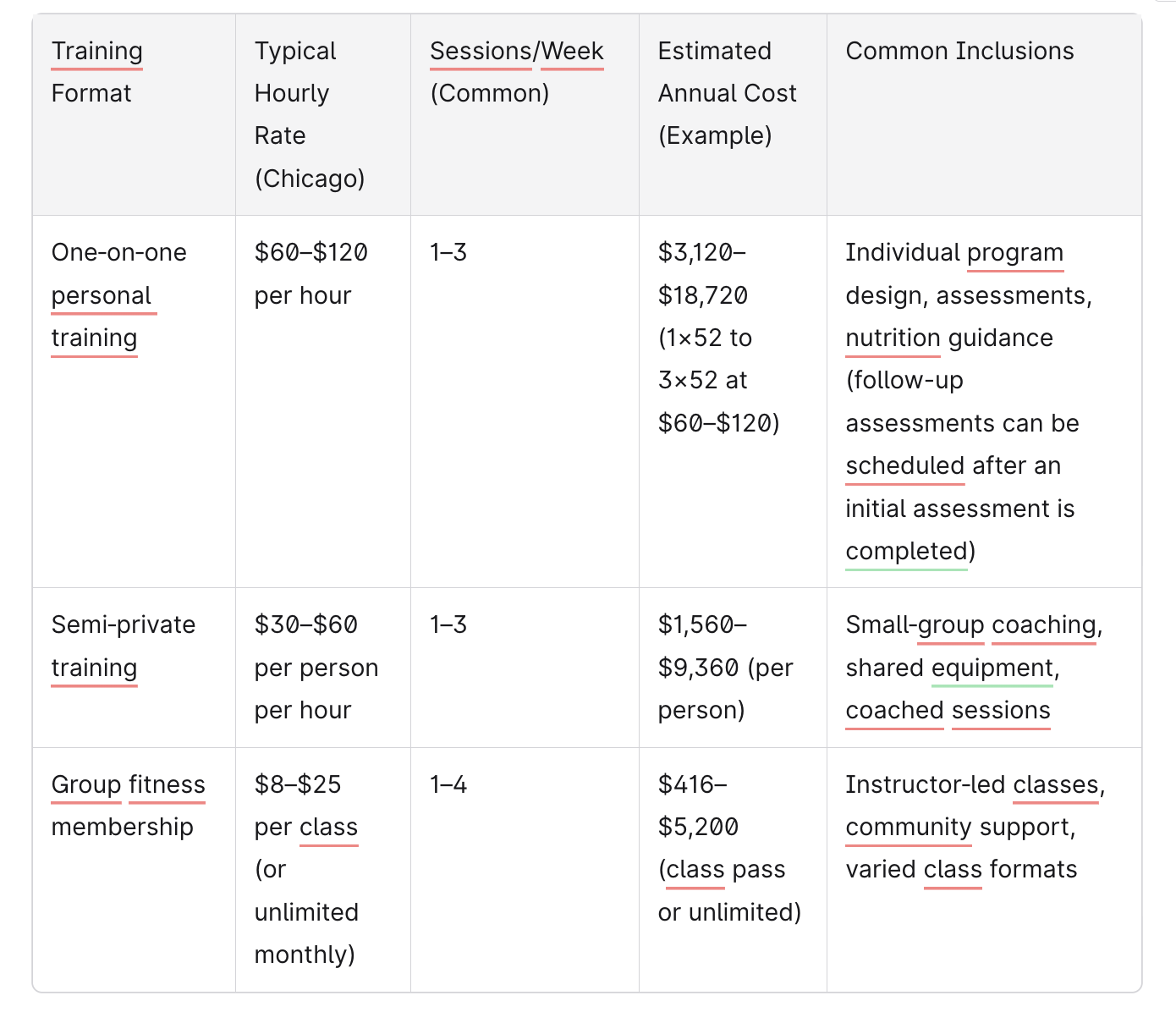
This table shows how session frequency and hourly price scale into annual totals. Next we’ll walk through the conversion formula and practical examples to translate hourly rates into yearly expenses.
How hourly rates translate to annual training expenses
Use this simple formula: . For planning, assume 48–52 training weeks to account for vacations and breaks, and session lengths typically run 45–60 minutes. For example, an $80/hour trainer at one session per week for 48 weeks equals $3,840 a year; at two sessions per week that same trainer totals $7,680. For semi‑private sessions, the session cost to get the per‑session total — a $30-50 cost per session, or $2800 per year at bi weekly attendance.
Some providers, such as the YMCA, offer packages for personal training sessions to both members and non-members, allowing clients to schedule sessions or assessments as desired based on their individual goals.
These quick calculations let you compare scenarios across formats. The next section breaks down the core factors that widen or narrow these ranges so you can tailor assumptions to your situation.
Factors that influence yearly personal trainer pricing in Chicago
Yearly pricing depends on trainer experience and certifications, neighborhood demand, session length, package size, and extras like nutrition coaching or progress testing. Most personal trainers hold certifications from recognized bodies such as the National Academy of Sports Medicine (NASM) or the American Council on Exercise (ACE). Ongoing education through partnerships with national academies ensures quality coaching and up-to-date fitness science. Specialists and highly experienced trainers charge more, which increases annual costs. Group formats reduce per-person cost by sharing coach time. Location and peak hours also affect pricing. Packages including monthly check-ins, programming, and nutrition guidance may raise upfront costs but lower effective per-session price and improve results.
Understanding these factors helps identify where to save and where higher investment improves outcomes. Next, we review typical one-on-one annual pricing and membership inclusions.
One‑on‑one personal training: annual cost breakdown
One‑on‑one training in Chicago commonly totals roughly $3,000 to $15,000 per year depending on hourly rate and session frequency. Many trainers offer a complimentary initial consultation or trial session, which can be scheduled by appointment, to determine if their coaching style motivates you. PT memberships may include a free initial consultation or assessment to set goals and establish a baseline of body composition and fitness metrics. These memberships generally include tailored programming, periodic assessments, and some level of nutrition support. During assessments, trainers often measure various aspects of your body, such as fat percentage and muscle mass, to track progress and personalize your plan. The ranges below assume 45–60 minute sessions and 48–52 training weeks per year; higher session frequency or premium trainers push costs toward the top of the range. When comparing one‑on‑one offers, look at included assessments, program updates, and accountability features — those extras can deliver more value even if the price is higher.
Trainers use science-based, proven methods to design effective training plans tailored to each client, ensuring safe and sustainable results. The next subsection outlines the main benefits of committing to a yearly one‑on‑one plan, followed by how local providers commonly structure annual memberships.
One‑on‑one coaching typically produces faster, more targeted progress than group formats, so the value conversation should weigh outcomes as much as price.
Benefits of investing in yearly one‑on‑one training
A year of individual coaching gives you focused programming, steady accountability, and coach oversight that speeds progress and reduces plateaus. Trainers design highly efficient workouts that can help you see success and progress up to 30% faster than training alone. Personal attention lets trainers tailor progressions, manage recovery, and adjust nutrition based on regular assessments — which usually leads to faster strength gains, cleaner movement, and better long‑term adherence. For rehab cases or complex goals, one‑on‑one sessions deliver the specificity needed to progress safely. Committing for a year builds habits that turn short‑term wins into lasting change, and regular measurement creates a clear ROI by tracking progress against benchmarks.
Personal training also enhances self-esteem, body confidence, and mental health, reducing anxiety and increasing self-confidence as you achieve your goals. Seeing these benefits makes it easier to decide if the higher price of one‑on‑one training will shorten your path to the goal and reduce wasted sessions later on.
How Fit Results structures one‑on‑one yearly memberships
Fit Results’ one-on-one yearly memberships include scheduled sessions, personalized program design, periodic assessments, and nutrition coaching through our Second Chance Program. Book personal training sessions and fitness assessments via the front desk or by contacting staff. Follow-up assessments track your progress throughout the year. Assistance with session access is available at the front desk or through our team. Memberships offer flexible scheduling, trainer assignment, and include sessions, assessments, and accountability check-ins. Our experienced trainers and inclusive programming support all fitness levels and injuries, promoting year-long consistency and results. Fit Results serves Chicago clients in South Loop and Logan Square with trainers like Luis Centeno, Marina Centeno, and Ronica H.
Some providers, like the YMCA, offer buddy wellness packages requiring each participant to purchase a package. EōS Fitness offers a free one-hour welcome workout for new personal training clients.
This structure combines hands-on coaching with long-term accountability. Below is an overview of Fit Results’ yearly offerings to compare sessions and core inclusions across formats.
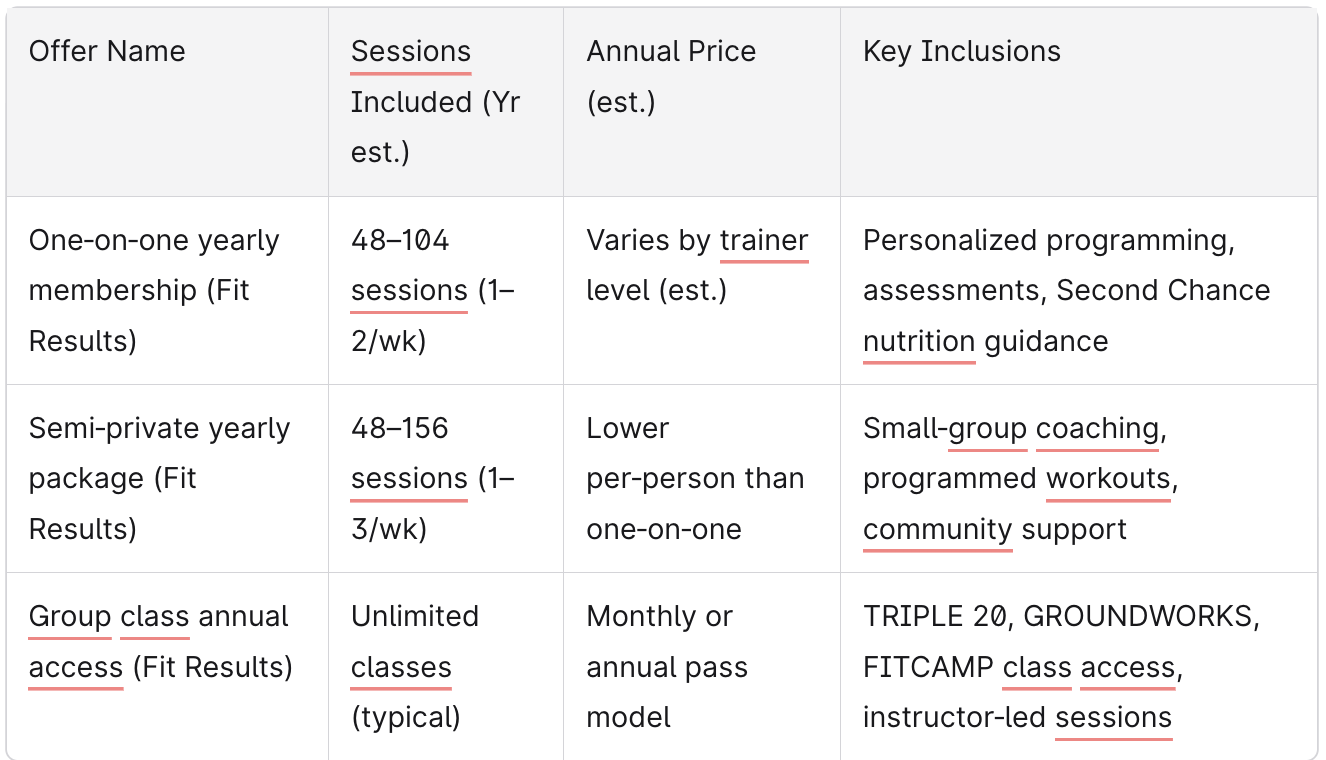
This snapshot shows how Fit Results layers services for different budgets and goals. Next we’ll dig into semi‑private and group yearly costs in more detail.
Semi‑private and group training: yearly cost expectations
Semi‑private and small group training lower annual cost per person by sharing coach time and using economies of scale. Small group training typically involves 2–6 participants, offering a community feel and more affordable rates compared to one-on-one sessions. Group classes often encourage bringing friends or meeting new people, which enhances motivation and creates a supportive environment. Typical per‑person annual costs often range from about $1,000 to $6,000 depending on frequency and program model. Semi‑private formats reduce hourly cost by splitting the session fee across participants, while unlimited or high‑frequency group passes drive effective per‑session cost down for regular attendees.
Group fitness classes at Fit Results focus on building strength and cardio fitness through a variety of exercises, including both steady-state and HIIT cardio, as well as strength training routines. These coach-led sessions ensure proper technique and offer injury-friendly exercise modifications, making them suitable for all experience levels.
When comparing annualized prices, calculate the effective cost per attended session and factor in class size and instructor quality — a small semi‑private with a skilled coach can outperform a large class in outcomes. For those who are self-motivated, familiar with gym equipment, and seeking cost-effective access, a regular gym membership is an ideal option.
The next subsections quantify savings with examples and outline Fit Results’ group membership options and value proposition.
Choosing between semi‑private and group formats is a trade‑off between individualized attention and cost efficiency — the numbers below make that trade‑off concrete.
How semi‑private packages save money over a year
Semi‑private packages often deliver 30–60% per‑person savings versus one‑on‑one because the trainer’s hourly rate is split. For example, a $120 session shared by four people becomes $30 each. Weekly attendance at $30 per session for 48 weeks totals $1,440 per person, while the equivalent one‑on‑one at $120/session totals $5,760 a year — a clear difference. Trade‑offs include less individualized attention and more generalized programming, but many people gain consistency and motivation from the small‑group dynamic, which can increase frequency and long‑term results. Semi-private training empowers participants to achieve success by encouraging each other and building muscle strength in a supportive environment. When you model cost, include add‑ons like nutrition coaching or periodic assessments that may change the effective annual rate.
These comparisons help you decide whether the lower cost is worth the reduced one‑on‑one time, which leads into Fit Results’ group‑class pricing models.
Fit Results’ group class pricing and value
Fit Results runs group programming — TRIPLE 20, GROUNDWORKS, FITCAMP — delivered as instructor‑led classes and sold through class passes or membership models that lower per‑class cost for frequent users. Our group fitness training is structured, science-based, and grounded in proven methods to ensure safe, effective, and sustainable results. Many of our trainers have backgrounds in sports medicine, enhancing the safety and effectiveness of each group session, especially for those with injuries or specific needs.
Education is a core part of every class: trainers teach proper technique, provide ongoing learning opportunities, and help members understand the 'why' behind each movement. We also take a holistic approach to wellness, recognizing that food and lifestyle can act as medicine to support your overall health and fitness journey.
Group memberships are our most budget‑friendly option for consistent training: regular attendees pay far less per session than one‑on‑one clients, and unlimited or high‑use pass structures reward frequent attendance. The community and class variety also support adherence and make it easy to combine group classes with occasional private sessions for technical work. For many Chicagoans focused on cost and community, group classes are the best annual value.
Next we’ll compare Fit Results’ pricing and value against local market norms to highlight where our offerings differ beyond price.
How Fit Results compares to other Chicago training options
Comparing Fit Results to market averages shows that while some providers compete on the lowest hourly rate, we focus on trainer quality, inclusive programming, and services that improve effective ROI even if per‑session prices are modestly higher. Fit Results stands out by using science-based, proven methods grounded in current sports science research to deliver success for our clients. Our certified personal trainers provide customized workout routines based on individual fitness goals, and typically have a degree in an exercise-science-related field or equivalent experience. Market ranges for one‑on‑one training vary, but Fit Results differentiates with the Second Chance Program (nutrition guidance and accountability), experienced trainers, and a community approach — features that can shorten time to goal and reduce the total sessions needed. The table below visualizes common provider types and Fit Results’ relative strengths.
Looking beyond sticker price helps you weigh value‑adds like nutrition and community that often improve outcomes and adherence.
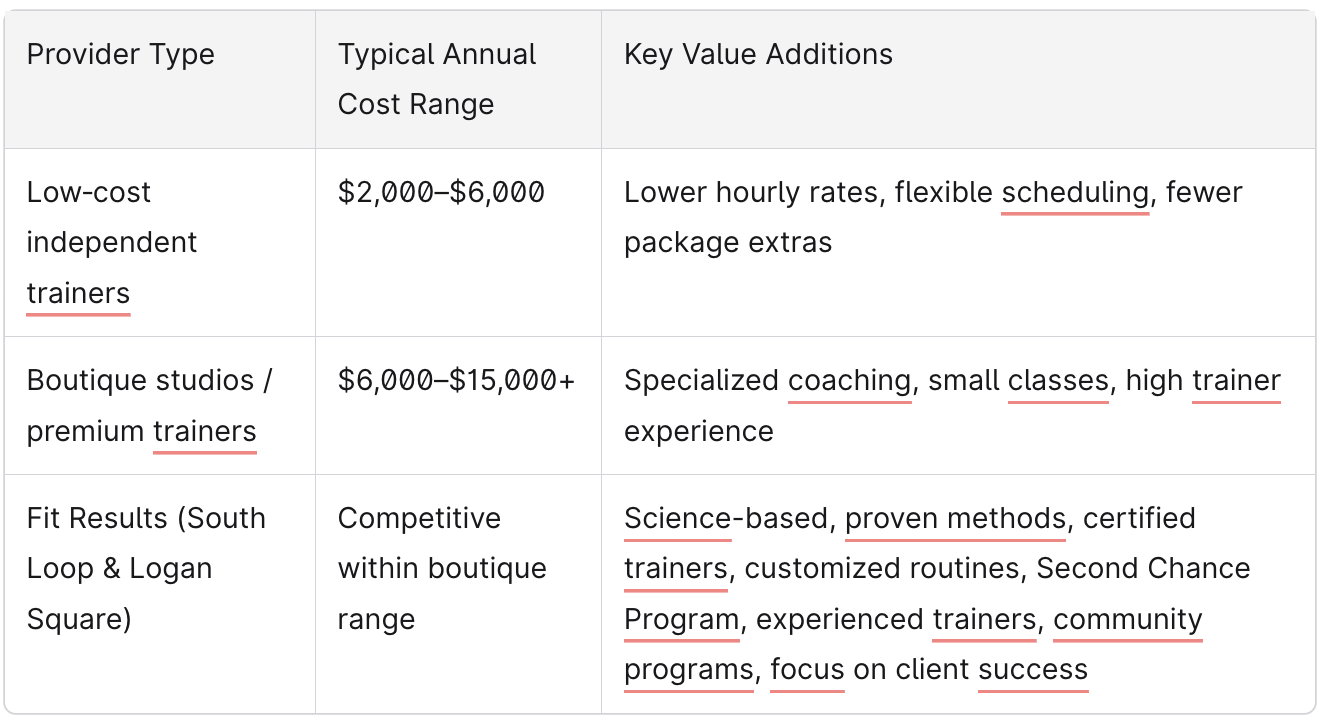
Science-based, proven methods, certified trainers, customized routines, Second Chance Program, experienced trainers, community programs, focus on client success
This view shows Fit Results prioritizes holistic value over competing on lowest price alone. The next subsection explains those differentiators in more detail.
What Fit Results offers beyond price
Fit Results brings several non‑price value elements that improve annual outcomes: our Second Chance Program for nutrition and accountability, experienced trainers who deliver progressive programming, and a supportive community that increases consistency. That combination reduces friction in long‑term training — nutrition support speeds visible results, skilled coaches lower injury risk and optimize progressions, and community classes create social reinforcement that keeps you showing up. Our programming is adaptable for different fitness levels and injuries so clients can stay consistent through setbacks. Aggregated client outcomes suggest that combining these services often reduces the total sessions needed to reach goals, improving cost‑effectiveness over a year.
Members can receive assistance at the desk for any questions, support needs, or issues accessing their personal training membership or purchased sessions. Our staff is always available to help manage your subscription or provide immediate help.
Fit Results personal training memberships often include access to fitness technology for watching and tracking your progress, such as monitoring biological age and body composition changes. This technology allows us to personalize your fitness plan and provide ongoing support, ensuring your program adapts as you progress.
Beyond training sessions, gym memberships frequently include services and amenities designed to attract and retain members.
Fitness club membership value & personal training services* FIT aims to attract members by offering class schedules, premium services like massage or tanning, personal training, and other amenities that add perceived value (Value proposition, 2009).*
Knowing these value‑adds helps you evaluate offers beyond sticker price. The next subsection looks at how neighborhood choice affects cost and convenience.
Fit Results South Loop: Your Destination for Personal Training Excellence
Located in the heart of Chicago's South Loop, Fit Results offers a premier PT membership experience tailored to help you reach your goals with the best expert trainers that will help guide and community support. Our South Loop location is designed for professionals and residents seeking a welcoming gym environment where personalized coaching meets proven, science-based fitness programs.
At Fit Results South Loop, our certified personal trainers create customized workout plans that focus on building muscle strength, improving endurance, and enhancing overall health. Whether you are starting your fitness journey or aiming to break through a plateau, our trainers use proven methods to design programs that align with your specific goals and fitness level.
Our personal training memberships include regular fitness assessments to establish your baseline and track progress, nutrition coaching through our Second Chance Program, and access to a variety of group training classes such as TRIPLE 20, GROUNDWORKS, and FITCAMP. These group classes complement your one-on-one sessions by providing fun, motivating environments to build confidence and community.
Scheduling your personal training sessions and assessments is simple, with assistance available at the front desk or through the ease of our booking app to ensure your plan fits your lifestyle. Our South Loop gym emphasizes inclusivity and adaptability, accommodating all fitness levels and those recovering from injuries.
Choosing Fit Results South Loop means investing in a comprehensive, supportive fitness experience that empowers you to maximize your training investment, build lasting habits, and enjoy the benefits of improved mental health, confidence, and physical performance. Join us to start your personalized fitness journey today with a free consultation tailored to your specific goals.
Technology and tracking: modern tools that add value
In today's fitness world, technology is a powerful friend that help clients and personal trainers work together more better to achieve fitness goals that we all want. Modern digital tools has made it easier than ever to track your fitness journey, set goals that are specific, and monitor progress in real time which is amazing. Whether you're just starting out or looking to break through a plateau that has stopped you, these innovations allow trainers to create a workout plan that is customized and matches your fitness level and adapts as you improve together. By putting technology into your training, you gain more insight into your workouts, nutrition, and overall health—this empower you to stay motivated and accountable every step of the way because we are in this together like a partnership.
How digital progress tracking enhances your training investment
Digital progress tracking has revolutionized the way personal training supports your fitness goals and helps you move ahead in your fitness journey. With the help of apps and wearable devices, you and your certified personal trainer can monitor every aspect of your training, from workout performance to nutrition habits and overall health metrics that helps you stay motivated. This data-driven approach allows trainers to fine-tune your workout plan, making adjustments based on your progress and ensuring you're always moving closer to your goals like a true partnership. Tracking tools also boost accountability and motivation—seeing your improvements in black and white can be incredibly rewarding and keeps you focused on your next milestone because we set goals and we achieve them together. For example, using apps like MyFitnessPal to log meals or a Fitbit to track daily activity gives both you and your trainer a clear picture of your habits, making it easier to celebrate successes and identify areas for improvement that helps everyone the same. Digital tracking helps newbies that have never worked out in their life to the person that has some knowledge of fitness and what to do. Ultimately, digital tracking transforms your personal training investment into a more measurable, motivating, and results-driven experience that brings to light the many people that are committed to help others when they need encouragement and fitness expertise.
Popular apps and devices used by Chicago trainers
Chicago's top trainers is passionate about helping clients and they leverage a range of apps and devices to help you maximize your personal training results. Fitness wearables like Garmin and Apple Watch is popular choices for tracking workouts, heart rate, and daily activity. These devices provide real-time feedback that helps you and your trainer to adjust your plan as needed and helps you stay motivated. Mobile apps such as Nike Training Club and JEFIT offer guided workouts and progress tracking. These apps make it easy to stay on top of your fitness journey between sessions and helps you when you need encouragement. Many local gyms and clubs from all walks of life, including Fit Results, use digital platforms like MindBody or Trainerize to help streamline scheduling and deliver customized workout routines. These platforms facilitate communication between clients and trainers and helps everyone stay connected. These tools not only make it simple to book your next session or access your workout plan, but also helps ensure you're consistently working toward your fitness goals like a partnership. By embracing technology, you can maximize your training investment and achieve better results. You can enjoy a more engaging and connected fitness experience that helps you whether you're training one-on-one, in a small group, or as part of a vibrant club community that encourages you to move ahead in life.
Strategies to maximize value from a yearly training plan
To get the most from an annual training plan, combine package discounts with a mix of one‑on‑one and group sessions, prioritize consistent attendance, and leverage nutrition education and accountability to accelerate results. Learning what to eat to support your fitness goals is essential—food can act as medicine, helping you recover, boost energy, and improve overall wellness. These strategies not only lower effective per‑session cost and shorten time to goal, but also maximize your success by enhancing self-esteem and body confidence through improved fitness outcomes.
Practical tactics include negotiating bundled rates for combined services, clarifying contract terms (refunds, freezes, transfers), and planning seasonal training phases with higher‑frequency blocks followed by maintenance. Ongoing education—both for you and your trainers—ensures your plan stays effective and up-to-date with the latest fitness and nutrition science. The subsections below give examples of discount mechanics and explain why semi‑private or group training often delivers the best affordability for steady progress.
Applying these tactics ensures your annual commitment produces measurable progress and personal success, rather than just recurring payments.
How package discounts and long‑term commitments lower annual cost
Prepaying or committing long‑term typically knocks 10–30% off per‑session cost versus month‑to‑month pricing, depending on provider policy and package size. For example, a $400/month plan might drop to an effective $320/month with a 20% annual prepay — nearly $960 saved over a year. Multi‑session bundles often include free assessments or program design that add value. When negotiating, confirm freeze policies, refunds, transferability, and the ability to cancel your membership or scheduled sessions in person at the front desk before billing occurs to avoid surprise fees if your schedule changes. Also verify what deliverables are included — assessments, nutrition check‑ins, or progress reports — so you can compare offers fairly.
Knowing how discounts work helps you evaluate true annual cost and safeguard your investment with clear contract terms, including how to manage cancellations at the front desk.
Why semi‑private or group training is a smart affordable choice
Semi‑private and group training lower the marginal cost of coach time while keeping professional oversight and structured programming, making them ideal for people who want affordability plus accountability. Group formats empower participants by providing personalized support and guidance, and encourage you to bring friends or meet new ones for added motivation and support. This social aspect, combined with our strong community, helps you stay committed to your goals. Group formats let you attend frequently at a low per‑session cost, and semi‑private groups still offer enough coach attention for safe progressions. These options are well suited to conditioning, weight management, or general fitness goals rather than highly specialized training. Pairing occasional one‑on‑one sessions with regular group classes creates a hybrid model — technical tuning plus low‑cost frequent training.
Choosing these formats tends to increase attendance and frequency, which improves outcome‑per‑dollar versus irregular one‑on‑one sessions.
Common questions about yearly personal trainer costs in Chicago
Personal Training FAQs
Here are concise, actionable answers to common questions about yearly personal training costs in Chicago so you can compare quickly and decide if an annual plan fits your goals. Each answer includes ranges and the assumptions used. For any questions or support needs, members can get assistance at the desk, where our staff is ready to help. After these personal training FAQs, we outline how to request a tailored quote and book a consultation with local providers. Appointments for consultations can be booked in person at the desk or online for your convenience. When choosing a trainer, keep in mind that personal trainers are often required to have certifications from recognized organizations, ensuring you receive professional guidance.
What is the average yearly cost for personal training in Chicago?
For typical one‑on‑one frequencies (1–2 sessions/week) the average yearly cost in Chicago usually falls between $3,000 and $9,000, assuming 48–52 training weeks per year. For example, 1×/week at $75/hour for 48 weeks equals $3,600; 2×/week at the same rate equals $7,200. Semi‑private and group formats reduce per‑person totals substantially when modeled on a per‑person basis — often 30–60% lower. Key variables are trainer experience, package inclusions, and session length. Use the formula to make your own projection and adjust for vacations and holidays.
Are yearly personal training memberships worth the investment?
Yes — when you want consistent accountability, tailored programming, and measurable progress over months, a yearly membership typically delivers better long‑term ROI than pay‑as‑you‑go. Benefits include package discounts, habit formation from scheduled sessions, and faster progress from progressive programming. Yearly memberships also support greater success by providing the structure needed to reach personal milestones, while ongoing personal training can boost confidence, reduce anxiety, and improve mental health and self-esteem. Downsides are upfront commitment and potential schedule rigidity. Pay‑as‑you‑go can work for short‑term needs or unpredictable schedules, but if your goals need ongoing coaching, a yearly plan generally gives stronger results per dollar. Consider your discipline, schedule, and timeline when choosing the model that fits your needs.
For a personalized recommendation based on your availability and goals, contact local providers for a consultation and itemized membership breakdown.
Fit Results offers in‑person consultations and membership overviews at our South Loop location, staffed by the best professional trainers and supported by the Second Chance Program. Prospective members can call the studio number listed on our site to ask about current membership options and schedule a free consultation. Our South Loop team can outline one‑on‑one, semi‑private, and group yearly packages and recommend a plan that fits your schedule and objectives.
- Schedule a consultation: Discuss goals and availability with a trainer to build a personalized annual plan.
- Compare bundles: Request an itemized quote showing sessions, assessments, and included services.
- Confirm terms: Verify freeze, refund, and transfer policies before you commit.
These steps move you from budgeting to booking with a clear idea of what an annual investment will deliver.
Frequently asked questions
What should I look for when choosing a personal trainer in Chicago?
Look for credentials, relevant experience, and a track record of client results. Personal trainers are often required to have certifications from recognized organizations, such as the National Academy of Sports Medicine (NASM) or the American Council on Exercise (ACE)—these national academy certifications ensure your trainer has a solid foundation in science-based, effective, and safe fitness programs. Ongoing education is also important, as it keeps trainers updated with the latest techniques and enhances the quality of coaching and results achieved by clients. Match the trainer’s style to your preferences (hands‑on coaching vs. group energy) and ask about their approach to nutrition and overall wellness — those make a big difference. Read client reviews and ask for references or before/after examples to gauge results and fit.
How can I determine the right training format for my goals?
Pick the format that matches your goal, budget, and schedule. One‑on‑one works best for rehab, performance goals, or highly individualized plans. Semi‑private or small group training involves 2–6 participants, offering a community feel and more affordable rates compared to one-on-one sessions. Group classes are ideal for community‑driven, frequent training. Think about how often you’ll realistically attend and whether you need technical correction or just consistent conditioning.
Are there any hidden costs with personal training memberships?
Potential extra costs include initial assessments, nutrition consultations, or add‑on services not covered by the base membership. Some trainers charge for late cancellations or reschedules, and may require you to cancel in person at the front desk before billing occurs. Ask up front about all fees, equipment requirements, and facility access so there are no surprises.
What is the typical duration of personal training sessions?
Sessions commonly last 45–60 minutes, which allows for warm‑up, main work, and cooldown. Some trainers offer shorter or longer sessions depending on goals and client needs — discuss preferred session length when you book.
How often should I train with a personal trainer for optimal results?
Most clients do well with 1–3 sessions per week. Beginners or those targeting rapid change may benefit from more frequent sessions; advanced clients might use fewer sessions for maintenance. Regular PT sessions help build strength, improve muscle strength, and enhance cardio fitness. Work with your trainer to design a frequency that fits your goals and recovery capacity.
Can I combine personal training with other fitness activities?
Absolutely. Combining personal training with group classes, outdoor workouts, or activities with friends can empower you to stay motivated and consistent. This approach not only keeps routines fresh but also improves overall results. Tell your trainer about your other activities so they can build a balanced program that avoids overlap and supports progress.
What should I expect during my first personal training session?
Your first session is typically scheduled by appointment and includes an intake where your trainer will discuss your goals, review your medical history or injuries, and conduct an assessment to establish a baseline of your body composition and fitness level. This baseline helps track your progress and tailor your program to your unique needs. You’ll be guided through specific exercises, with instruction on proper technique, using science-based, proven methods to ensure safety and effectiveness. Personal training memberships may also include a free initial consultation or assessment to establish your fitness goals and baseline measurements. This session sets the foundation for your personalized program.
Conclusion
Knowing the true costs and benefits of personal training in Chicago helps you choose a plan that fits your life and moves you toward your goals. Compare formats, check what’s included, and pick the location and schedule that reduce friction so you actually use the membership. Whether you go one‑on‑one, semi‑private, or group, the right annual plan can deliver meaningful health and fitness gains. Ready to figure out what works for you? Explore our membership options and schedule a consultation to get a plan tailored to your goals.
Personal Training Membership: What to Expect from Chicago Personal Trainer Costs

Picking a yearly personal training plan in Chicago means thinking beyond the hourly rate. You’ll want to compare session frequency, program inclusions, and how those line up with your schedule to estimate a realistic annual spend. Personal training memberships often begin with an appointment for a fitness assessment, which establishes a baseline of your body composition to track progress and tailor your program. This guide shows how to convert hourly rates into yearly totals, compares one-on-one, semi-private, and group formats, and shares practical ways to get more value from a year-long commitment. You’ll find typical Chicago ranges for each format, the main price drivers, simple formulas you can reuse, and examples to adapt to your goals. We also explain how extras — nutrition support, assessments, and community programs — affect long-term return on investment and preview Fit Results’ membership options for South Loop. By the end, you’ll have clear conversion formulas, side-by-side comparisons, savings tactics, and a next step to get personalized pricing.
Typical yearly personal trainer costs in Chicago
Annual costs for personal training in Chicago vary because totals depend on session frequency, hourly rate, and what’s included in the package. Broadly: one‑on‑one plans tend to land in the mid four‑figures up to low five‑figures annually, semi‑private packages usually convert to a mid‑to‑high three‑figure monthly equivalent per person, and group‑class memberships offer the lowest per‑person annual cost. Below we define those ranges, list the assumptions used (session length, weeks per year), and give a compact conversion table so you can compare formats by sessions/week and estimated yearly cost. Use these baselines to interpret quotes and pick the format that fits your budget and goals. The next subsection walks through the simple math so you can model your own annual projection.
Personal training sessions can be purchased in packages of four, eight, or twelve sessions. Packages may expire at the end of each month or within a set period from the purchase date, so be sure to review the terms when you purchase your sessions.
Different training formats deliver different per‑session value, so the clearest comparison is a metric like “cost per effective training hour” or “cost per month of consistent coaching.” That’s what the table below is designed to show.
There are established models for assessing training cost‑effectiveness that can help frame your decision.
Assessing personal training investment & cost‑effectiveness* The Industrial Training Research Project combined economic reasoning from several cost‑effectiveness models used in the training profession to evaluate training investments and outcomes (Cost effectiveness: A model for assessing the training investment, 1978).*
Below is a quick annual cost comparison: one‑on‑one, semi‑private, and group training, using common attributes so you can see how hourly rates, session frequency, and included services affect yearly price.

This table shows how session frequency and hourly price scale into annual totals. Next we’ll walk through the conversion formula and practical examples to translate hourly rates into yearly expenses.
How hourly rates translate to annual training expenses
Use this simple formula: . For planning, assume 48–52 training weeks to account for vacations and breaks, and session lengths typically run 45–60 minutes. For example, an $80/hour trainer at one session per week for 48 weeks equals $3,840 a year; at two sessions per week that same trainer totals $7,680. For semi‑private sessions, the session cost to get the per‑session total — a $30-50 cost per session, or $2800 per year at bi weekly attendance.
Some providers, such as the YMCA, offer packages for personal training sessions to both members and non-members, allowing clients to schedule sessions or assessments as desired based on their individual goals.
These quick calculations let you compare scenarios across formats. The next section breaks down the core factors that widen or narrow these ranges so you can tailor assumptions to your situation.
Factors that influence yearly personal trainer pricing in Chicago
Yearly pricing depends on trainer experience and certifications, neighborhood demand, session length, package size, and extras like nutrition coaching or progress testing. Most personal trainers hold certifications from recognized bodies such as the National Academy of Sports Medicine (NASM) or the American Council on Exercise (ACE). Ongoing education through partnerships with national academies ensures quality coaching and up-to-date fitness science. Specialists and highly experienced trainers charge more, which increases annual costs. Group formats reduce per-person cost by sharing coach time. Location and peak hours also affect pricing. Packages including monthly check-ins, programming, and nutrition guidance may raise upfront costs but lower effective per-session price and improve results.
Understanding these factors helps identify where to save and where higher investment improves outcomes. Next, we review typical one-on-one annual pricing and membership inclusions.
One‑on‑one personal training: annual cost breakdown
One‑on‑one training in Chicago commonly totals roughly $3,000 to $15,000 per year depending on hourly rate and session frequency. Many trainers offer a complimentary initial consultation or trial session, which can be scheduled by appointment, to determine if their coaching style motivates you. PT memberships may include a free initial consultation or assessment to set goals and establish a baseline of body composition and fitness metrics. These memberships generally include tailored programming, periodic assessments, and some level of nutrition support. During assessments, trainers often measure various aspects of your body, such as fat percentage and muscle mass, to track progress and personalize your plan. The ranges below assume 45–60 minute sessions and 48–52 training weeks per year; higher session frequency or premium trainers push costs toward the top of the range. When comparing one‑on‑one offers, look at included assessments, program updates, and accountability features — those extras can deliver more value even if the price is higher.
Trainers use science-based, proven methods to design effective training plans tailored to each client, ensuring safe and sustainable results. The next subsection outlines the main benefits of committing to a yearly one‑on‑one plan, followed by how local providers commonly structure annual memberships.
One‑on‑one coaching typically produces faster, more targeted progress than group formats, so the value conversation should weigh outcomes as much as price.
Benefits of investing in yearly one‑on‑one training
A year of individual coaching gives you focused programming, steady accountability, and coach oversight that speeds progress and reduces plateaus. Trainers design highly efficient workouts that can help you see success and progress up to 30% faster than training alone. Personal attention lets trainers tailor progressions, manage recovery, and adjust nutrition based on regular assessments — which usually leads to faster strength gains, cleaner movement, and better long‑term adherence. For rehab cases or complex goals, one‑on‑one sessions deliver the specificity needed to progress safely. Committing for a year builds habits that turn short‑term wins into lasting change, and regular measurement creates a clear ROI by tracking progress against benchmarks.
Personal training also enhances self-esteem, body confidence, and mental health, reducing anxiety and increasing self-confidence as you achieve your goals. Seeing these benefits makes it easier to decide if the higher price of one‑on‑one training will shorten your path to the goal and reduce wasted sessions later on.
How Fit Results structures one‑on‑one yearly memberships
Fit Results’ one-on-one yearly memberships include scheduled sessions, personalized program design, periodic assessments, and nutrition coaching through our Second Chance Program. Book personal training sessions and fitness assessments via the front desk or by contacting staff. Follow-up assessments track your progress throughout the year. Assistance with session access is available at the front desk or through our team. Memberships offer flexible scheduling, trainer assignment, and include sessions, assessments, and accountability check-ins. Our experienced trainers and inclusive programming support all fitness levels and injuries, promoting year-long consistency and results. Fit Results serves Chicago clients in South Loop and Logan Square with trainers like Luis Centeno, Marina Centeno, and Ronica H.
Some providers, like the YMCA, offer buddy wellness packages requiring each participant to purchase a package. EōS Fitness offers a free one-hour welcome workout for new personal training clients.
This structure combines hands-on coaching with long-term accountability. Below is an overview of Fit Results’ yearly offerings to compare sessions and core inclusions across formats.

This snapshot shows how Fit Results layers services for different budgets and goals. Next we’ll dig into semi‑private and group yearly costs in more detail.
Semi‑private and group training: yearly cost expectations
Semi‑private and small group training lower annual cost per person by sharing coach time and using economies of scale. Small group training typically involves 2–6 participants, offering a community feel and more affordable rates compared to one-on-one sessions. Group classes often encourage bringing friends or meeting new people, which enhances motivation and creates a supportive environment. Typical per‑person annual costs often range from about $1,000 to $6,000 depending on frequency and program model. Semi‑private formats reduce hourly cost by splitting the session fee across participants, while unlimited or high‑frequency group passes drive effective per‑session cost down for regular attendees.
Group fitness classes at Fit Results focus on building strength and cardio fitness through a variety of exercises, including both steady-state and HIIT cardio, as well as strength training routines. These coach-led sessions ensure proper technique and offer injury-friendly exercise modifications, making them suitable for all experience levels.
When comparing annualized prices, calculate the effective cost per attended session and factor in class size and instructor quality — a small semi‑private with a skilled coach can outperform a large class in outcomes. For those who are self-motivated, familiar with gym equipment, and seeking cost-effective access, a regular gym membership is an ideal option.
The next subsections quantify savings with examples and outline Fit Results’ group membership options and value proposition.
Choosing between semi‑private and group formats is a trade‑off between individualized attention and cost efficiency — the numbers below make that trade‑off concrete.
How semi‑private packages save money over a year
Semi‑private packages often deliver 30–60% per‑person savings versus one‑on‑one because the trainer’s hourly rate is split. For example, a $120 session shared by four people becomes $30 each. Weekly attendance at $30 per session for 48 weeks totals $1,440 per person, while the equivalent one‑on‑one at $120/session totals $5,760 a year — a clear difference. Trade‑offs include less individualized attention and more generalized programming, but many people gain consistency and motivation from the small‑group dynamic, which can increase frequency and long‑term results. Semi-private training empowers participants to achieve success by encouraging each other and building muscle strength in a supportive environment. When you model cost, include add‑ons like nutrition coaching or periodic assessments that may change the effective annual rate.
These comparisons help you decide whether the lower cost is worth the reduced one‑on‑one time, which leads into Fit Results’ group‑class pricing models.
Fit Results’ group class pricing and value
Fit Results runs group programming — TRIPLE 20, GROUNDWORKS, FITCAMP — delivered as instructor‑led classes and sold through class passes or membership models that lower per‑class cost for frequent users. Our group fitness training is structured, science-based, and grounded in proven methods to ensure safe, effective, and sustainable results. Many of our trainers have backgrounds in sports medicine, enhancing the safety and effectiveness of each group session, especially for those with injuries or specific needs.
Education is a core part of every class: trainers teach proper technique, provide ongoing learning opportunities, and help members understand the 'why' behind each movement. We also take a holistic approach to wellness, recognizing that food and lifestyle can act as medicine to support your overall health and fitness journey.
Group memberships are our most budget‑friendly option for consistent training: regular attendees pay far less per session than one‑on‑one clients, and unlimited or high‑use pass structures reward frequent attendance. The community and class variety also support adherence and make it easy to combine group classes with occasional private sessions for technical work. For many Chicagoans focused on cost and community, group classes are the best annual value.
Next we’ll compare Fit Results’ pricing and value against local market norms to highlight where our offerings differ beyond price.
How Fit Results compares to other Chicago training options
Comparing Fit Results to market averages shows that while some providers compete on the lowest hourly rate, we focus on trainer quality, inclusive programming, and services that improve effective ROI even if per‑session prices are modestly higher. Fit Results stands out by using science-based, proven methods grounded in current sports science research to deliver success for our clients. Our certified personal trainers provide customized workout routines based on individual fitness goals, and typically have a degree in an exercise-science-related field or equivalent experience. Market ranges for one‑on‑one training vary, but Fit Results differentiates with the Second Chance Program (nutrition guidance and accountability), experienced trainers, and a community approach — features that can shorten time to goal and reduce the total sessions needed. The table below visualizes common provider types and Fit Results’ relative strengths.
Looking beyond sticker price helps you weigh value‑adds like nutrition and community that often improve outcomes and adherence.

Science-based, proven methods, certified trainers, customized routines, Second Chance Program, experienced trainers, community programs, focus on client success
This view shows Fit Results prioritizes holistic value over competing on lowest price alone. The next subsection explains those differentiators in more detail.
What Fit Results offers beyond price
Fit Results brings several non‑price value elements that improve annual outcomes: our Second Chance Program for nutrition and accountability, experienced trainers who deliver progressive programming, and a supportive community that increases consistency. That combination reduces friction in long‑term training — nutrition support speeds visible results, skilled coaches lower injury risk and optimize progressions, and community classes create social reinforcement that keeps you showing up. Our programming is adaptable for different fitness levels and injuries so clients can stay consistent through setbacks. Aggregated client outcomes suggest that combining these services often reduces the total sessions needed to reach goals, improving cost‑effectiveness over a year.
Members can receive assistance at the desk for any questions, support needs, or issues accessing their personal training membership or purchased sessions. Our staff is always available to help manage your subscription or provide immediate help.
Fit Results personal training memberships often include access to fitness technology for watching and tracking your progress, such as monitoring biological age and body composition changes. This technology allows us to personalize your fitness plan and provide ongoing support, ensuring your program adapts as you progress.
Beyond training sessions, gym memberships frequently include services and amenities designed to attract and retain members.
Fitness club membership value & personal training services* FIT aims to attract members by offering class schedules, premium services like massage or tanning, personal training, and other amenities that add perceived value (Value proposition, 2009).*
Knowing these value‑adds helps you evaluate offers beyond sticker price. The next subsection looks at how neighborhood choice affects cost and convenience.
Fit Results South Loop: Your Destination for Personal Training Excellence
Located in the heart of Chicago's South Loop, Fit Results offers a premier PT membership experience tailored to help you reach your goals with the best expert trainers that will help guide and community support. Our South Loop location is designed for professionals and residents seeking a welcoming gym environment where personalized coaching meets proven, science-based fitness programs.
At Fit Results South Loop, our certified personal trainers create customized workout plans that focus on building muscle strength, improving endurance, and enhancing overall health. Whether you are starting your fitness journey or aiming to break through a plateau, our trainers use proven methods to design programs that align with your specific goals and fitness level.
Our personal training memberships include regular fitness assessments to establish your baseline and track progress, nutrition coaching through our Second Chance Program, and access to a variety of group training classes such as TRIPLE 20, GROUNDWORKS, and FITCAMP. These group classes complement your one-on-one sessions by providing fun, motivating environments to build confidence and community.
Scheduling your personal training sessions and assessments is simple, with assistance available at the front desk or through the ease of our booking app to ensure your plan fits your lifestyle. Our South Loop gym emphasizes inclusivity and adaptability, accommodating all fitness levels and those recovering from injuries.
Choosing Fit Results South Loop means investing in a comprehensive, supportive fitness experience that empowers you to maximize your training investment, build lasting habits, and enjoy the benefits of improved mental health, confidence, and physical performance. Join us to start your personalized fitness journey today with a free consultation tailored to your specific goals.
Technology and tracking: modern tools that add value
In today's fitness world, technology is a powerful friend that help clients and personal trainers work together more better to achieve fitness goals that we all want. Modern digital tools has made it easier than ever to track your fitness journey, set goals that are specific, and monitor progress in real time which is amazing. Whether you're just starting out or looking to break through a plateau that has stopped you, these innovations allow trainers to create a workout plan that is customized and matches your fitness level and adapts as you improve together. By putting technology into your training, you gain more insight into your workouts, nutrition, and overall health—this empower you to stay motivated and accountable every step of the way because we are in this together like a partnership.
How digital progress tracking enhances your training investment
Digital progress tracking has revolutionized the way personal training supports your fitness goals and helps you move ahead in your fitness journey. With the help of apps and wearable devices, you and your certified personal trainer can monitor every aspect of your training, from workout performance to nutrition habits and overall health metrics that helps you stay motivated. This data-driven approach allows trainers to fine-tune your workout plan, making adjustments based on your progress and ensuring you're always moving closer to your goals like a true partnership. Tracking tools also boost accountability and motivation—seeing your improvements in black and white can be incredibly rewarding and keeps you focused on your next milestone because we set goals and we achieve them together. For example, using apps like MyFitnessPal to log meals or a Fitbit to track daily activity gives both you and your trainer a clear picture of your habits, making it easier to celebrate successes and identify areas for improvement that helps everyone the same. Digital tracking helps newbies that have never worked out in their life to the person that has some knowledge of fitness and what to do. Ultimately, digital tracking transforms your personal training investment into a more measurable, motivating, and results-driven experience that brings to light the many people that are committed to help others when they need encouragement and fitness expertise.
Popular apps and devices used by Chicago trainers
Chicago's top trainers is passionate about helping clients and they leverage a range of apps and devices to help you maximize your personal training results. Fitness wearables like Garmin and Apple Watch is popular choices for tracking workouts, heart rate, and daily activity. These devices provide real-time feedback that helps you and your trainer to adjust your plan as needed and helps you stay motivated. Mobile apps such as Nike Training Club and JEFIT offer guided workouts and progress tracking. These apps make it easy to stay on top of your fitness journey between sessions and helps you when you need encouragement. Many local gyms and clubs from all walks of life, including Fit Results, use digital platforms like MindBody or Trainerize to help streamline scheduling and deliver customized workout routines. These platforms facilitate communication between clients and trainers and helps everyone stay connected. These tools not only make it simple to book your next session or access your workout plan, but also helps ensure you're consistently working toward your fitness goals like a partnership. By embracing technology, you can maximize your training investment and achieve better results. You can enjoy a more engaging and connected fitness experience that helps you whether you're training one-on-one, in a small group, or as part of a vibrant club community that encourages you to move ahead in life.
Strategies to maximize value from a yearly training plan
To get the most from an annual training plan, combine package discounts with a mix of one‑on‑one and group sessions, prioritize consistent attendance, and leverage nutrition education and accountability to accelerate results. Learning what to eat to support your fitness goals is essential—food can act as medicine, helping you recover, boost energy, and improve overall wellness. These strategies not only lower effective per‑session cost and shorten time to goal, but also maximize your success by enhancing self-esteem and body confidence through improved fitness outcomes.
Practical tactics include negotiating bundled rates for combined services, clarifying contract terms (refunds, freezes, transfers), and planning seasonal training phases with higher‑frequency blocks followed by maintenance. Ongoing education—both for you and your trainers—ensures your plan stays effective and up-to-date with the latest fitness and nutrition science. The subsections below give examples of discount mechanics and explain why semi‑private or group training often delivers the best affordability for steady progress.
Applying these tactics ensures your annual commitment produces measurable progress and personal success, rather than just recurring payments.
How package discounts and long‑term commitments lower annual cost
Prepaying or committing long‑term typically knocks 10–30% off per‑session cost versus month‑to‑month pricing, depending on provider policy and package size. For example, a $400/month plan might drop to an effective $320/month with a 20% annual prepay — nearly $960 saved over a year. Multi‑session bundles often include free assessments or program design that add value. When negotiating, confirm freeze policies, refunds, transferability, and the ability to cancel your membership or scheduled sessions in person at the front desk before billing occurs to avoid surprise fees if your schedule changes. Also verify what deliverables are included — assessments, nutrition check‑ins, or progress reports — so you can compare offers fairly.
Knowing how discounts work helps you evaluate true annual cost and safeguard your investment with clear contract terms, including how to manage cancellations at the front desk.
Why semi‑private or group training is a smart affordable choice
Semi‑private and group training lower the marginal cost of coach time while keeping professional oversight and structured programming, making them ideal for people who want affordability plus accountability. Group formats empower participants by providing personalized support and guidance, and encourage you to bring friends or meet new ones for added motivation and support. This social aspect, combined with our strong community, helps you stay committed to your goals. Group formats let you attend frequently at a low per‑session cost, and semi‑private groups still offer enough coach attention for safe progressions. These options are well suited to conditioning, weight management, or general fitness goals rather than highly specialized training. Pairing occasional one‑on‑one sessions with regular group classes creates a hybrid model — technical tuning plus low‑cost frequent training.
Choosing these formats tends to increase attendance and frequency, which improves outcome‑per‑dollar versus irregular one‑on‑one sessions.
Common questions about yearly personal trainer costs in Chicago
Personal Training FAQs
Here are concise, actionable answers to common questions about yearly personal training costs in Chicago so you can compare quickly and decide if an annual plan fits your goals. Each answer includes ranges and the assumptions used. For any questions or support needs, members can get assistance at the desk, where our staff is ready to help. After these personal training FAQs, we outline how to request a tailored quote and book a consultation with local providers. Appointments for consultations can be booked in person at the desk or online for your convenience. When choosing a trainer, keep in mind that personal trainers are often required to have certifications from recognized organizations, ensuring you receive professional guidance.
What is the average yearly cost for personal training in Chicago?
For typical one‑on‑one frequencies (1–2 sessions/week) the average yearly cost in Chicago usually falls between $3,000 and $9,000, assuming 48–52 training weeks per year. For example, 1×/week at $75/hour for 48 weeks equals $3,600; 2×/week at the same rate equals $7,200. Semi‑private and group formats reduce per‑person totals substantially when modeled on a per‑person basis — often 30–60% lower. Key variables are trainer experience, package inclusions, and session length. Use the formula to make your own projection and adjust for vacations and holidays.
Are yearly personal training memberships worth the investment?
Yes — when you want consistent accountability, tailored programming, and measurable progress over months, a yearly membership typically delivers better long‑term ROI than pay‑as‑you‑go. Benefits include package discounts, habit formation from scheduled sessions, and faster progress from progressive programming. Yearly memberships also support greater success by providing the structure needed to reach personal milestones, while ongoing personal training can boost confidence, reduce anxiety, and improve mental health and self-esteem. Downsides are upfront commitment and potential schedule rigidity. Pay‑as‑you‑go can work for short‑term needs or unpredictable schedules, but if your goals need ongoing coaching, a yearly plan generally gives stronger results per dollar. Consider your discipline, schedule, and timeline when choosing the model that fits your needs.
For a personalized recommendation based on your availability and goals, contact local providers for a consultation and itemized membership breakdown.
Fit Results offers in‑person consultations and membership overviews at our South Loop location, staffed by the best professional trainers and supported by the Second Chance Program. Prospective members can call the studio number listed on our site to ask about current membership options and schedule a free consultation. Our South Loop team can outline one‑on‑one, semi‑private, and group yearly packages and recommend a plan that fits your schedule and objectives.
- Schedule a consultation: Discuss goals and availability with a trainer to build a personalized annual plan.
- Compare bundles: Request an itemized quote showing sessions, assessments, and included services.
- Confirm terms: Verify freeze, refund, and transfer policies before you commit.
These steps move you from budgeting to booking with a clear idea of what an annual investment will deliver.
Frequently asked questions
What should I look for when choosing a personal trainer in Chicago?
Look for credentials, relevant experience, and a track record of client results. Personal trainers are often required to have certifications from recognized organizations, such as the National Academy of Sports Medicine (NASM) or the American Council on Exercise (ACE)—these national academy certifications ensure your trainer has a solid foundation in science-based, effective, and safe fitness programs. Ongoing education is also important, as it keeps trainers updated with the latest techniques and enhances the quality of coaching and results achieved by clients. Match the trainer’s style to your preferences (hands‑on coaching vs. group energy) and ask about their approach to nutrition and overall wellness — those make a big difference. Read client reviews and ask for references or before/after examples to gauge results and fit.
How can I determine the right training format for my goals?
Pick the format that matches your goal, budget, and schedule. One‑on‑one works best for rehab, performance goals, or highly individualized plans. Semi‑private or small group training involves 2–6 participants, offering a community feel and more affordable rates compared to one-on-one sessions. Group classes are ideal for community‑driven, frequent training. Think about how often you’ll realistically attend and whether you need technical correction or just consistent conditioning.
Are there any hidden costs with personal training memberships?
Potential extra costs include initial assessments, nutrition consultations, or add‑on services not covered by the base membership. Some trainers charge for late cancellations or reschedules, and may require you to cancel in person at the front desk before billing occurs. Ask up front about all fees, equipment requirements, and facility access so there are no surprises.
What is the typical duration of personal training sessions?
Sessions commonly last 45–60 minutes, which allows for warm‑up, main work, and cooldown. Some trainers offer shorter or longer sessions depending on goals and client needs — discuss preferred session length when you book.
How often should I train with a personal trainer for optimal results?
Most clients do well with 1–3 sessions per week. Beginners or those targeting rapid change may benefit from more frequent sessions; advanced clients might use fewer sessions for maintenance. Regular PT sessions help build strength, improve muscle strength, and enhance cardio fitness. Work with your trainer to design a frequency that fits your goals and recovery capacity.
Can I combine personal training with other fitness activities?
Absolutely. Combining personal training with group classes, outdoor workouts, or activities with friends can empower you to stay motivated and consistent. This approach not only keeps routines fresh but also improves overall results. Tell your trainer about your other activities so they can build a balanced program that avoids overlap and supports progress.
What should I expect during my first personal training session?
Your first session is typically scheduled by appointment and includes an intake where your trainer will discuss your goals, review your medical history or injuries, and conduct an assessment to establish a baseline of your body composition and fitness level. This baseline helps track your progress and tailor your program to your unique needs. You’ll be guided through specific exercises, with instruction on proper technique, using science-based, proven methods to ensure safety and effectiveness. Personal training memberships may also include a free initial consultation or assessment to establish your fitness goals and baseline measurements. This session sets the foundation for your personalized program.
Conclusion
Knowing the true costs and benefits of personal training in Chicago helps you choose a plan that fits your life and moves you toward your goals. Compare formats, check what’s included, and pick the location and schedule that reduce friction so you actually use the membership. Whether you go one‑on‑one, semi‑private, or group, the right annual plan can deliver meaningful health and fitness gains. Ready to figure out what works for you? Explore our membership options and schedule a consultation to get a plan tailored to your goals.


.png)
