


Ankle Flexibility Squats: Tests, Fixes, and Training Guide
Introduction
Ankle flexibility squats are all about the link between your ankle’s dorsiflexion range and how well you can squat deep, stable, and pain-free. If your ankles are stiff, you might find yourself lifting your heels, leaning too far forward, or not hitting the depth you want. This guide cuts through the noise with simple tests, focused drills, and smart training tips to boost your ankle range so your squats feel better and safer.
What This Guide Covers
This article explains how ankle flexibility directly impacts squat technique through simple at-home assessments, specific ankle mobility exercises that transfer to squatting, and practical programming to integrate mobility work into your training routine. We focus on actionable solutions rather than complex anatomy, though we won’t cover complete rehabilitation protocols for severe ankle injuries or post-surgical guidelines—consult a physical therapy professional for those situations.
Who This Is For
This guide targets lifters who struggle to reach parallel in back or front squats, CrossFitters battling overhead squat mobility, general gym-goers dealing with stiff ankles, and home exercisers wanting deeper bodyweight squats. Whether you’re a beginner learning squat mechanics or an experienced lifter who relies on weightlifting shoes, you’ll find practical strategies to improve your ankle range and squat performance.
Why Ankle Flexibility Matters for Squats
Poor ankle mobility forces your body into compensatory patterns during squats: heels lift off the ground, knees stop traveling forward, or your torso collapses into excessive forward lean to maintain balance. Restricted ankle dorsiflexion can also lead to increased knee valgus, which is a compensatory inward movement of the knees that increases injury risk. These compensations limit squat depth, increase injury risk, and reduce the training stimulus on target muscles. Good ankle mobility allows deeper, more stable squats with better posture.
What You’ll Learn:
- Simple tests to determine if limited ankle mobility restricts your squat depth
- The difference between soft tissue tightness and joint restrictions in your ankle. It is important to identify the root cause of ankle mobility restrictions to determine the most effective treatment approach.
- Specific ankle mobility exercises that directly transfer to squatting patterns
- How to program mobility work efficiently without extending workouts by 30 minutes
- When to use tools like weightlifting shoes strategically versus when they become a crutch
Understanding Ankle Flexibility in the Context of Squats
Ankle flexibility for squats primarily involves dorsiflexion—the ability of your shin to move forward over your foot while keeping your heel planted. The ankle joint is a hinge joint, primarily allowing movement in one plane, which is crucial for proper squatting mechanics. This ankle movement allows your knee to travel forward during the squat descent, enabling deeper positions while maintaining an upright torso and balanced foot pressure.

Key Ankle Movements Relevant to Squatting
Dorsiflexion occurs when your shin moves forward and the angle between your foot and lower leg decreases, like at the bottom of a deep squat. Plantarflexion is the opposite motion—pointing your toes down—which happens when you drive out of the squat hole. After plantarflexion, the foot returns to a flexed position as you transition back into the squat, especially when using resistance bands for ankle flexibility exercises. While plantarflexion provides power for standing up, inadequate dorsiflexion limits how deep you can descend with proper form.
Inversion and eversion (ankle tilting side-to-side) affect frontal plane control during squats. Good ankle stability in these directions helps maintain proper knee tracking over your toes and prevents ankle rolling, especially important in single-leg squat variations.
This connects to ankle flexibility for squats because sufficient ankle dorsiflexion range allows your knees to move forward so you can maintain an upright torso and keep your heels flat throughout the full range of motion.
How Ankle Flexibility Shapes Squat Technique
Ankle range of motion directly influences several critical squat mechanics. Squat depth depends heavily on ankle dorsiflexion—limited ankle range forces you to stop descending before reaching parallel, even if your hip mobility would allow deeper positions. Torso angle changes dramatically with ankle restrictions: poor ankle mobility forces excessive forward lean to keep your center of mass over your feet.
Foot pressure distribution shifts when ankle dorsiflexion is inadequate. Instead of maintaining balanced contact across your whole foot, limited ankle mobility often causes heel lifting or shifting weight toward your toes, compromising stability and power transfer.
Different squat variations demand varying amounts of ankle dorsiflexion. Front squats and high-bar back squats require more ankle mobility to maintain the upright torso position, while low-bar back squats can accommodate some ankle restriction through increased hip hinge. Overhead squats demand the most ankle range due to the overhead load requiring maximal torso upright position. Olympic lifting movements, such as the clean and snatch, require even greater ankle dorsiflexion to maintain proper form and safety during these high-performance lifts.
Building on this foundation, the next section provides simple tests to determine whether ankle flexibility limits your specific squat patterns.
Factors Restricting Ankle Mobility
Ankle mobility is something that really makes all the difference when it comes to moving better, especially when you're trying to squat or doing other lower body exercises. There's several things that can mess with your ankle range and make it hard to get that deep, stable squat we all want. Understanding what's holding you back is the first step to helping you move better and perform like the athlete you are.
Soft Tissue Tightness:One of the biggest things that limits ankle mobility is when your calf muscles, Achilles tendon, and plantar fascia gets all tight and stiff. When these tissues are tight, they stop your ankle from doing dorsiflexion—that's the movement that lets your knee travel forward over your foot like it should. This makes it real hard to keep your heels down and get to that proper squat depth we're working toward. Regular mobility work, like calf stretches and foam rolling, is going to help loosen up that soft tissue tightness and get your ankle range moving better.
Joint and Bony Restrictions:Sometimes, the problem comes right from the ankle joint itself. You might have a bony block or joint capsule stiffness that creates this hard stop or pinching feeling at the front of your ankle, and it just won't let you go any further with dorsiflexion. These restrictions needs targeted mobility drills, like banded joint mobilizations, to get that mobility back and restore the normal range you should have.
Previous Ankle Injuries:If you have a history of ankle injuries, like ankle sprains, that can leave behind scar tissue and chronic stiffness that really affects your ankle mobility. This reduced ankle dorsiflexion can stick around long after that initial injury happened, and it affects your ability to squat deeper and move the way you want to. We need to address these lingering effects with specific mobility exercises and, if you need it, physical therapy is going to be crucial for getting back that full ankle function.
Influence of Hip and Thoracic Mobility:While we're focusing on the ankle joint, restrictions in your hip mobility or thoracic spine mobility can also impact how your ankle moves when you're squatting or doing other movements. If your hips or upper back are tight, your body is going to compensate by shifting extra stress to the ankle, and that limits your squat pattern even more and increases your risk of getting hurt.
Footwear and External Factors:The shoes you wear, especially those weightlifting shoes with elevated heels, can temporarily hide limited ankle mobility by letting you squat deeper. However, if you rely only on footwear, you're not addressing the real cause of your ankle restriction. We want to incorporate mobility exercises and sometimes train barefoot or in flat shoes so you can develop lasting improvements in ankle range that actually stick.
Why Addressing Ankle Mobility Matters:Good ankle mobility is essential for keeping proper squat form, reducing compensations that stress your knees and hips, and preventing injuries from happening. By improving ankle dorsiflexion and overall ankle range, you're going to squat deeper, move more efficiently, and enhance your athletic performance like you want. Whether you're recovering from an ankle injury or just want to move better, making ankle mobility exercises a priority and addressing what's causing the restriction is going to pay off both now and long term.
You want to incorporate a mix of stretching, foam rolling, and resistance band drills into your routine to target both soft tissue and joint restrictions. If you experience persistent stiffness or pain, you need to consult a physical therapy professional for a personalized approach that works for you. By making ankle mobility a regular part of your training, you're setting the foundation for better movement, injury prevention, and long-term health that's going to change how you feel and perform.
Assessing Your Ankles: Are They Limiting Your Squats?
Now that you understand how ankle mobility affects squatting mechanics, these assessments will reveal whether ankle range restrictions contribute to your squat limitations. Testing both isolated ankle range and squatting patterns gives you the clearest picture of where to focus your mobility efforts.
Screen 1: Bodyweight Squat Check
When to use this: As your primary squat mobility screen before any ankle-specific interventions.
- Setup: Stand barefoot or in flat shoes with feet shoulder-width apart, arms extended forward for counterbalance
- Descent: Slowly lower into your deepest possible squat while keeping both heels flat on the ground
- Observe: Note where you feel restrictions—does heel lifting occur? Do your knees stop well behind your toes? Does your torso fold forward excessively to maintain balance?
- Assess: Film yourself from the side and front if possible to objectively evaluate these compensations
If you feel the primary restriction at the front or back of your ankle joint and your hips feel relatively mobile, limited ankle dorsiflexion likely restricts your squat depth and quality.
Screen 2: Knee-to-Wall (Weight-Bearing Lunge) Test
This assessment quantifies your functional ankle dorsiflexion range in a weight-bearing position that closely mimics squatting demands.
Setup and execution:
- Position: Assume a half kneeling position facing a wall with your front foot’s toes approximately 10-14 cm (4-5.5 inches) from the wall
- Movement: Drive your front knee toward the wall without allowing your heel to lift, keeping your knee tracking over the middle of your foot. As your shin moves forward, your foot moves and the talus bone moves backwards relative to the tibia—this backward glide is essential for proper dorsiflexion.
- Measurement: Find the maximum distance where your knee can still touch the wall while maintaining heel contact
- Bilateral testing: Test both your left ankle and right ankle separately to identify asymmetries
When using band mobilizations to improve ankle mobility, proper band placement can help the foot move backwards, facilitating the talus bone's backward glide for improved ankle joint mobility.
Normal range: Distances of 10+ cm generally support comfortable squatting mechanics, roughly corresponding to 30+ degrees of ankle dorsiflexion. Significant differences between your right leg and left leg (>2 cm) may indicate previous ankle injuries or movement compensations.
This connects to your squat performance because greater knee forward travel with your heel down in this test directly translates to easier balance and deeper positions in actual squats.
Interpreting Your Results
Your test sensations reveal different underlying restrictions requiring targeted approaches. Soft tissue tightness typically produces a stretching or pulling sensation in your calf muscles, Achilles tendon, or plantar fascia during the knee-to-wall test. This pattern often responds well to targeted stretching and soft tissue work.
Joint or bony restrictions create a sharp pinching sensation at the front of your ankle joint or a hard end-feel that doesn’t improve with gentle stretching. This pattern may involve ankle joint capsule stiffness or bony limitations that require joint-specific mobilization techniques.
Asymmetrical patterns where one ankle shows significantly reduced ankle dorsiflexion compared to the other often result from previous ankle sprains, fractures, or chronic compensations that require unilateral attention in your mobility programming.
Understanding your specific restriction pattern helps you select the most effective ankle mobility exercises from the targeted interventions in the next section.
Improving Ankle Flexibility Specifically for Squats
This section focuses on ankle mobility exercises that directly transfer to squat positions rather than generic ankle stretches. The following interventions are designed to improve ankle mobility specifically for better squat performance. Based on your assessment findings, you can emphasize soft tissue or joint-focused interventions to address your specific ankle restrictions most effectively.
Soft-Tissue Focus: Calf, Achilles, and Plantar Fascia
Tight gastrocnemius and soleus muscles directly limit how far your knee can travel forward during squatting by restricting ankle dorsiflexion range. The gastrocnemius crosses both your knee and ankle joints, while the soleus only crosses the ankle joint, requiring different stretching positions to target each effectively.
Key soft tissue interventions:
Standing calf stretch (gastrocnemius): Place your hands against a squat rack or wall, step your target leg back, and lean forward while keeping your back knee straight and heel down. Position your feet at squat stance width rather than in a narrow line to better match squatting demands.
Half-kneeling soleus stretch: Assume a half kneeling position with your front knee bent and drive your knee forward over your toes while keeping your front heel down. This bent-knee position isolates the soleus muscle that’s active during squats.
Plantar fascia release: Use a small ball or foam roller under your foot before squats if you feel restriction through your arch during ankle dorsiflexion testing.
Hold these stretches for 20-30 seconds and repeat 2-3 times per side. These work most effectively when combined with active movement rather than passive stretching alone.
Soft tissue restriction around the ankle joint is a common cause of restricted ankle mobility. Foam rolling or using a lacrosse ball on the calves before squatting can help improve ankle flexibility by addressing tightness in the soft tissue. Additionally, self-myofascial release with a massage stick can help alleviate tightness in the calves, further reducing restrictions and supporting better ankle dorsiflexion during squats.
Joint & Capsule Focus: Mobilizations for a “Pinchy” Ankle
When your knee-to-wall test reveals pinching at the front of your ankle joint or a hard block sensation, joint-focused mobilizations address ankle joint capsule restrictions and improve the sliding motion between your talus bone and lower leg bones.
Banded ankle dorsiflexion mobilization: Loop a resistance band low around the front of your ankle (over the talus bone) with the band pulling backwards. Step into a lunge position and drive your knee forward over your toes while the band assists the backwards pull of your talus bone, creating joint space.
Active ankle rocks: Stand with your front foot on a low step or wedge and gently rock your knee forward over your toes, emphasizing smooth motion through any restriction. Focus on moving through your available range rather than forcing into painful positions.
Safety note: Any sharp pain or worsening symptoms during these mobilizations signals the need to stop and consider professional assessment from a physical therapy practitioner.
To reinforce the improved range of motion from joint mobilizations, it is important to develop dorsiflexion strength through isometric holds and controlled exercises. This helps maintain ankle flexibility and supports better squat performance.
Squat-Specific Ankle Flexibility Drills
Practicing ankle dorsiflexion in actual squatting positions accelerates transfer to your squat performance by training the ankle range in the exact movement patterns where you need it.
Supported deep squat hold: Grab a squat rack or suspension trainer and slowly sink into your deepest squat position. Gently rock your knees forward and side-to-side while maintaining heel contact, using the support to explore end-range positions safely. Holding deep squat positions allows tissues to adapt and lengthen, which is crucial for long-term mobility gains.
Goblet squat pry: Hold a kettlebell or dumbbell at chest level as counterbalance and sit into a deep squat. Shift your body weight and gently push your knees forward and outward with your elbows while maintaining an upright torso and full foot contact.
Split-squat ankle rocks: In a split-squat position, rock forward to emphasize ankle dorsiflexion on your front leg while maintaining heel contact. Shift your weight onto one foot, then switch to the other leg to ensure balanced flexibility and strength. This unilateral approach allows you to address left ankle and right ankle restrictions independently.
Heel-elevated squats can be used to allow for greater forward knee travel and a more upright torso, directly improving dorsiflexion.
Key Points:
- Move slowly and stay within mild to moderate stretching sensations, avoiding extreme pain
- Maintain contact with your whole foot: big toe, little toe, and heel on the ground
- Use 2-3 sets of 30-45 seconds of gentle movement per side, performed several times per week
These drills build the foundation for integrating ankle mobility work into your regular training routine, which the next section addresses through practical programming strategies.
Programming Ankle Flexibility Work Into Your Squat Training
Consistent, moderate-duration mobility work produces better results than occasional marathon stretching sessions. Specialized performance programs can provide a structured approach to improving ankle flexibility and overall movement quality. This section provides a practical framework to integrate ankle mobility exercises into your warm-ups, training days, and recovery sessions without significantly extending workout time.
Step-by-Step: 10-Minute Pre-Squat Ankle Prep
When to use this: Before any squat-heavy or lunge-heavy lower body workout.
- Quick Retest (1 minute): Perform 1-2 knee-to-wall tests per side to assess your current ankle stiffness and compare to baseline measurements
- Soft-Tissue or Joint Drill (3-4 minutes): Select 1-2 interventions from the previous section based on your restriction type—calf stretches for soft tissue tightness or banded mobilizations for joint restrictions. For calf stretches, try a high plank position and place your left foot on top of your right heel to intensify the stretch and target the calf muscles. Adjust or lower your right knee for comfort or to focus the stretch on different muscles as needed.
- Squat-Position Mobility (3-4 minutes): Perform supported deep squat rocks or goblet squat pries to prepare your ankle range in squatting-specific positions
- Activation & Strength (2-3 minutes): Complete 5-8 slow-tempo bodyweight squats focusing on knee forward travel and balanced foot pressure to activate the improved range
Comparison: Mobility Work vs Heel Elevation
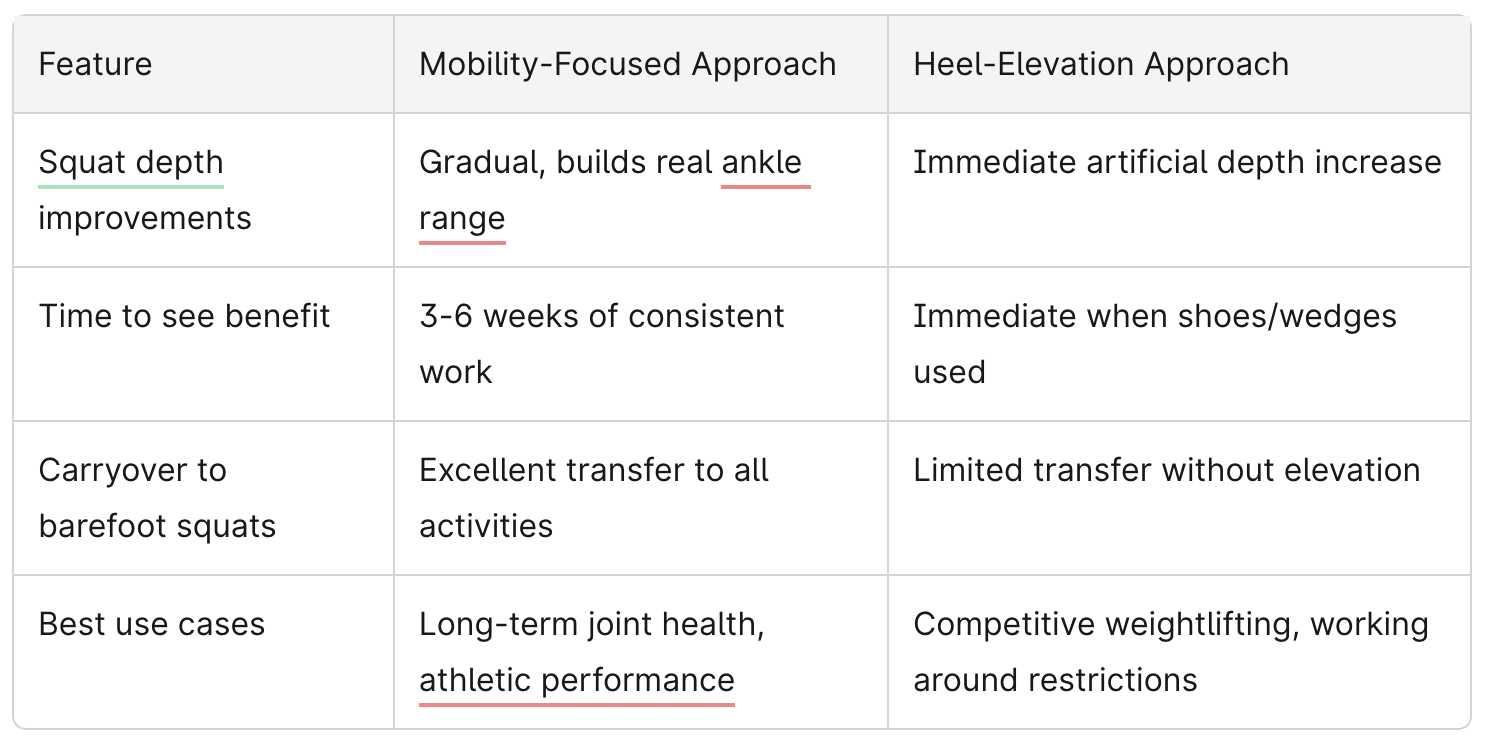
Most lifters benefit from combining both approaches: building long-term ankle mobility through targeted exercises while strategically using heel elevation tools like weightlifting shoes during heavy squat sessions or when learning new movement patterns.
This integrated approach addresses both immediate performance needs and long-term ankle joint health, though several common challenges can derail progress if not addressed proactively.
Common Challenges and Solutions
These troubleshooting strategies address the most frequent obstacles that prevent ankle mobility improvements from translating to better squat performance and long-term progress.
Challenge 1: Heels Keep Lifting in Squats Despite Stretching
This persistent issue typically results from inadequate training frequency, overreliance on static stretching, or practicing ankle mobility in positions that don’t match squatting demands.
Solution: Add daily 2-3 minute sessions of knee-over-toe ankle rocks and supported deep squat holds to increase exposure frequency. Use a small heel wedge under both heels during heavy squat sets while your mobility catches up, gradually reducing the height as your ankle dorsiflexion range improves.
Reassess your progress every 3-4 weeks using the knee-to-wall test to confirm objective improvements in ankle range rather than relying solely on subjective feelings.
Challenge 2: Pinching or Sharp Pain at the Front of the Ankle
Distinguishing between productive stretching sensations and problematic joint pain prevents setbacks and identifies when professional help is needed.
Solution: Emphasize banded ankle mobilizations and gentle joint movements within pain-free ranges, avoiding any techniques that reproduce sharp pinching sensations. Focus on improving the quality of movement in your available range rather than aggressively pushing into restricted zones.
If anterior ankle pinching persists for several weeks or worsens with loading, seek evaluation from a sports medicine provider or physical therapy professional, as some structural ankle limitations may require clinical intervention.
Challenge 3: One Ankle More Stiff From Old Sprains
Previous ankle injuries commonly leave residual stiffness and movement restrictions that create asymmetrical squat patterns and compensation strategies.
Solution: Program additional mobility volume on your restricted side (1-2 extra sets of targeted drills), incorporate single-leg exercises like split squats and step-downs to address unilateral deficits, and pay special attention to symmetrical knee tracking during bilateral squats.
Consider that some degree of asymmetry may persist after old ankle injuries, but improving the available range and control on the restricted side typically produces significant squat improvements.
Addressing these common roadblocks leads to more confident, consistent squatting progress and better long-term ankle joint health.
Conclusion and Next Steps
Ankle flexibility—specifically ankle dorsiflexion range—represents a major controllable factor determining your squat depth, movement quality, and injury prevention. Limited ankle mobility creates a cascade of compensations that restrict performance and increase stress on other joints, while good ankle mobility enables deeper, more stable squats with improved posture and load distribution.
To Get Started:
- Complete the bodyweight squat check and knee-to-wall test this week to identify your primary ankle restrictions
- Select 2-3 ankle mobility exercises from this guide and incorporate them into every lower body warm-up for the next 4-6 weeks
- Re-film your squat technique after one month to compare squat depth, heel contact, and overall movement comfort
Related Topics:
Hip mobility for squats (focusing on hip flexion and external rotation), core and upper-back control for maintaining upright squat positions, and ankle strength training for runners and field athletes represent logical next steps once your ankle dorsiflexion range improves. These areas work synergistically with ankle flexibility to optimize squatting mechanics and athletic performance.
Additional Resources
Assessment and technique videos: Search for “knee to wall test” and “banded ankle mobilization” demonstrations to ensure proper technique for the assessments and interventions described in this guide.
Progress tracking: Consider logging your knee-to-wall distances and maximum squat depth measurements in a simple training notebook or smartphone app to objectively monitor improvements over time.
Professional guidance: Consult a licensed physical therapist or sports medicine provider for persistent ankle pain, history of ankle fractures, post-surgical ankle restrictions, or if your mobility work doesn’t produce improvements after 6-8 weeks of consistent effort.
Ankle Flexibility Squats: Tests, Fixes, and Training Guide
Introduction
Ankle flexibility squats are all about the link between your ankle’s dorsiflexion range and how well you can squat deep, stable, and pain-free. If your ankles are stiff, you might find yourself lifting your heels, leaning too far forward, or not hitting the depth you want. This guide cuts through the noise with simple tests, focused drills, and smart training tips to boost your ankle range so your squats feel better and safer.
What This Guide Covers
This article explains how ankle flexibility directly impacts squat technique through simple at-home assessments, specific ankle mobility exercises that transfer to squatting, and practical programming to integrate mobility work into your training routine. We focus on actionable solutions rather than complex anatomy, though we won’t cover complete rehabilitation protocols for severe ankle injuries or post-surgical guidelines—consult a physical therapy professional for those situations.
Who This Is For
This guide targets lifters who struggle to reach parallel in back or front squats, CrossFitters battling overhead squat mobility, general gym-goers dealing with stiff ankles, and home exercisers wanting deeper bodyweight squats. Whether you’re a beginner learning squat mechanics or an experienced lifter who relies on weightlifting shoes, you’ll find practical strategies to improve your ankle range and squat performance.
Why Ankle Flexibility Matters for Squats
Poor ankle mobility forces your body into compensatory patterns during squats: heels lift off the ground, knees stop traveling forward, or your torso collapses into excessive forward lean to maintain balance. Restricted ankle dorsiflexion can also lead to increased knee valgus, which is a compensatory inward movement of the knees that increases injury risk. These compensations limit squat depth, increase injury risk, and reduce the training stimulus on target muscles. Good ankle mobility allows deeper, more stable squats with better posture.
What You’ll Learn:
- Simple tests to determine if limited ankle mobility restricts your squat depth
- The difference between soft tissue tightness and joint restrictions in your ankle. It is important to identify the root cause of ankle mobility restrictions to determine the most effective treatment approach.
- Specific ankle mobility exercises that directly transfer to squatting patterns
- How to program mobility work efficiently without extending workouts by 30 minutes
- When to use tools like weightlifting shoes strategically versus when they become a crutch
Understanding Ankle Flexibility in the Context of Squats
Ankle flexibility for squats primarily involves dorsiflexion—the ability of your shin to move forward over your foot while keeping your heel planted. The ankle joint is a hinge joint, primarily allowing movement in one plane, which is crucial for proper squatting mechanics. This ankle movement allows your knee to travel forward during the squat descent, enabling deeper positions while maintaining an upright torso and balanced foot pressure.
Key Ankle Movements Relevant to Squatting
Dorsiflexion occurs when your shin moves forward and the angle between your foot and lower leg decreases, like at the bottom of a deep squat. Plantarflexion is the opposite motion—pointing your toes down—which happens when you drive out of the squat hole. After plantarflexion, the foot returns to a flexed position as you transition back into the squat, especially when using resistance bands for ankle flexibility exercises. While plantarflexion provides power for standing up, inadequate dorsiflexion limits how deep you can descend with proper form.
Inversion and eversion (ankle tilting side-to-side) affect frontal plane control during squats. Good ankle stability in these directions helps maintain proper knee tracking over your toes and prevents ankle rolling, especially important in single-leg squat variations.
This connects to ankle flexibility for squats because sufficient ankle dorsiflexion range allows your knees to move forward so you can maintain an upright torso and keep your heels flat throughout the full range of motion.
How Ankle Flexibility Shapes Squat Technique
Ankle range of motion directly influences several critical squat mechanics. Squat depth depends heavily on ankle dorsiflexion—limited ankle range forces you to stop descending before reaching parallel, even if your hip mobility would allow deeper positions. Torso angle changes dramatically with ankle restrictions: poor ankle mobility forces excessive forward lean to keep your center of mass over your feet.
Foot pressure distribution shifts when ankle dorsiflexion is inadequate. Instead of maintaining balanced contact across your whole foot, limited ankle mobility often causes heel lifting or shifting weight toward your toes, compromising stability and power transfer.
Different squat variations demand varying amounts of ankle dorsiflexion. Front squats and high-bar back squats require more ankle mobility to maintain the upright torso position, while low-bar back squats can accommodate some ankle restriction through increased hip hinge. Overhead squats demand the most ankle range due to the overhead load requiring maximal torso upright position. Olympic lifting movements, such as the clean and snatch, require even greater ankle dorsiflexion to maintain proper form and safety during these high-performance lifts.
Building on this foundation, the next section provides simple tests to determine whether ankle flexibility limits your specific squat patterns.
Factors Restricting Ankle Mobility
Ankle mobility is something that really makes all the difference when it comes to moving better, especially when you're trying to squat or doing other lower body exercises. There's several things that can mess with your ankle range and make it hard to get that deep, stable squat we all want. Understanding what's holding you back is the first step to helping you move better and perform like the athlete you are.
Soft Tissue Tightness:One of the biggest things that limits ankle mobility is when your calf muscles, Achilles tendon, and plantar fascia gets all tight and stiff. When these tissues are tight, they stop your ankle from doing dorsiflexion—that's the movement that lets your knee travel forward over your foot like it should. This makes it real hard to keep your heels down and get to that proper squat depth we're working toward. Regular mobility work, like calf stretches and foam rolling, is going to help loosen up that soft tissue tightness and get your ankle range moving better.
Joint and Bony Restrictions:Sometimes, the problem comes right from the ankle joint itself. You might have a bony block or joint capsule stiffness that creates this hard stop or pinching feeling at the front of your ankle, and it just won't let you go any further with dorsiflexion. These restrictions needs targeted mobility drills, like banded joint mobilizations, to get that mobility back and restore the normal range you should have.
Previous Ankle Injuries:If you have a history of ankle injuries, like ankle sprains, that can leave behind scar tissue and chronic stiffness that really affects your ankle mobility. This reduced ankle dorsiflexion can stick around long after that initial injury happened, and it affects your ability to squat deeper and move the way you want to. We need to address these lingering effects with specific mobility exercises and, if you need it, physical therapy is going to be crucial for getting back that full ankle function.
Influence of Hip and Thoracic Mobility:While we're focusing on the ankle joint, restrictions in your hip mobility or thoracic spine mobility can also impact how your ankle moves when you're squatting or doing other movements. If your hips or upper back are tight, your body is going to compensate by shifting extra stress to the ankle, and that limits your squat pattern even more and increases your risk of getting hurt.
Footwear and External Factors:The shoes you wear, especially those weightlifting shoes with elevated heels, can temporarily hide limited ankle mobility by letting you squat deeper. However, if you rely only on footwear, you're not addressing the real cause of your ankle restriction. We want to incorporate mobility exercises and sometimes train barefoot or in flat shoes so you can develop lasting improvements in ankle range that actually stick.
Why Addressing Ankle Mobility Matters:Good ankle mobility is essential for keeping proper squat form, reducing compensations that stress your knees and hips, and preventing injuries from happening. By improving ankle dorsiflexion and overall ankle range, you're going to squat deeper, move more efficiently, and enhance your athletic performance like you want. Whether you're recovering from an ankle injury or just want to move better, making ankle mobility exercises a priority and addressing what's causing the restriction is going to pay off both now and long term.
You want to incorporate a mix of stretching, foam rolling, and resistance band drills into your routine to target both soft tissue and joint restrictions. If you experience persistent stiffness or pain, you need to consult a physical therapy professional for a personalized approach that works for you. By making ankle mobility a regular part of your training, you're setting the foundation for better movement, injury prevention, and long-term health that's going to change how you feel and perform.
Assessing Your Ankles: Are They Limiting Your Squats?
Now that you understand how ankle mobility affects squatting mechanics, these assessments will reveal whether ankle range restrictions contribute to your squat limitations. Testing both isolated ankle range and squatting patterns gives you the clearest picture of where to focus your mobility efforts.
Screen 1: Bodyweight Squat Check
When to use this: As your primary squat mobility screen before any ankle-specific interventions.
- Setup: Stand barefoot or in flat shoes with feet shoulder-width apart, arms extended forward for counterbalance
- Descent: Slowly lower into your deepest possible squat while keeping both heels flat on the ground
- Observe: Note where you feel restrictions—does heel lifting occur? Do your knees stop well behind your toes? Does your torso fold forward excessively to maintain balance?
- Assess: Film yourself from the side and front if possible to objectively evaluate these compensations
If you feel the primary restriction at the front or back of your ankle joint and your hips feel relatively mobile, limited ankle dorsiflexion likely restricts your squat depth and quality.
Screen 2: Knee-to-Wall (Weight-Bearing Lunge) Test
This assessment quantifies your functional ankle dorsiflexion range in a weight-bearing position that closely mimics squatting demands.
Setup and execution:
- Position: Assume a half kneeling position facing a wall with your front foot’s toes approximately 10-14 cm (4-5.5 inches) from the wall
- Movement: Drive your front knee toward the wall without allowing your heel to lift, keeping your knee tracking over the middle of your foot. As your shin moves forward, your foot moves and the talus bone moves backwards relative to the tibia—this backward glide is essential for proper dorsiflexion.
- Measurement: Find the maximum distance where your knee can still touch the wall while maintaining heel contact
- Bilateral testing: Test both your left ankle and right ankle separately to identify asymmetries
When using band mobilizations to improve ankle mobility, proper band placement can help the foot move backwards, facilitating the talus bone's backward glide for improved ankle joint mobility.
Normal range: Distances of 10+ cm generally support comfortable squatting mechanics, roughly corresponding to 30+ degrees of ankle dorsiflexion. Significant differences between your right leg and left leg (>2 cm) may indicate previous ankle injuries or movement compensations.
This connects to your squat performance because greater knee forward travel with your heel down in this test directly translates to easier balance and deeper positions in actual squats.
Interpreting Your Results
Your test sensations reveal different underlying restrictions requiring targeted approaches. Soft tissue tightness typically produces a stretching or pulling sensation in your calf muscles, Achilles tendon, or plantar fascia during the knee-to-wall test. This pattern often responds well to targeted stretching and soft tissue work.
Joint or bony restrictions create a sharp pinching sensation at the front of your ankle joint or a hard end-feel that doesn’t improve with gentle stretching. This pattern may involve ankle joint capsule stiffness or bony limitations that require joint-specific mobilization techniques.
Asymmetrical patterns where one ankle shows significantly reduced ankle dorsiflexion compared to the other often result from previous ankle sprains, fractures, or chronic compensations that require unilateral attention in your mobility programming.
Understanding your specific restriction pattern helps you select the most effective ankle mobility exercises from the targeted interventions in the next section.
Improving Ankle Flexibility Specifically for Squats
This section focuses on ankle mobility exercises that directly transfer to squat positions rather than generic ankle stretches. The following interventions are designed to improve ankle mobility specifically for better squat performance. Based on your assessment findings, you can emphasize soft tissue or joint-focused interventions to address your specific ankle restrictions most effectively.
Soft-Tissue Focus: Calf, Achilles, and Plantar Fascia
Tight gastrocnemius and soleus muscles directly limit how far your knee can travel forward during squatting by restricting ankle dorsiflexion range. The gastrocnemius crosses both your knee and ankle joints, while the soleus only crosses the ankle joint, requiring different stretching positions to target each effectively.
Key soft tissue interventions:
Standing calf stretch (gastrocnemius): Place your hands against a squat rack or wall, step your target leg back, and lean forward while keeping your back knee straight and heel down. Position your feet at squat stance width rather than in a narrow line to better match squatting demands.
Half-kneeling soleus stretch: Assume a half kneeling position with your front knee bent and drive your knee forward over your toes while keeping your front heel down. This bent-knee position isolates the soleus muscle that’s active during squats.
Plantar fascia release: Use a small ball or foam roller under your foot before squats if you feel restriction through your arch during ankle dorsiflexion testing.
Hold these stretches for 20-30 seconds and repeat 2-3 times per side. These work most effectively when combined with active movement rather than passive stretching alone.
Soft tissue restriction around the ankle joint is a common cause of restricted ankle mobility. Foam rolling or using a lacrosse ball on the calves before squatting can help improve ankle flexibility by addressing tightness in the soft tissue. Additionally, self-myofascial release with a massage stick can help alleviate tightness in the calves, further reducing restrictions and supporting better ankle dorsiflexion during squats.
Joint & Capsule Focus: Mobilizations for a “Pinchy” Ankle
When your knee-to-wall test reveals pinching at the front of your ankle joint or a hard block sensation, joint-focused mobilizations address ankle joint capsule restrictions and improve the sliding motion between your talus bone and lower leg bones.
Banded ankle dorsiflexion mobilization: Loop a resistance band low around the front of your ankle (over the talus bone) with the band pulling backwards. Step into a lunge position and drive your knee forward over your toes while the band assists the backwards pull of your talus bone, creating joint space.
Active ankle rocks: Stand with your front foot on a low step or wedge and gently rock your knee forward over your toes, emphasizing smooth motion through any restriction. Focus on moving through your available range rather than forcing into painful positions.
Safety note: Any sharp pain or worsening symptoms during these mobilizations signals the need to stop and consider professional assessment from a physical therapy practitioner.
To reinforce the improved range of motion from joint mobilizations, it is important to develop dorsiflexion strength through isometric holds and controlled exercises. This helps maintain ankle flexibility and supports better squat performance.
Squat-Specific Ankle Flexibility Drills
Practicing ankle dorsiflexion in actual squatting positions accelerates transfer to your squat performance by training the ankle range in the exact movement patterns where you need it.
Supported deep squat hold: Grab a squat rack or suspension trainer and slowly sink into your deepest squat position. Gently rock your knees forward and side-to-side while maintaining heel contact, using the support to explore end-range positions safely. Holding deep squat positions allows tissues to adapt and lengthen, which is crucial for long-term mobility gains.
Goblet squat pry: Hold a kettlebell or dumbbell at chest level as counterbalance and sit into a deep squat. Shift your body weight and gently push your knees forward and outward with your elbows while maintaining an upright torso and full foot contact.
Split-squat ankle rocks: In a split-squat position, rock forward to emphasize ankle dorsiflexion on your front leg while maintaining heel contact. Shift your weight onto one foot, then switch to the other leg to ensure balanced flexibility and strength. This unilateral approach allows you to address left ankle and right ankle restrictions independently.
Heel-elevated squats can be used to allow for greater forward knee travel and a more upright torso, directly improving dorsiflexion.
Key Points:
- Move slowly and stay within mild to moderate stretching sensations, avoiding extreme pain
- Maintain contact with your whole foot: big toe, little toe, and heel on the ground
- Use 2-3 sets of 30-45 seconds of gentle movement per side, performed several times per week
These drills build the foundation for integrating ankle mobility work into your regular training routine, which the next section addresses through practical programming strategies.
Programming Ankle Flexibility Work Into Your Squat Training
Consistent, moderate-duration mobility work produces better results than occasional marathon stretching sessions. Specialized performance programs can provide a structured approach to improving ankle flexibility and overall movement quality. This section provides a practical framework to integrate ankle mobility exercises into your warm-ups, training days, and recovery sessions without significantly extending workout time.
Step-by-Step: 10-Minute Pre-Squat Ankle Prep
When to use this: Before any squat-heavy or lunge-heavy lower body workout.
- Quick Retest (1 minute): Perform 1-2 knee-to-wall tests per side to assess your current ankle stiffness and compare to baseline measurements
- Soft-Tissue or Joint Drill (3-4 minutes): Select 1-2 interventions from the previous section based on your restriction type—calf stretches for soft tissue tightness or banded mobilizations for joint restrictions. For calf stretches, try a high plank position and place your left foot on top of your right heel to intensify the stretch and target the calf muscles. Adjust or lower your right knee for comfort or to focus the stretch on different muscles as needed.
- Squat-Position Mobility (3-4 minutes): Perform supported deep squat rocks or goblet squat pries to prepare your ankle range in squatting-specific positions
- Activation & Strength (2-3 minutes): Complete 5-8 slow-tempo bodyweight squats focusing on knee forward travel and balanced foot pressure to activate the improved range
Comparison: Mobility Work vs Heel Elevation
Most lifters benefit from combining both approaches: building long-term ankle mobility through targeted exercises while strategically using heel elevation tools like weightlifting shoes during heavy squat sessions or when learning new movement patterns.
This integrated approach addresses both immediate performance needs and long-term ankle joint health, though several common challenges can derail progress if not addressed proactively.
Common Challenges and Solutions
These troubleshooting strategies address the most frequent obstacles that prevent ankle mobility improvements from translating to better squat performance and long-term progress.
Challenge 1: Heels Keep Lifting in Squats Despite Stretching
This persistent issue typically results from inadequate training frequency, overreliance on static stretching, or practicing ankle mobility in positions that don’t match squatting demands.
Solution: Add daily 2-3 minute sessions of knee-over-toe ankle rocks and supported deep squat holds to increase exposure frequency. Use a small heel wedge under both heels during heavy squat sets while your mobility catches up, gradually reducing the height as your ankle dorsiflexion range improves.
Reassess your progress every 3-4 weeks using the knee-to-wall test to confirm objective improvements in ankle range rather than relying solely on subjective feelings.
Challenge 2: Pinching or Sharp Pain at the Front of the Ankle
Distinguishing between productive stretching sensations and problematic joint pain prevents setbacks and identifies when professional help is needed.
Solution: Emphasize banded ankle mobilizations and gentle joint movements within pain-free ranges, avoiding any techniques that reproduce sharp pinching sensations. Focus on improving the quality of movement in your available range rather than aggressively pushing into restricted zones.
If anterior ankle pinching persists for several weeks or worsens with loading, seek evaluation from a sports medicine provider or physical therapy professional, as some structural ankle limitations may require clinical intervention.
Challenge 3: One Ankle More Stiff From Old Sprains
Previous ankle injuries commonly leave residual stiffness and movement restrictions that create asymmetrical squat patterns and compensation strategies.
Solution: Program additional mobility volume on your restricted side (1-2 extra sets of targeted drills), incorporate single-leg exercises like split squats and step-downs to address unilateral deficits, and pay special attention to symmetrical knee tracking during bilateral squats.
Consider that some degree of asymmetry may persist after old ankle injuries, but improving the available range and control on the restricted side typically produces significant squat improvements.
Addressing these common roadblocks leads to more confident, consistent squatting progress and better long-term ankle joint health.
Conclusion and Next Steps
Ankle flexibility—specifically ankle dorsiflexion range—represents a major controllable factor determining your squat depth, movement quality, and injury prevention. Limited ankle mobility creates a cascade of compensations that restrict performance and increase stress on other joints, while good ankle mobility enables deeper, more stable squats with improved posture and load distribution.
To Get Started:
- Complete the bodyweight squat check and knee-to-wall test this week to identify your primary ankle restrictions
- Select 2-3 ankle mobility exercises from this guide and incorporate them into every lower body warm-up for the next 4-6 weeks
- Re-film your squat technique after one month to compare squat depth, heel contact, and overall movement comfort
Related Topics:
Hip mobility for squats (focusing on hip flexion and external rotation), core and upper-back control for maintaining upright squat positions, and ankle strength training for runners and field athletes represent logical next steps once your ankle dorsiflexion range improves. These areas work synergistically with ankle flexibility to optimize squatting mechanics and athletic performance.
Additional Resources
Assessment and technique videos: Search for “knee to wall test” and “banded ankle mobilization” demonstrations to ensure proper technique for the assessments and interventions described in this guide.
Progress tracking: Consider logging your knee-to-wall distances and maximum squat depth measurements in a simple training notebook or smartphone app to objectively monitor improvements over time.
Professional guidance: Consult a licensed physical therapist or sports medicine provider for persistent ankle pain, history of ankle fractures, post-surgical ankle restrictions, or if your mobility work doesn’t produce improvements after 6-8 weeks of consistent effort.
.png)